
If you are wondering how long does it take to raise your credit score, there is no universal timeline. Some changes can appear after updated account information reaches the credit bureaus, while rebuilding after missed payments or other serious negative information can take much longer.
Your starting profile, payment history, revolving balances, age of accounts, new applications, and the timing of creditor updates all matter. No lender, credit bureau, or credit-repair company can guarantee that one action will produce a specific number of points by a specific date.
The useful approach is to understand which factors can change relatively quickly and which require months or years of responsible behavior.
For broader background, read our guide to how credit scores are calculated, highest credit score guide, and money-management guide.
Key Takeaways
- Changes to revolving balances may show up relatively quickly after creditors report updated data.
- Payment history improves through consistent behavior over time.
- Credit-report errors should be disputed with both the reporting company and the furnisher.
- Accurate negative information generally cannot simply be disputed away.
- Hard inquiries can affect scores; checking your own report is a soft inquiry.
- FICO places the greatest weighting on payment history and amounts owed.
- No legitimate source can promise a precise score increase by a guaranteed date.
How Long Does It Take to Raise Your Credit Score?
The answer depends on what is holding your profile back.

Changes can appear after new information is reported
Credit reports are not updated every time you make a purchase or payment. Creditors provide account information periodically, and the three nationwide reporting companies may receive updates at different times.
For example, reducing a large revolving balance may help once the new balance appears on your reports and a scoring model calculates a new result.
That does not mean everyone will receive the same improvement. FICO explains that the impact of a particular action depends on the consumer’s entire credit file.
Meaningful rebuilding often takes longer
A person with recent missed payments, collections, charge-offs, or other serious negative information may need a much longer period of positive activity.
CFPB guidance emphasizes that rebuilding takes time and that there are no shortcuts or secrets.
See the official CFPB credit rebuilding guidance.
New credit files can behave differently
A thin or recently established file has less history behind it, so new information can have a larger relative effect.
FICO says a consumer generally needs about six months of credit history before enough information exists to generate a first FICO Score.
No exact increase can be guaranteed
Beware of claims that a company can add a fixed number of points within a few weeks.
Your result depends on the complete information used by the scoring model, and different models can produce different numbers.
What Determines How Quickly Your Credit Changes?
Several factors determine whether a change appears quickly or develops slowly.
Credit reporting timing
Your lender, credit-card issuer, or servicer may provide information to one or more credit reporting companies periodically.
Because creditors are not required to report to every bureau, information can differ among Equifax, Experian, and TransUnion.
FICO score factors
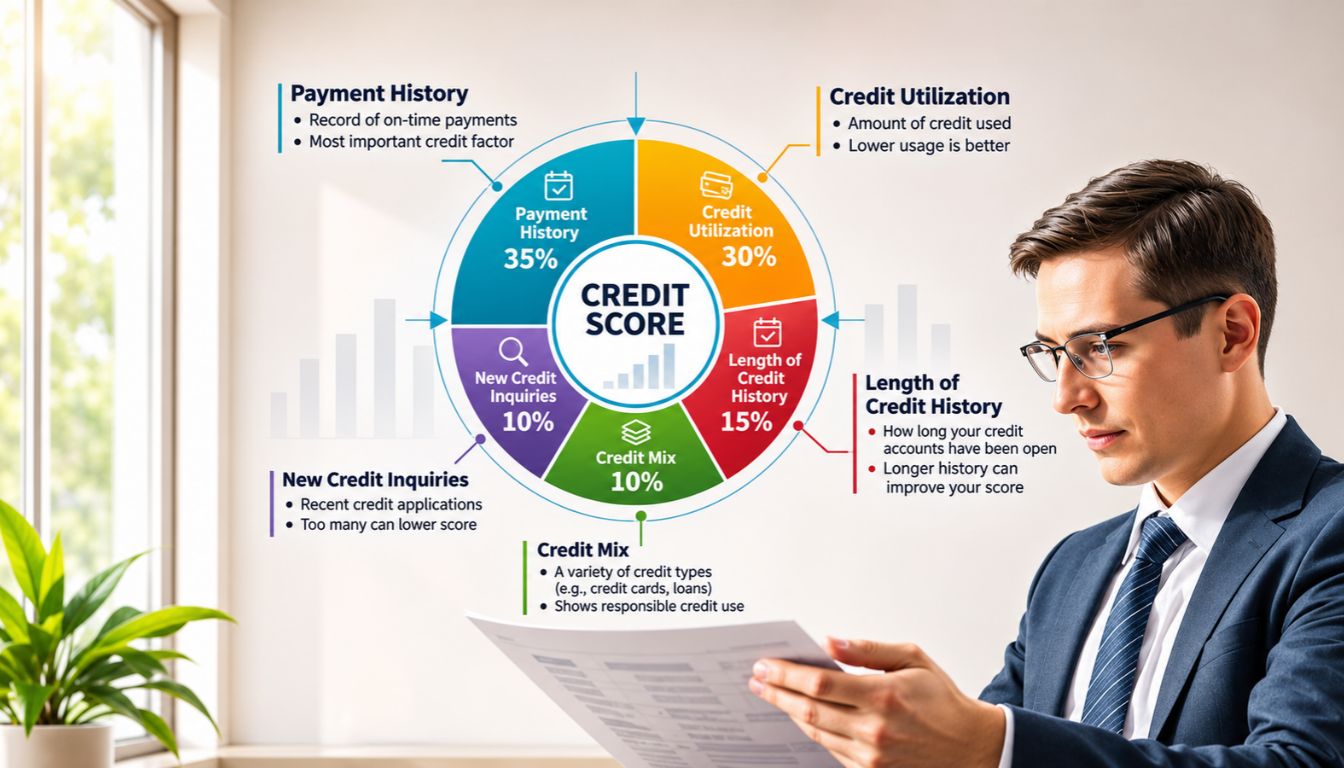
FICO currently groups the information used in its scores into five broad categories:
| FICO Category | Typical Weight |
|---|---|
| Payment History | 35% |
| Amounts Owed | 30% |
| Length of Credit History | 15% |
| New Credit | 10% |
| Credit Mix | 10% |
FICO also cautions that the importance of each category can vary based on the information in an individual’s file.
You can review the official FICO score-factor explanation.
Different bureaus can show different information
Your reports are separate files.
A creditor might report to all three nationwide reporting companies, only one or two, or update them at different times. As a result, scores based on those files can differ.
What Can Change First?
Some parts of your financial profile can react to new information faster than others.
Lower revolving balances
Your credit utilization ratio compares revolving balances with available limits.
Reducing a high balance can improve the amounts-owed portion of a scoring model once updated information is reported.

CFPB advises consumers not to get too close to credit limits and notes that high utilization can hurt scores.
Corrected inaccurate information
If an inaccurate late payment, balance, account, or other item is corrected after a dispute, the information used for scoring may change once the correction appears.
The amount of any resulting score movement cannot be predicted in advance.
Payment history builds gradually
One on-time payment is useful, but a long pattern of paying accounts as agreed is much more meaningful than one isolated month.
FICO identifies payment history as its largest category at 35%.
Account age changes slowly
Length of history depends largely on time. There is no responsible shortcut to make accounts years older.
1. Review All Three Credit Reports First
Before choosing a strategy, see what your reports actually contain.

Use AnnualCreditReport.com
Use AnnualCreditReport.com, the federally authorized source for reports from Equifax, Experian, and TransUnion.
CFPB notes that the nationwide credit reporting companies currently provide weekly online access to reports when requested.
Check each report separately
Look for:
- accounts you do not recognize;
- late payments that are incorrect;
- wrong balances or credit limits;
- closed accounts reported as open;
- duplicate debts;
- incorrect account ownership;
- and information resulting from identity theft.
Do not treat every negative item as an error
A negative entry is not inaccurate simply because it hurts your borrowing profile.
CFPB states that accurate negative information generally cannot be removed just because a consumer asks for it to be deleted.
Most negative account-payment information can generally remain for up to seven years.
2. Pay Every Account on Time
Consistent on-time payment behavior is one of the most important long-term actions you can take.
Set up reminders or autopay
Automatic payments can reduce the risk of forgetting a due date.
If you use autopay, keep sufficient funds in the linked bank account so the payment does not fail.
At least protect the minimum payment
If you cannot pay a card in full immediately, paying at least the required minimum by the due date helps avoid an additional late payment.
Continue paying balances down as your budget allows.
Act quickly after a missed payment
If you miss a due date, contact the creditor and bring the account current as quickly as possible.
Ask whether any hardship program or account-specific assistance is available rather than assuming an extension will automatically be granted.
Our financial tips guide and personal finance guide can help with payment planning.
3. Reduce Revolving Balances
Lowering revolving debt can be one of the faster factors to change because utilization uses current reported balances.
How to calculate utilization
Divide a revolving balance by its credit limit.
For example:
| Balance | Limit | Utilization |
|---|---|---|
| $500 | $2,000 | 25% |
| $1,500 | $2,000 | 75% |
Look at both total and individual-card usage
Scoring systems can consider how much revolving credit you are using overall and information on individual accounts.
Focus first on balances that are close to their limits while still making every required payment on time.
Do not carry debt merely to build credit
You do not need to pay interest merely to establish payment history.
CFPB recommends paying card balances in full each month where possible to avoid finance charges and keep utilization under control.
For related debt planning, read our credit-card debt guide.
4. Limit Unnecessary Hard Inquiries
A hard inquiry usually occurs when you formally apply for new credit.
CFPB states that hard inquiries can affect scores because scoring models consider how recently and frequently you apply.
Checking your own report does not hurt your score
Your own request for a credit report is a soft inquiry and does not affect your score.
Existing creditor account reviews and certain prescreening activities can also be soft inquiries.
See the official CFPB explanation of hard and soft inquiries.
Rate shopping is different
For certain loan types such as mortgages and auto loans, scoring models generally recognize comparison shopping when multiple inquiries occur within a relatively short window.
CFPB describes common rate-shopping windows of roughly 14 to 45 days, depending on the scoring model.
If you are shopping for vehicle credit, compare our affordable auto loan guide, subprime auto loan guide, and new vs used car rate guide.
5. Dispute Genuine Credit Report Errors
A legitimate credit bureau dispute is for inaccurate or incomplete information.
Dispute with both sides
CFPB recommends disputing inaccurate information with:
- the credit reporting company showing the error;
- and the company that supplied the information, known as the furnisher.
How long does an investigation take?
A credit reporting company generally must investigate within 30 days.
In certain circumstances, the investigation may take up to 45 days, such as when additional relevant information is submitted during the investigation period.
Read the official CFPB dispute-timeline guidance.
Provide useful supporting documentation
Include enough information to identify the disputed item and explain specifically why it is inaccurate.
Useful documents can include:
- account statements;
- payment confirmations;
- letters from the creditor;
- identity-theft documentation where relevant;
- or other records supporting your claim.
Do not repeatedly dispute information you know is accurate
A formal dispute is not a tool for erasing legitimate late payments or other accurate negative history.
CFPB warns consumers to be cautious of credit-repair companies claiming they can remove current, accurate negative information.
6. Keep Older Accounts When It Makes Financial Sense
Length of credit history represents about 15% of a typical FICO Score calculation.
Closing a card does not immediately erase its history
Closing an account does not necessarily make its history disappear from your report immediately.
Positive closed-account information can remain for years.
Closing can reduce available revolving credit
If you close a credit card with an available limit, your remaining utilization can increase even when your balances stay exactly the same.
That is one reason to consider utilization before closing an account.
But do not keep an expensive account solely for scoring
An annual fee or other cost may make an old account unattractive.
Financial cost and account usefulness should remain part of the decision.
7. Consider Credit-Building Products Carefully
People with thin or damaged files sometimes consider products specifically designed to help establish payment history.
Secured credit cards
A secured credit card generally requires a cash security deposit.
CFPB notes that secured cards can help establish a record when used responsibly.
Before applying, compare:
- annual fee;
- APR;
- deposit requirement;
- credit limit;
- reporting practices;
- and rules for returning the deposit or upgrading.
Credit-builder loans
A credit-builder loan typically holds the borrowed amount in a savings account while you make scheduled payments.
At the end of the arrangement, you receive the accumulated funds according to the product terms.
Before signing, determine:
- interest expense;
- administrative fees;
- monthly payment;
- term;
- and which bureaus receive payment information.
Authorized-user status
Being added as an authorized user may affect your file if the issuer reports the account, but benefits are not guaranteed.
The primary cardholder’s balance and payment behavior can matter, so understand the account before relying on this strategy.
Avoid opening accounts only to improve credit mix
FICO assigns credit mix about 10%, far less than payment history and amounts owed.
Do not take out an unnecessary loan simply to add another account type.
If you are considering borrowing anyway, compare our no-origination-fee personal loan guide, personal loan rates guide, and secured personal loan guide.
How Payment History Affects the Timeline
Payment history is the largest FICO category, but improving it is usually a long-term process.
Why a missed payment can matter more than one good month
A long positive pattern is expected from lower-risk borrowers. A recent delinquency introduces new negative information and can therefore have a meaningful impact.
Negative information loses relevance over time
CFPB notes that recent negative information generally has more effect than older negative information.
Most negative payment-history information can generally be reported for up to seven years.
See the CFPB’s credit-report retention guidance.
Accurate late payments usually cannot be disputed away
If the information is accurate, a bureau generally does not have to remove it simply because you would prefer it gone.
Focus instead on preventing additional missed payments and adding newer positive history.
Why Credit Utilization Can Change Faster
Revolving balances can change every month, which means utilization can also move relatively quickly.
Do not obsess over a single universal percentage
There is no magic utilization number that guarantees a particular score.
Lower revolving usage is generally better than being close to your limits, but your overall profile still matters.
Paying before information is reported may reduce the balance seen by a scoring model
If you need a lower reported balance, ask your issuer when it normally reports account information.
Reporting practices can differ among issuers, so avoid assuming every company reports on exactly the same date.
Do not spend extra just because your limit increases
A higher credit limit can lower utilization mathematically if spending stays the same.
But additional available credit should not become an excuse for additional debt.
How Different Starting Profiles Change the Timeline
Thin or new files
Newer files contain less information, so each account can have a relatively larger influence.
FICO says approximately six months of history may be needed before a first FICO Score can be generated.
Files with recent delinquencies
A recent late payment, collection, or other serious event can continue influencing the profile while newer positive activity accumulates.
Established strong files
An established profile may be more stable because it contains years of account history.
There may also be less room to move upward if the score is already high.
What Not to Do When Trying to Improve Credit
Do not pay for guaranteed score increases
No legitimate company can guarantee an exact score improvement.
Do not dispute accurate information merely because it is negative
Use disputes to correct errors.
Do not open many new accounts at once
Multiple new accounts can affect new-credit and account-age factors and create additional payment obligations.
Do not carry interest-bearing balances merely for scoring
Paying interest is not necessary to demonstrate responsible card use.
Do not close old accounts automatically
First consider fees, utilization, account usefulness, and your overall financial situation.
How to Track Progress Without Hurting Your Score
Review your own reports
Checking your own reports does not create a damaging hard inquiry.
Use the same score model when comparing progress
Different scoring models can produce different numbers.
For a meaningful trend, compare the same model over time whenever possible.
Focus on report data, not daily score movement
Short-term score fluctuations are less important than correcting inaccurate data, reducing excessive debt, and maintaining reliable payments.
Related Best Finance Live Guides
- How Is a Credit Score Calculated?
- Highest Credit Score Guide
- Average Credit Card Debt
- Personal Loans for Bad Credit
- Personal Loan Rates
- Personal Loan With No Origination Fee
- Secured Personal Loans
- Secured vs Unsecured Personal Loans
- How to Get a Personal Loan
- What Is a Finance Charge?
- Master Your Money
- Complete Personal Finance Guide
- Top Financial Tips
- Personal Finance Course
- Best Finance Live Guide
- First-Time Auto Loan
- Subprime Auto Loans
- Affordable Auto Loans
- New vs Used Car Interest Rates
- Auto Finance Calculator
- Car Finance Options
- Best Auto Finance Deals
- Refinance Auto Loan
- Paying Off a Car Loan Early
- First-Time Business Loan
- Business Loans
- Business Loan Interest Rates
- Business Loan Payment Calculator
- Unsecured Small Business Loans
- What Is Business Finance?
- GreenSky Financing
- Pool Financing Guide
Conclusion
So, how long does it take to raise your credit score? There is no single timeline that applies to everyone.
Lower revolving balances or corrected errors can affect the information used for scoring relatively quickly once updates reach the reporting companies. Building stronger payment history and allowing older negative information to age generally takes much longer.
Start with your reports, correct genuine errors, make every required payment on time, reduce excessive revolving balances, and avoid unnecessary credit applications.
Most importantly, do not chase guaranteed point increases. Stronger credit is usually the result of accurate reporting and sustainable financial habits maintained over time.