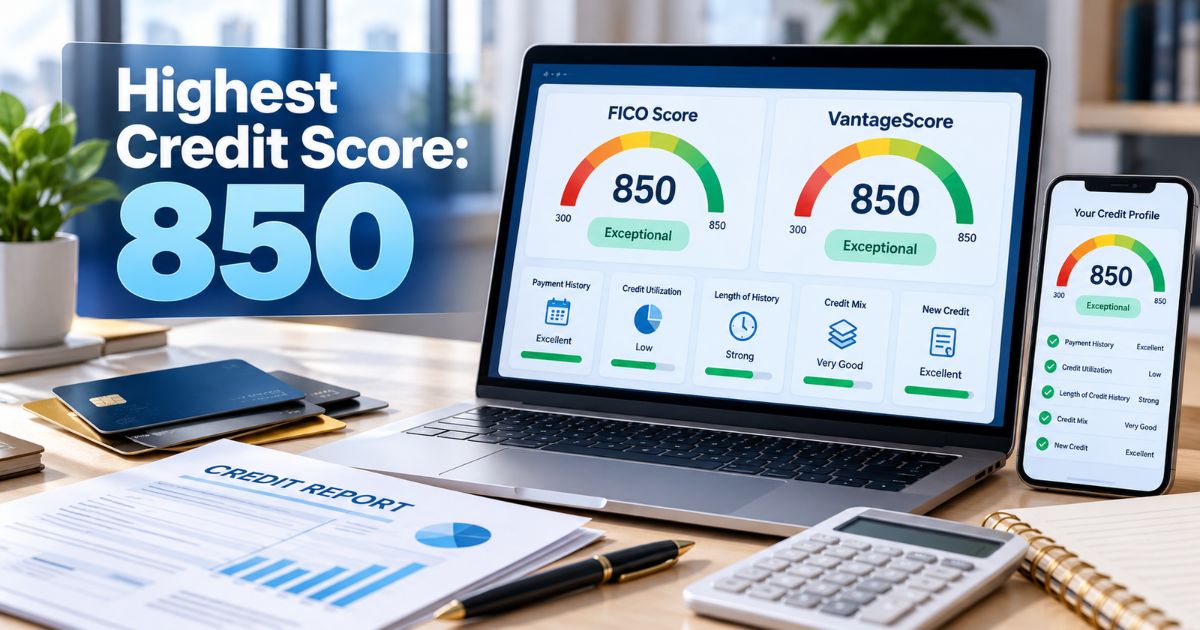
If you are wondering what is the highest credit score, the answer for the most widely used standard consumer scoring models is 850.
Base FICO Scores generally range from 300 to 850, and modern VantageScore models also use a 300-to-850 scale. However, some industry-specific FICO models used for auto lending and credit cards can range from 250 to 900.
This distinction matters because you do not have one universal credit score. The number you see can vary based on the scoring model, model version, credit bureau data, and the date the score is calculated.
Understanding what is the highest credit score is useful, but reaching the maximum should not become your only financial goal. A strong credit profile, manageable debt, accurate credit reports, and affordable borrowing decisions usually matter more than chasing a perfect number.
If you want a deeper explanation of scoring mechanics, read our guide to how credit scores are calculated.
Key Takeaways
- 850 is the maximum for standard base FICO Scores.
- Modern VantageScore models also generally use a 300–850 range.
- Industry-specific FICO Auto and Bankcard Scores can range from 250–900.
- You can have many valid credit scores at the same time.
- Credit bureaus maintain credit-report data; scoring models use that data to produce scores.
- You do not need a perfect 850 to qualify for competitive financial products.
- Payment history, utilization, credit age, new credit, and account mix can all matter.
1. What Is the Highest Credit Score?
For most consumers asking what is the highest credit score, the practical answer is 850.

Base FICO Scores: 300 to 850
FICO states that its base scores range from 300 to 850.
FICO currently categorizes base scores broadly as:
| FICO Score | Rating |
|---|---|
| 800–850 | Exceptional |
| 740–799 | Very Good |
| 670–739 | Good |
| 580–669 | Fair |
| Below 580 | Poor |
See the official FICO score-range guidance.
VantageScore: 300 to 850
The modern VantageScore scale also generally runs from 300 to 850.
That does not mean a FICO Score and VantageScore calculated from the same person’s credit file will always match. Each scoring system uses its own model.
See the official VantageScore consumer guidance.
Industry-specific FICO Scores can reach 900
This is an important exception when answering what is the highest credit score.
FICO Auto Scores and FICO Bankcard Scores can range from 250 to 900.
These models are designed for specific lending contexts and should not be confused with standard base FICO Scores.
2. Why You Can Have More Than One Credit Score
Many consumers are surprised to discover that they can have several legitimate credit scores at the same time.
Different scoring models
FICO and VantageScore are separate scoring systems.
Even within FICO, lenders may use:
- FICO Score 8;
- FICO Score 9;
- FICO Auto Scores;
- FICO Bankcard Scores;
- or mortgage-related FICO versions.
Different credit bureaus
Equifax, Experian, and TransUnion maintain separate credit files.
A creditor may report account information to one bureau before another, or in some cases may not report to all three.
If the underlying credit-report data differs, the resulting score can also differ.
Different calculation dates
Your credit profile changes over time.
Reported balances, payments, new accounts, inquiries, and account status updates can change the information used by a scoring model.
A score calculated today may therefore differ from one calculated several weeks later.
The bureau does not create every score itself
It is more accurate to say that credit bureaus maintain the underlying report data while FICO, VantageScore, or another scoring model analyzes that data.
This corrects a common misconception in older credit articles.
3. FICO vs VantageScore: What Is Different?
When readers ask what is the highest credit score, they often also want to know whether FICO or VantageScore matters more.
Both systems are legitimate, but lenders choose which scoring model they use.
| Feature | FICO | VantageScore |
|---|---|---|
| Standard Range | 300–850 | 300–850 |
| Maximum Standard Score | 850 | 850 |
| Industry-Specific Versions | Yes | Model-dependent |
| Credit Data | Bureau credit files | Bureau credit files |
| Model Formula | FICO methodology | VantageScore methodology |
FICO is widely used in lending
FICO states that its scores are widely used by major lenders.
Different lenders may select different FICO versions depending on whether the product is:
- an auto loan;
- credit card;
- mortgage;
- personal loan;
- or another credit product.
VantageScore is also used by financial institutions
VantageScore states that thousands of financial institutions use its scores.
Consumers may also encounter VantageScore through financial apps, card issuers, and credit-monitoring services.
Do not compare scores without checking the model
A FICO Score of 780 and a VantageScore of 760 do not necessarily mean something is wrong.
First identify:
- the score provider;
- the model version;
- the credit bureau;
- and the date calculated.
4. What Credit Score Factors Matter Most?
Understanding what is the highest credit score becomes more useful when you understand how credit behavior affects scoring.

Payment history
Paying credit obligations on time is one of the most important habits for maintaining a strong credit profile.
FICO identifies payment history as its largest traditional score category.
The CFPB likewise recommends paying loans and bills on time every time.
Credit utilization ratio
Your credit utilization ratio compares revolving balances with available credit limits.
For example:
- Total credit limits: $20,000
- Reported balances: $4,000
- Utilization: 20%
High utilization can signal greater borrowing pressure.
The CFPB advises consumers not to get too close to their credit limits and notes that many experts recommend remaining below 30%, while lower usage can be better.
Do not treat 30% as a magic cutoff
Thirty percent is a useful planning guideline, not a point where a score suddenly changes from good to bad.
You also do not need to carry an interest-bearing balance to build credit.
Length of credit history
A longer history of responsibly managed credit gives scoring models more information about your behavior.
Account age can therefore influence your profile.
New credit
Applying for several accounts in a short period can affect your score.
A lender’s review associated with a new credit application is generally a hard inquiry.
Hard inquiries may affect scores because scoring systems consider recent credit-seeking activity.
Credit mix
Credit reports can contain both revolving and installment accounts.
Examples include:
- credit cards;
- personal loans;
- auto loans;
- student loans;
- and mortgages.
You should not borrow money solely to create a more varied credit mix.
If you genuinely need financing, compare costs using our personal loan rates guide or auto finance calculator.
5. Why a Perfect 850 Is Not Necessary
One reason people ask what is the highest credit score is that they assume a perfect score is required for the best financial opportunities.
That is not generally true.
FICO considers 800+ exceptional
FICO places scores of 800 and above in its Exceptional category.
A consumer therefore does not have to reach exactly 850 to have a very strong credit profile.
Lenders set their own standards
No single credit-score cutoff guarantees approval or the lowest available interest rate across every lender.
Lenders can also evaluate:
- income;
- existing debts;
- assets;
- down payment;
- collateral;
- loan amount;
- and their own underwriting rules.
An 850 does not guarantee approval
A borrower with an excellent score can still be declined if other underwriting requirements are not met.
For example, a lender may determine that the requested payment is too large relative to income.
Focus on affordability too
A high score can help with financing opportunities, but borrowing should still fit your budget.
Use our Master Your Money guide and personal finance guide to evaluate borrowing within your broader finances.
6. How to Check Your Credit Reports and Scores
Knowing what is the highest credit score does little good if the information behind your own score is inaccurate.

Check your reports through the authorized source
Use AnnualCreditReport.com to obtain your reports from Equifax, Experian, and TransUnion.
The CFPB states that consumers can currently access reports online weekly from each nationwide credit reporting company.
Checking your own report does not lower your score
Reviewing your own credit report is a soft inquiry.
The CFPB confirms that checking your own report does not hurt your credit score.
Check for common credit-report errors
Look for:
- accounts that are not yours;
- incorrect balances;
- incorrect credit limits;
- closed accounts listed as open;
- payments incorrectly reported as late;
- duplicate debts;
- and identity information belonging to someone else.
These are among the common errors identified by the CFPB.
Compare all three reports
Information may differ across bureaus.
A difference does not automatically mean an error, but unusual or unfamiliar information should be investigated.
7. How to Build an Excellent Credit Profile
Instead of obsessing over what is the highest credit score, focus on habits that create a strong financial record.
Pay every account on time
Set up reminders or automatic payments when appropriate.
If an account is already late, getting current and staying current can be an important priority.
Keep revolving balances manageable
Avoid repeatedly operating close to your credit limits.
Paying balances in full when possible also reduces interest expense.
Apply only for credit you need
Frequent applications can create multiple hard inquiries and several new accounts.
Apply because the product serves a genuine financial need.
Preserve useful older accounts when appropriate
Closing a credit card can reduce available credit and potentially increase utilization.
However, keeping every account open forever is not always sensible.
Consider:
- annual fees;
- fraud risk;
- account usefulness;
- and your ability to manage the account responsibly.
Use credit-building products carefully
Consumers with limited history may consider products such as secured credit cards or credit-builder loans.
Compare fees, interest, reporting practices, and terms before opening an account.
Our secured borrowing guide explains how collateral-backed credit works.
How to Dispute Credit Report Errors
If your credit report contains incorrect information, you have the right to dispute it.
Dispute with the credit reporting company
Explain what is wrong and provide supporting documents.
Also contact the furnisher
The CFPB recommends disputing inaccurate information with both the credit reporting company and the business that supplied the information.
Keep records
Save:
- copies of dispute letters;
- supporting documents;
- confirmation numbers;
- and responses.
Accurate negative information is different
Accurate current negative information generally cannot be removed simply because it lowers your score.
The CFPB warns consumers to be cautious of companies claiming they can remove accurate negative information for a fee.
How Long Negative Information Can Stay on a Credit Report
Most negative account information can generally remain for up to seven years.
Some information can remain longer depending on the type of record and applicable law.
Do not rely on fixed score-recovery timelines
The original version of this article included fixed estimates such as 30–45 days for utilization and 6–24 months for late payments.
Those should not be presented as guaranteed recovery periods.
How quickly a score changes depends on:
- the scoring model;
- the entire credit file;
- when information is reported;
- the severity of negative information;
- and other account activity.
Balance changes may appear after reporting
Paying down a credit-card balance can affect utilization after the creditor reports updated information.
The exact score impact cannot be predicted in advance.
Credit Scores and Auto Loans
A strong score can improve your position when shopping for auto financing, but the lender will still review additional factors.
For vehicle financing, see:
- New Car vs Used Car Interest Rates
- Auto Finance Calculator
- Best Auto Finance Deals
- Affordable Auto Loans
- First-Time Auto Loan
- Refinance Auto Loan
- Paying Off a Car Loan Early
FICO also offers industry-specific Auto Scores that can range from 250 to 900.
Credit Scores and Personal Loans
A strong credit profile may improve your borrowing options, but personal-loan approval also depends on lender underwriting.
Useful guides include:
- How to Get a Personal Loan
- Personal Loan Rates
- Personal Loans for Bad Credit
- Unsecured vs Secured Personal Loans
- Personal Loans for Moving Expenses
- Finance Charges Explained
Credit Utilization: Should You Aim for 0%, 10%, or 30%?
There is no single utilization percentage that guarantees a particular score.
Under 30% is a common guideline
The CFPB notes that experts often recommend staying below 30% of total available revolving credit.
Lower utilization may be even better
The CFPB also notes that some experts recommend keeping utilization below 10%.
You do not need to carry a balance
Carrying interest-bearing credit-card debt does not provide a special scoring benefit.
Paying balances in full can reduce interest costs while still demonstrating account usage.
For broader context, see our average credit card debt guide.
Hard Inquiries vs Soft Inquiries
Understanding inquiries helps when working toward strong credit.
Hard inquiry
A hard inquiry commonly occurs after you apply for new credit.
It may affect your score.
Soft inquiry
A soft inquiry can occur when:
- you check your own credit;
- an existing creditor reviews your account;
- or certain prescreening activity occurs.
Soft inquiries do not affect your scores.
Rate shopping
For certain loan types, multiple inquiries made within a limited shopping window can generally be treated as one inquiry by scoring models.
The CFPB notes that the relevant window can range from roughly 14 to 45 days depending on the model.
What Does an 850 Credit Score Actually Get You?
After learning what is the highest credit score, it is natural to ask what an 850 actually changes.
It signals very low credit risk
A very high score generally indicates a strong history of managing credit obligations.
It may improve access to competitive terms
Strong credit can make it easier to qualify for competitive offers.
However, individual lenders still set their own requirements.
It does not guarantee the lowest possible rate
Rates can also depend on:
- loan type;
- amount borrowed;
- term;
- collateral;
- market conditions;
- income;
- and lender policy.
It does not guarantee a specific credit limit
Card issuers can evaluate income and other information when setting limits.
850 should not become an obsession
Going from an already exceptional score to a perfect score may offer little practical financial improvement.
Focus on healthy borrowing behavior and affordable financial decisions instead.
Common Credit Score Myths
Myth: You only have one credit score
You can have many scores because different models, versions, bureaus, and dates can produce different results.
Myth: Checking your own score hurts your credit
Checking your own credit is a soft inquiry and does not hurt your score.
Myth: You need to carry credit-card debt
You do not need to pay interest to build a good credit score.
Myth: 30% utilization is a magic threshold
It is a guideline, not a guaranteed scoring breakpoint.
Myth: 850 guarantees approval
Lenders consider factors beyond credit score.
Myth: Credit repair companies can erase accurate history
Accurate negative information generally cannot simply be removed because you pay a company.
Related Personal Finance Guides
- How Is a Credit Score Calculated?
- Average Credit Card Debt in 2026
- Master Your Money
- Complete Personal Finance Guide
- Personal Finance Course
- Top Financial Tips
- Financial Planning Hub
- How to Get a Personal Loan
- Personal Loans for Bad Credit
- Secured Personal Loans
- New vs Used Car Interest Rates
- Auto Finance Calculator
- Refinance Auto Loan
Conclusion
So, what is the highest credit score? For standard base FICO Scores and modern VantageScore models, the maximum is generally 850.
However, some industry-specific FICO Auto and Bankcard Scores range as high as 900. This is why you should always identify the scoring model before comparing two numbers.
A perfect score is not required to demonstrate excellent credit. FICO already categorizes scores of 800 and above as Exceptional.
Rather than chasing a perfect number, focus on accurate credit reports, on-time payments, manageable revolving balances, thoughtful new-credit applications, and long-term account management.
Those habits can help you maintain a strong credit profile while avoiding unnecessary debt and interest costs.