Average credit card debt in the United States remains high in 2026, but there is no single number that perfectly describes every American borrower. Different data providers measure balances using different populations, reporting dates, and methodologies.
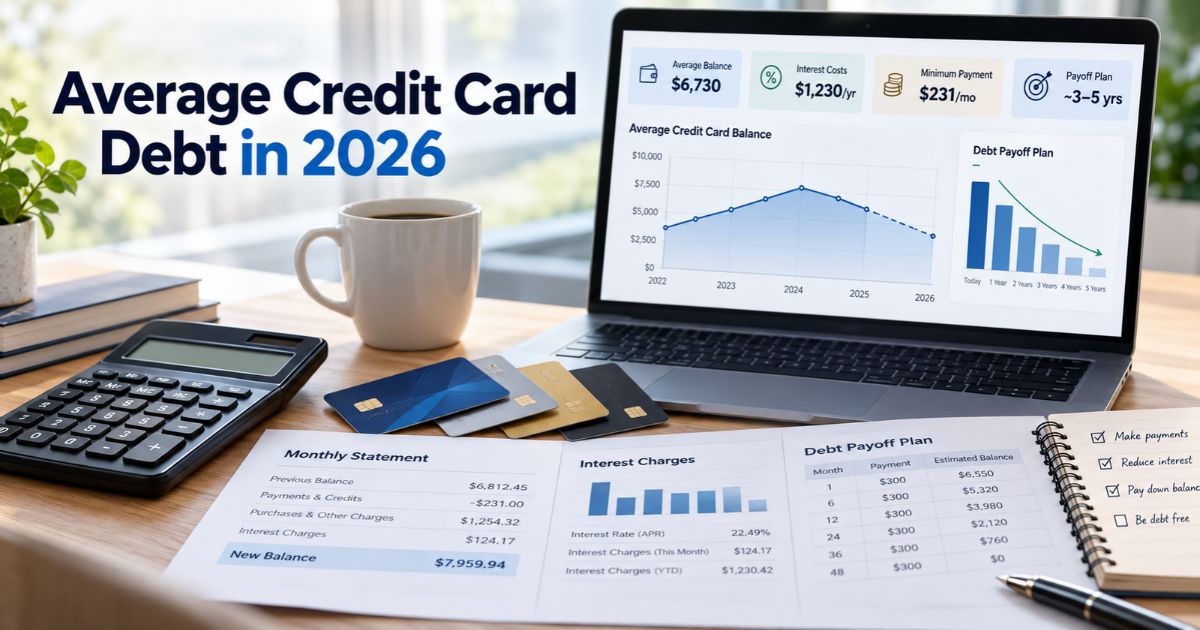
Experian reported an average credit card balance of $6,659 per consumer as of March 2026. TransUnion reported average bankcard debt of $6,610 per borrower in the second quarter of 2026. Meanwhile, the Federal Reserve Bank of New York reported $1.263 trillion in total U.S. credit-card balances at the end of Q2 2026.
Those figures answer different questions. An individual average should not be confused with nationwide aggregate debt, household debt, or the amount carried from month to month and charged interest.
Understanding average credit card debt is most useful when you use national figures as context—not as a target. Your income, APR, required payments, emergency savings, credit utilization, and ability to pay the balance matter much more than whether you are above or below the national average.
For broader financial planning, also review our Master Your Money guide, complete personal finance guide, and top financial tips.
Key Takeaways
- Experian reported an average consumer credit-card balance of $6,659 in March 2026.
- TransUnion reported average bankcard debt of $6,610 per borrower in Q2 2026.
- New York Fed data showed $1.263 trillion in total U.S. credit-card balances in Q2 2026.
- Average balances, total balances, and revolving balances are not interchangeable statistics.
- Your APR and repayment pattern can matter more than the national average.
- High utilization can affect credit scores even when payments are made on time.
- A sustainable payoff strategy should protect essential expenses while reducing high-cost debt.
1. What Is the Average Credit Card Debt in 2026?
The latest available 2026 data places average credit card debt in the mid-$6,000 range per consumer or borrower, depending on the dataset.

Experian: $6,659 average balance
Experian reported that the average U.S. consumer credit-card balance reached $6,659 in March 2026, compared with $6,618 one year earlier.
Experian also reported approximately $1.246 trillion in total consumer credit-card balances in its March 2026 dataset.
See the current Experian credit-card debt report.
TransUnion: $6,610 per borrower
TransUnion’s Q2 2026 Consumer Pulse data reported average bankcard debt of $6,610 per borrower, up from $6,473 in Q2 2025.
Its dataset also reported $1.14 trillion in bankcard balances and approximately 176.9 million consumers carrying a balance.
These numbers differ from Experian because the underlying databases and definitions are different.
New York Fed: $1.263 trillion total
The Federal Reserve Bank of New York reported that aggregate credit-card balances rose by $21 billion during Q2 2026 to approximately $1.263 trillion.
That figure is a national total rather than an individual average credit card balance.
See the New York Fed Q2 2026 Household Debt and Credit report.
Why the numbers do not match exactly
Different reports may vary because of:
- different reporting dates;
- different borrower populations;
- different account definitions;
- credit-bureau versus lender datasets;
- and differences between bankcards, revolving credit, and credit-card balances.
For this reason, do not combine several datasets into one supposedly exact national figure.
2. Average Credit Card Debt vs Total U.S. Revolving Debt
Understanding average credit card debt requires separating credit cards from broader revolving consumer credit.

What is revolving credit?
Revolving credit lets consumers repeatedly borrow up to an approved limit and repay the balance over time. When discussing average credit card debt, it is important to separate credit-card balances from the broader revolving-credit category.
Credit cards make up most of the Federal Reserve’s revolving consumer-credit category, but the category can also include other revolving credit products.
The Federal Reserve’s G.19 Consumer Credit release should therefore not automatically be described as a pure credit-card debt measure.
What happened to revolving credit in August 2026?
The Federal Reserve reported that revolving consumer credit decreased at a seasonally adjusted annual rate of 4.2% in August 2026.
This monthly decline does not necessarily mean average credit card debt fell at the same rate. Revolving-credit data can fluctuate from month to month and should be considered alongside quarterly credit-card balances and longer-term trends.
Individual balance vs national total
| Metric | What It Measures |
|---|---|
| Average Consumer Balance | Average balance associated with consumers in a dataset |
| Average Debt per Borrower | Average among borrowers included in that dataset |
| Total Credit-Card Balance | Aggregate outstanding balances nationwide |
| Revolving Consumer Credit | Broader category that includes mostly cards plus other revolving credit |
These distinctions are important when comparing your own debt with national statistics.
3. U.S. Credit Card Debt Trends in 2026
Average credit card debt has grown much more slowly in 2026 than during several earlier years, but aggregate balances remain historically large.

Average balances have been relatively flat
Experian’s average consumer balance increased only 0.6% from March 2025 to March 2026, from $6,618 to $6,659.
However, total balances in Experian’s dataset increased 5.4%, partly because the number of credit-card accounts also increased.
Generation differences are substantial
Experian’s March 2026 data showed substantial differences among generations:
| Generation | Average Credit-Card Balance |
|---|---|
| Gen Z | $3,483 |
| Millennials | $7,013 |
| Gen X | $9,560 |
| Baby Boomers | $6,676 |
Gen X carried the largest average balance in that dataset. This illustrates why one national average should not be treated as representative of every age group.
Serious delinquency remains important
TransUnion reported a borrower-level bankcard delinquency rate of 2.26% for accounts 90 or more days past due in Q2 2026, compared with 2.17% one year earlier.
The New York Fed reported that transitions into serious delinquency were broadly stable in Q2, while new credit-card delinquencies remained elevated enough to warrant monitoring.
High interest rates increase repayment pressure
Even when average credit card debt is relatively stable, high APRs can make balances expensive to carry.
Experian cited an average revolving-account APR of about 22.15% as of May 2026.
Borrowers should check their own card agreement because individual APRs can differ substantially.
Our finance charge guide explains how interest and borrowing costs affect repayment.
4. How to Compare Your Debt With the Average
Comparing your own balance with average credit card debt can provide context, but the national number should not determine whether your debt is manageable.

Add every current card balance
Review the latest statement or current online balance for each account.
Include:
- general-purpose credit cards;
- store cards;
- cards with promotional balances;
- and any revolving balances you are actively repaying.
Compare the trend, not just one number
Ask whether your total balance is:
- declining;
- stable;
- or increasing month after month.
A $7,000 balance that is steadily falling may represent less financial stress than a $3,000 balance that increases every month.
Compare debt with income and cash flow
Someone earning $150,000 annually and someone earning $35,000 may experience the same $6,000 balance very differently.
Your budget should therefore matter more than whether your balance is higher or lower than average credit card debt.
Use our money-management guide and financial planning guide to assess the wider picture.
5. What Credit Card Debt Costs in Interest
The cost of average credit card debt depends heavily on APR and repayment speed.
Understand your credit card APR
Credit-card APR represents an annualized interest rate. Many card APRs are variable, which means the rate can change when the underlying benchmark changes.
Check your statement for the actual APR applying to:
- purchases;
- balance transfers;
- cash advances;
- and any promotional balances.
Illustrative interest example
Suppose a borrower carries $6,659—the Experian March 2026 average—with a hypothetical 22% APR.
If the balance remained unchanged for an entire year, a simple rough annual interest estimate would exceed $1,400.
Actual credit-card interest is generally calculated using daily or average-daily-balance methods, so this simple example should not be treated as an exact statement calculation.
Why minimum payments can be expensive
The minimum monthly payment keeps an account from becoming past due when paid on time, but minimum-only repayment can extend debt for years.
The Consumer Financial Protection Bureau advises paying more than the minimum when possible because doing so can reduce both interest cost and payoff time.
See the CFPB’s credit-card payment guidance.
Use the payoff disclosure on your statement
Credit-card statements include information showing how long repayment could take if you make only minimum payments.
Use that disclosure instead of relying on generic online estimates.
6. Credit Utilization and Credit Scores
Average credit card debt and credit utilization are related but not identical.
Your credit utilization ratio compares revolving balances with available revolving limits.
Utilization example
If your total card limits are $20,000 and reported balances are $4,000:
$4,000 ÷ $20,000 = 20% utilization
If balances rise to $10,000 without a limit change, utilization becomes 50%.
Why utilization can matter
Credit-scoring models can view high revolving utilization as a sign of increased credit risk.
If you want a full explanation, read our guide to how a credit score is calculated.
Do not confuse utilization with affordability
A low utilization percentage does not necessarily mean the debt is affordable.
For example, someone with $10,000 in card balances and $100,000 in credit limits has only 10% utilization, but the $10,000 balance may still strain the household budget.
Closing cards can change utilization
Closing a card can reduce total available credit and potentially increase utilization if balances remain on other accounts.
However, you should also consider annual fees, fraud risk, and whether the account still serves a useful purpose.
7. Debt-to-Income Ratio and Monthly Affordability
A second important measure is your debt-to-income ratio, commonly called DTI.
DTI generally compares required monthly debt payments with gross monthly income.
Basic DTI formula
Total required monthly debt payments ÷ gross monthly income × 100
For example:
- gross monthly income: $6,000;
- required monthly debt payments: $1,800;
- DTI: 30%.
Credit-card utilization and DTI measure different things
| Metric | Main Focus |
|---|---|
| Credit Utilization | Revolving balances compared with limits |
| Debt-to-Income Ratio | Monthly debt obligations compared with gross income |
| Average Credit Card Debt | Statistical benchmark from a consumer dataset |
Neither utilization nor DTI should be viewed in isolation from your actual household expenses.
Before applying for another loan, review our personal loan guide and personal loan rates guide.
How to Build a Credit Card Payoff Strategy
If your balance is causing financial pressure, your credit card payoff strategy matters more than how your debt compares with average credit card debt.
List every balance and APR
Create a simple table containing:
- card name;
- balance;
- APR;
- minimum payment;
- due date;
- credit limit;
- and promotional expiration date.
Debt avalanche method
The debt avalanche prioritizes the highest-interest balance while required minimums are paid on all other accounts.
This approach generally minimizes interest when followed consistently.
Debt snowball method
The debt snowball prioritizes the smallest balance first.
It may cost more in interest than a strict avalanche approach but can provide motivational wins for some borrowers.
Choose the method you can sustain
The mathematically cheapest strategy is not useful if you abandon it.
Select a repayment plan that fits your income and allows you to continue covering essentials.
Should You Use a Personal Loan for Credit Card Debt?
A debt-consolidation personal loan may offer a fixed repayment schedule, but it is not automatically cheaper.
Compare:
- new APR;
- origination fee;
- monthly payment;
- repayment term;
- total repayment;
- and what happens to the credit cards after consolidation.
Our personal loan rate guide can help with comparison.
If credit is weak, also review personal loans for bad credit.
To understand collateral risk, compare secured personal loans with our secured versus unsecured loan guide.
What About a 0% Balance Transfer?
A genuine promotional 0% APR balance-transfer offer can reduce interest temporarily if you qualify.
Before transferring debt, check:
- balance-transfer fee;
- promotional period;
- regular APR after the promotion;
- payment requirements;
- and whether you can realistically repay the transferred balance in time.
A balance transfer does not reduce debt by itself. It only changes where the debt is held and potentially changes the interest cost.
How to Prevent Credit Card Debt From Growing
Reducing average credit card debt at a national level is outside your control, but you can control many factors affecting your own balances.
Build a realistic budget
Protect essential expenses such as:
- housing;
- utilities;
- food;
- insurance;
- transportation;
- healthcare;
- and required debt payments.
Our personal finance guide explains how to create a broader financial plan.
Build an emergency reserve
Even a modest reserve can reduce the need to rely on cards when a vehicle repair, medical expense, or other unexpected bill appears.
Stop adding new discretionary debt
Payoff strategies become much harder when new card spending continuously replaces the balances being repaid.
Review subscriptions and recurring charges
Small recurring expenses can add up when placed on a credit card automatically.
Credit Card Debt Before Applying for an Auto Loan
High card balances can affect both your credit profile and your monthly cash flow when you apply for vehicle financing.
Before shopping for a vehicle, use our:
- Auto Finance Calculator
- First-Time Auto Loan Guide
- Best Auto Finance Deals
- Auto Finance Options Guide
- Affordable Auto Loan Guide
If you already have a vehicle loan, our auto loan refinancing guide explains when replacing an existing contract may or may not reduce costs.
Be especially cautious about adding a very long car loan while carrying expensive card debt. See our 96-month auto loan guide for the risks of extended terms.
When to Contact Your Credit Card Company
If you believe you cannot make the required payment, act before the account becomes more seriously delinquent.
The CFPB recommends contacting your card company immediately rather than waiting until you are far behind.
Be prepared to explain:
- why you cannot make the minimum payment;
- how much you can afford;
- when normal payments may resume;
- and what temporary arrangement you are requesting.
Review the CFPB’s current guidance for consumers who cannot pay a credit-card bill.
When Nonprofit Credit Counseling May Help
Professional assistance may be appropriate when your debt is increasing despite regular payments or you cannot consistently meet minimums.
What credit counseling can provide
A reputable counselor may help with:
- budgeting;
- reviewing debts;
- evaluating repayment options;
- and, in some situations, arranging a debt management plan.
Understand a debt management plan
A debt management plan may involve making one payment to a counseling organization, which then distributes payments to participating creditors.
Fees, creditor participation, account restrictions, and possible credit effects should be reviewed before enrolling.
Be cautious with debt-settlement companies
The CFPB warns consumers about companies that promise to eliminate debt, demand improper upfront fees, or encourage borrowers to stop communicating with creditors.
Debt settlement can involve significant risks, including additional interest, damaged credit, collection activity, and possible lawsuits.
When Legal Help May Be Appropriate
Consider qualified legal advice when dealing with:
- a collection lawsuit;
- wage-garnishment concerns;
- bankruptcy questions;
- disputed ownership of debt;
- or severe financial hardship.
Legal advice is different from ordinary debt counseling and should come from a qualified professional familiar with your circumstances and jurisdiction.
How Credit Card Debt Connects With Your Credit Score
The dollar amount of average credit card debt does not directly determine your credit score.
What matters is how information in your credit reports interacts with the scoring model.
Important factors can include:
- payment history;
- credit utilization;
- account age;
- new credit activity;
- and credit mix.
Read our credit score calculation guide for a full explanation.
Do Not Borrow Just to Match the National Average
The national average credit card debt is descriptive, not prescriptive.
If your balance is $1,000, there is no financial benefit to increasing it because other Americans owe more.
Similarly, having a balance above the national average does not automatically mean you are in financial crisis.
Evaluate:
- whether you can make payments comfortably;
- whether the balance is increasing;
- the APR you are paying;
- whether you have emergency savings;
- and whether the debt interferes with other financial goals.
Related Personal Finance Guides
Continue your research with these Best Finance Live resources:
- Master Your Money
- Complete Personal Finance Guide
- Personal Finance Course Guide
- Top Financial Tips
- Financial Planning Hub
- How a Credit Score Is Calculated
- How to Get a Personal Loan
- Personal Loan Rates
- Personal Loans for Bad Credit
- Secured Personal Loans
- Secured vs Unsecured Personal Loans
- Finance Charges Explained
- Personal Loans for Moving Expenses
Conclusion
Average credit card debt provides useful context for understanding consumer finances in 2026, but there is no single number that describes every American.
Experian reported a $6,659 average consumer balance in March 2026, while TransUnion reported $6,610 in average bankcard debt per borrower in Q2. The New York Fed separately reported $1.263 trillion in aggregate U.S. card balances for Q2.
The differences do not mean one source is necessarily wrong. They reflect different populations, reporting periods, and measurement methods.
Your own financial health should be judged by affordability rather than comparison with average credit card debt. Review your APRs, minimum payments, utilization, income, essential expenses, and whether balances are shrinking or growing.
If debt is manageable, create a structured payoff strategy and avoid unnecessary new charges. If payments are becoming difficult, contact card issuers early and consider reputable nonprofit counseling before the problem becomes more serious.
National statistics are useful benchmarks, but the strongest goal is not to become “average.” It is to build a debt level and repayment plan that fits your income and supports your long-term financial stability.
Frequently Asked Questions
What is the average credit card debt in 2026?
How much total credit card debt do Americans have?
Frequently Asked Questions
What is the average credit card debt in 2026?
Experian reported an average credit card debt balance of $6,659 per consumer as of March 2026. TransUnion separately reported average bankcard debt of $6,610 per borrower in Q2 2026. The figures differ because the datasets and methodologies are different.
How much total credit card debt do Americans have?
The Federal Reserve Bank of New York reported approximately $1.263 trillion in aggregate U.S. credit-card balances at the end of Q2 2026.
Is having more than the average credit card balance bad?
Not automatically. A balance should be evaluated based on income, APR, required payments, cash flow, savings, and repayment progress rather than the national average alone.
What is the difference between average credit card debt and revolving credit?
Average credit-card debt refers to an average balance within a particular dataset. Federal Reserve revolving consumer credit is a broader category that consists mainly of credit-card loans but can include other revolving credit products.
How does credit card debt affect my credit score?
Credit-card balances can affect credit utilization, which is an important scoring factor. Late payments can also damage payment history. The total dollar balance alone does not determine your score.
Is 30% credit utilization a hard limit?
No. Thirty percent is commonly used as a guideline, not a universal scoring threshold. In general, lower revolving utilization can be more favorable than higher utilization when other factors are similar.
Is the debt avalanche or debt snowball better?
The avalanche generally minimizes interest by targeting the highest APR first. The snowball targets the smallest balance first and may provide motivational progress. The better strategy is one you can consistently maintain.
Can a personal loan help pay off credit cards?
A consolidation loan can create a fixed payment schedule and may reduce interest if the new APR and fees are favorable. Compare the total repayment cost before replacing card debt with another loan.
What should I do if I cannot make my minimum card payment?
Contact the card issuer as soon as possible. Explain why you cannot make the minimum, what you can afford, and when normal payments may resume. Do not wait for multiple missed payments before seeking help.
When should I consider credit counseling?
Consider reputable nonprofit credit counseling when balances keep growing, minimum payments are becoming difficult, or you need help building a realistic repayment plan. Review fees and services carefully before enrolling.