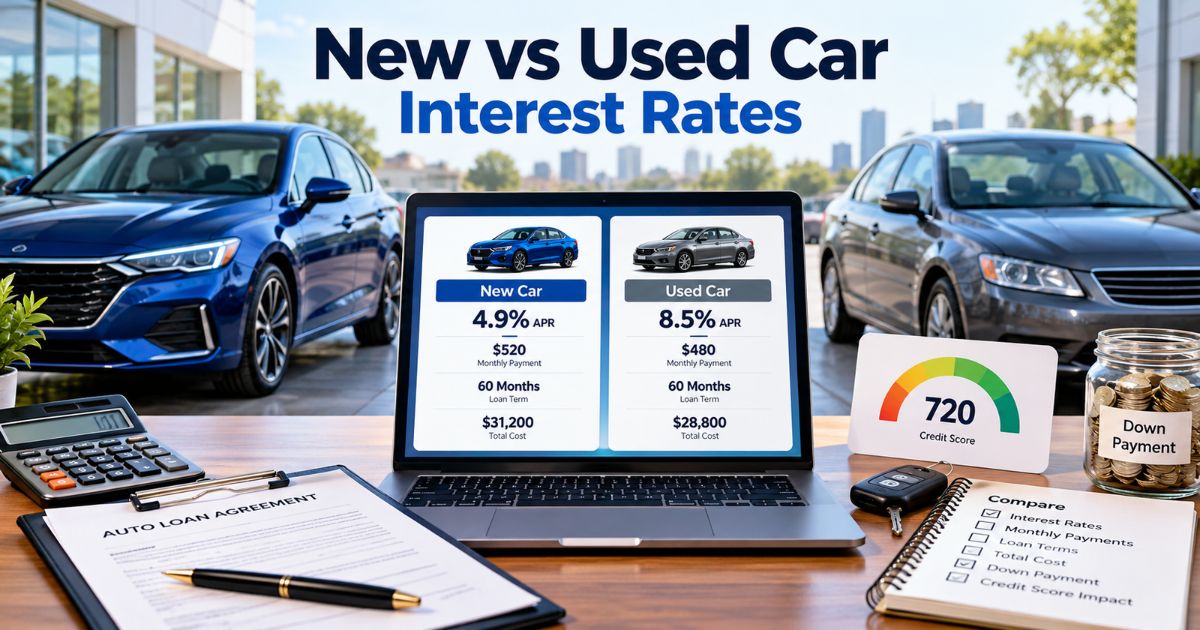
New car vs used car interest rates can differ substantially, and current U.S. data generally shows lower financing rates for new vehicles. However, a lower APR does not automatically make a new car cheaper overall.
According to Experian’s Q2 2026 automotive finance data, the average interest rate was 6.35% for new-car loans and 11.19% for used-car loans. At the same time, average new-car buyers financed much more money, which pushed their average monthly payments above those of used-car buyers.
This distinction matters. The best choice depends on the vehicle price, amount financed, APR, down payment, loan term, credit profile, available incentives, insurance, maintenance, and depreciation.
When comparing new car vs used car interest rates, focus on the complete financial picture rather than choosing whichever option displays the lowest advertised percentage.
If you are preparing to finance a vehicle, also review our auto finance calculator guide, auto finance options, and best auto finance deals.
Key Takeaways
- Average new-car loan rates were lower than used-car rates in Q2 2026.
- Experian reported average rates of 6.35% for new loans and 11.19% for used loans.
- New-car payments can still be higher because borrowers generally finance larger amounts.
- Credit profile, loan term, vehicle type, lender, and down payment can affect your actual APR.
- Manufacturer incentives can sometimes make new-car financing unusually cheap for qualifying buyers.
- Compare APR, amount financed, term, monthly payment, and total repayment—not payment alone.
- Preapproval from multiple lenders can give you a useful benchmark before visiting a dealership.
1. New Car vs Used Car Interest Rates: What the 2026 Data Shows
Current new car vs used car interest rates show a meaningful difference between the two markets.

Experian’s Q2 2026 data reported the following averages:
| Auto Loan Metric | New Cars | Used Cars |
|---|---|---|
| Average Interest Rate | 6.35% | 11.19% |
| Average Monthly Payment | $765 | $542 |
| Average Loan Amount | $43,610 | $27,852 |
| Average Loan Term | 69.5 months | 67.9 months |
Source: Experian Q2 2026 auto finance data.
Why used-car APRs are often higher
Lenders may price used vehicles differently because collateral value, vehicle age, mileage, resale value, and expected useful life can affect risk.
Used vehicles also generally do not receive the same subsidized manufacturer financing programs available on selected new models.
Why new-car payments can still be higher
The lower average rate does not offset the much larger amount many new-car buyers finance.
Experian reported an average new-car loan of $43,610 versus $27,852 for used vehicles in Q2 2026.
That is why comparing new car vs used car interest rates without comparing principal can produce the wrong conclusion.
No average rate is your guaranteed rate
The numbers above describe market averages. Your actual quote can differ based on:
- credit history;
- credit score;
- income and existing obligations;
- vehicle age;
- loan amount;
- down payment;
- loan term;
- lender;
- and current market conditions.
2. How Credit Affects New Car vs Used Car Interest Rates
Credit is one of the most important factors influencing new car vs used car interest rates.
Experian’s Q2 2026 data showed large differences by credit tier:
| VantageScore 4.0 Range | Average New-Car APR | Average Used-Car APR |
|---|---|---|
| 781–850 | 4.41% | 6.29% |
| 661–780 | 6.15% | 8.81% |
| 601–660 | 9.71% | 13.93% |
| 501–600 | 13.52% | 19.10% |
| 300–500 | 16.11% | 21.62% |
These are averages—not lender requirements or guaranteed quotes.
Avoid using one credit-score cutoff
There is no universal score such as 720 that guarantees the best auto rate across every lender.
Different lenders use different credit models, underwriting standards, loan-to-value limits, and vehicle requirements.
Our credit score calculation guide explains the major factors that can influence a credit profile.
Review your credit reports before applying
The Consumer Financial Protection Bureau recommends reviewing your credit reports before shopping for an auto loan and disputing inaccurate information when necessary.
You can obtain official reports through AnnualCreditReport.com.
Rate shopping does not require months of applications
The CFPB explains that auto-loan credit checks made within a rate-shopping window are generally treated as one inquiry for scoring purposes, although the exact window can vary by scoring model.
Try to concentrate serious auto-loan shopping within roughly 14 to 45 days.
3. Understand Auto Loan APR vs Interest Rate
When comparing new car vs used car interest rates, make sure you are comparing the same metric.
Interest rate
The interest rate represents the cost the lender charges for borrowing the principal.
APR
APR provides a broader measure of borrowing cost because it incorporates the interest rate plus certain additional loan charges.
The CFPB recommends comparing APR to APR when evaluating competing loans.
Read the official CFPB explanation of interest rate versus APR.
Why this matters
A loan advertised with an appealing interest rate can still have a higher effective cost if additional financed charges apply.
Review:
- APR;
- interest rate;
- amount financed;
- finance charge;
- monthly payment;
- loan term;
- and total of payments.
Our finance charge guide explains these borrowing costs in more detail.
4. Loan Term Length Can Change the Real Cost
Loan term length has a major influence on the total cost behind new car vs used car interest rates.
Long terms lower monthly payments
Spreading repayment over more months usually reduces the required monthly payment.
This can make an expensive vehicle appear easier to afford.
But long terms can raise total interest
The CFPB warns that a longer auto-loan term generally means more total interest even when the monthly payment falls.
Long loans also increase the risk that you will owe more than the vehicle is worth.
For an extreme example, review our 96-month auto loan guide.
One in three loans now exceeds 72 months
Experian reported in Q2 2026 that approximately one in three vehicle loans exceeded 72 months.
This makes term length an increasingly important part of evaluating total cost.
Choose the shortest term that fits safely
The shortest possible term is not automatically right if the monthly payment leaves no room for essentials or emergencies.
The goal is a term that balances affordability with reasonable total interest.
5. How Down Payment and Loan-to-Value Affect Financing
The down payment amount changes how much you must borrow and can affect the loan-to-value ratio.
What is loan-to-value?
Loan-to-value, or LTV, compares the loan balance with the vehicle’s value.
A larger down payment generally reduces the amount financed and the LTV.
There is no universal 20% or 10% rule
You may see recommendations to put 20% down on a new car or 10% on a used car.
Those can be planning guidelines, but they are not universal lender requirements.
Your appropriate down payment depends on:
- cash reserves;
- vehicle price;
- trade-in equity;
- APR;
- loan term;
- and other financial priorities.
A larger down payment can reduce borrowing cost
The CFPB notes that increasing your down payment reduces the amount you need to borrow and may sometimes help you obtain better financing terms.
Do not drain emergency savings
A large down payment can reduce interest, but leaving yourself with no financial cushion may force you to use expensive credit when an emergency occurs.
Our Master Your Money guide covers emergency savings and broader budgeting.
6. Compare Total Borrowing Cost, Not Just Monthly Payments
This is one of the most important lessons when studying new car vs used car interest rates.
A lower monthly payment does not necessarily mean a cheaper loan.
Compare the amount financed
Start with the actual principal after accounting for:
- negotiated vehicle price;
- taxes;
- down payment;
- trade-in equity or negative equity;
- dealer charges;
- and financed add-ons.
Compare identical terms when testing interest rates
If you want to understand only how a rate difference affects cost, compare the same:
- loan amount;
- term;
- payment schedule;
- and fees.
Illustrative example
Suppose two borrowers each finance $30,000 for 60 months.
| Example | New-Car Scenario | Used-Car Scenario |
|---|---|---|
| Amount Financed | $30,000 | $30,000 |
| Illustrative APR | 4.5% | 7.5% |
| Term | 60 months | 60 months |
| Approximate Total Interest | About $3,550 | About $6,070 |
These are educational examples, not current loan offers.
Real vehicles rarely have identical prices
In practice, the used car may cost substantially less.
A $25,000 used vehicle financed at a higher APR can still cost less overall than a $45,000 new vehicle financed at a lower rate.
Use our auto finance calculator to model different prices, rates, down payments, and terms.
7. Manufacturer Financing Incentives Can Change the Comparison
Manufacturer promotions can significantly affect new car vs used car interest rates.
Automakers sometimes offer special financing such as 0% APR or other subsidized rates on selected new vehicles.
The CFPB confirms that manufacturer incentives can include promotional APR financing and cash rebates.
Promotional financing has eligibility rules
Low-rate manufacturer financing may be limited to:
- buyers with strong credit;
- specific models;
- specific model years;
- shorter repayment terms;
- certain regions;
- or limited promotional periods.
Read the fine print before assuming the advertised rate applies to you.
0% financing is not available to everyone
The CFPB notes that 0% offers generally go to consumers with the strongest credit profiles and may require relatively short repayment terms.
Compare low APR with a cash rebate
Sometimes a buyer must choose between promotional financing and a cash incentive.
Compare both scenarios:
- vehicle price after rebate;
- amount financed;
- APR;
- term;
- monthly payment;
- and total repayment.
Do not assume the incentive makes the new car cheaper
A $40,000 new vehicle at a subsidized rate can still cost more than a much less expensive used vehicle.
The vehicle price remains central to the calculation.
Vehicle Depreciation and Negative Equity
Interest is not the only cost affecting a financed vehicle.
What is vehicle depreciation?
Vehicle depreciation is the decline in a car’s market value over time.
Both new and used vehicles depreciate, although the pattern can differ by model, age, mileage, condition, and market demand.
What is negative equity?
Negative equity occurs when you owe more on the loan than the vehicle is worth.
For example:
- loan balance: $24,000;
- vehicle value: $20,000;
- negative equity: $4,000.
The CFPB warns that longer loan terms can increase the risk of negative equity.
Rolling negative equity into another loan is expensive
If you trade a vehicle while underwater, the unpaid amount may be added to the next loan.
This can increase both the new principal and future interest.
Used-Car Financing Has Additional Vehicle Risks
Higher used car loan rates are only one consideration.
Vehicle age and mileage can matter
Some lenders impose limits on:
- vehicle age;
- mileage;
- loan amount;
- and maximum loan term.
Budget for maintenance
A used vehicle may have a lower purchase price but higher near-term maintenance or repair costs.
Consider obtaining a professional pre-purchase inspection.
Certified pre-owned financing
Certified pre-owned vehicles can occupy a middle ground between standard used and new cars.
Some manufacturer programs may include additional warranties or financing incentives, but certification standards vary.
Read the actual warranty and financing terms.
How to Shop for a Lower Auto Loan Rate
Shopping strategy can matter almost as much as the average new car vs used car interest rates.
Step 1: Set a total vehicle budget
Include more than the loan payment.
Budget for:
- purchase price;
- tax;
- registration;
- insurance;
- fuel or charging;
- maintenance;
- repairs;
- and parking where relevant.
Step 2: Check your credit
Review credit reports before lenders begin evaluating applications.
Correcting inaccurate information can improve the quality of the credit data lenders see.
Step 3: Get preapproved
The CFPB recommends obtaining financing offers before visiting the dealership.
A preapproval from a bank, credit union, or other lender can provide a benchmark for dealer financing.
If you are financing your first vehicle, review our first-time auto loan guide.
Step 4: Compare multiple lenders
Do not assume your current bank, dealership, or first online quote has the best terms.
Compare:
- banks;
- credit unions;
- online lenders;
- dealer-arranged financing;
- and manufacturer finance companies.
Step 5: Negotiate the vehicle price separately
A dealership can make a monthly payment look attractive by changing:
- term;
- down payment;
- trade-in value;
- or amount financed.
Understand the actual vehicle price first.
Step 6: Compare the dealer offer with your preapproval
The CFPB explains that dealer-arranged rates can include a markup over the lender’s underlying “buy rate.”
This does not mean every dealer offer is bad. Dealer or manufacturer financing can sometimes beat outside offers.
The key is comparison.
Read the CFPB’s dealer vs direct auto financing guidance.
Dealer Financing vs Bank or Credit Union Financing
| Factor | Direct Lender | Dealer Financing |
|---|---|---|
| Preapproval | Often available before shopping | Usually arranged at dealership |
| Rate Comparison | Easy to establish benchmark | May involve several dealer-connected lenders |
| Manufacturer Incentives | Generally unavailable | May be available through captive lender |
| Negotiation | Terms may be negotiable | Contract rate may be negotiable |
Our affordable auto loan guide provides additional comparison strategies.
Be Careful With In-House Financing
Some dealerships offer buy-here-pay-here or other forms of in-house financing.
These programs can help borrowers who have difficulty qualifying elsewhere, but rates and total costs may be high.
The CFPB notes that buy-here-pay-here financing commonly has higher interest rates.
Read our in-house car financing guide before considering this option.
How a Longer Loan Changes New vs Used Costs
Suppose a used car carries a higher APR but substantially lower principal.
A buyer may still spend less overall if the used vehicle is inexpensive and the loan term is reasonable.
But stretching a used-car loan to six, seven, or eight years can reduce that advantage.
You may still be paying for the vehicle when expensive age-related repairs begin.
When New-Car Financing May Make More Sense
New-car financing may be worth comparing when:
- a strong manufacturer incentive is available;
- your credit qualifies for the promotion;
- the purchase-price difference is reasonable;
- the warranty has meaningful value to you;
- and the payment fits comfortably within your budget.
Current new car vs used car interest rates alone should not drive the decision.
When Used-Car Financing May Make More Sense
A used vehicle may be financially attractive when:
- the purchase price is substantially lower;
- the vehicle has a strong condition and maintenance history;
- the higher APR does not erase the price savings;
- the loan term is reasonable;
- and expected maintenance fits your budget.
Run both options through an auto loan calculator rather than relying on intuition.
Should You Refinance Later?
Refinancing an auto loan may be worth investigating if your circumstances improve after purchase.
Refinancing may help when:
- your credit profile improves;
- market rates fall;
- your original APR was unusually high;
- and you still have enough loan balance remaining for savings to matter.
Compare total remaining cost
Do not refinance only because the new payment is lower.
Compare:
- current payoff amount;
- new APR;
- new loan term;
- fees;
- new monthly payment;
- and total remaining interest.
See our auto loan refinancing guide.
Paying the loan off early
If you later build sufficient savings, early payoff may also be an option.
Our paying off a car loan early guide explains payoff quotes, interest savings, and lien release.
Questions to Ask Before Signing Any Auto Loan
- What is the APR?
- What is the interest rate?
- What is the amount financed?
- How long is the loan term?
- What is the monthly payment?
- What is the finance charge?
- What is the total of payments?
- Are optional add-ons financed?
- Is negative equity being rolled into the new loan?
- Does a prepayment penalty apply?
- What happens after a late payment?
- What manufacturer incentives are available?
- Is a cash rebate available instead of promotional financing?
Related Auto Finance Guides
- Auto Finance Calculator
- Top Auto Finance Options
- Best Auto Finance Deals
- Affordable Auto Loans
- First-Time Auto Loan
- Refinance Auto Loan
- 96-Month Auto Loan
- Paying Off a Car Loan Early
- How to Sell a Financed Car
- Exeter Finance Guide
- Capital One Auto Finance
- California Auto Finance
- Nissan Auto Finance Guide
- In-House Car Financing
- Finance Charges Explained
- How Credit Scores Are Calculated
- Master Your Money
- Top Financial Tips
- Complete Personal Finance Guide
Conclusion
New car vs used car interest rates currently favor new vehicles on average, but that does not mean financing a new car will cost less.
Experian’s Q2 2026 data showed average rates of 6.35% for new vehicles and 11.19% for used vehicles. Yet new-car borrowers also financed substantially larger amounts and had higher average monthly payments.
The strongest comparison includes vehicle price, down payment, APR, amount financed, loan term, total interest, incentives, depreciation, maintenance, and insurance.
Get multiple financing quotes before visiting the dealership, compare them with manufacturer or dealer offers, and read the final contract before signing.
Ultimately, the better choice is not automatically the vehicle with the lower rate. It is the new or used vehicle whose complete ownership and financing costs fit your budget without placing unnecessary pressure on your long-term finances.