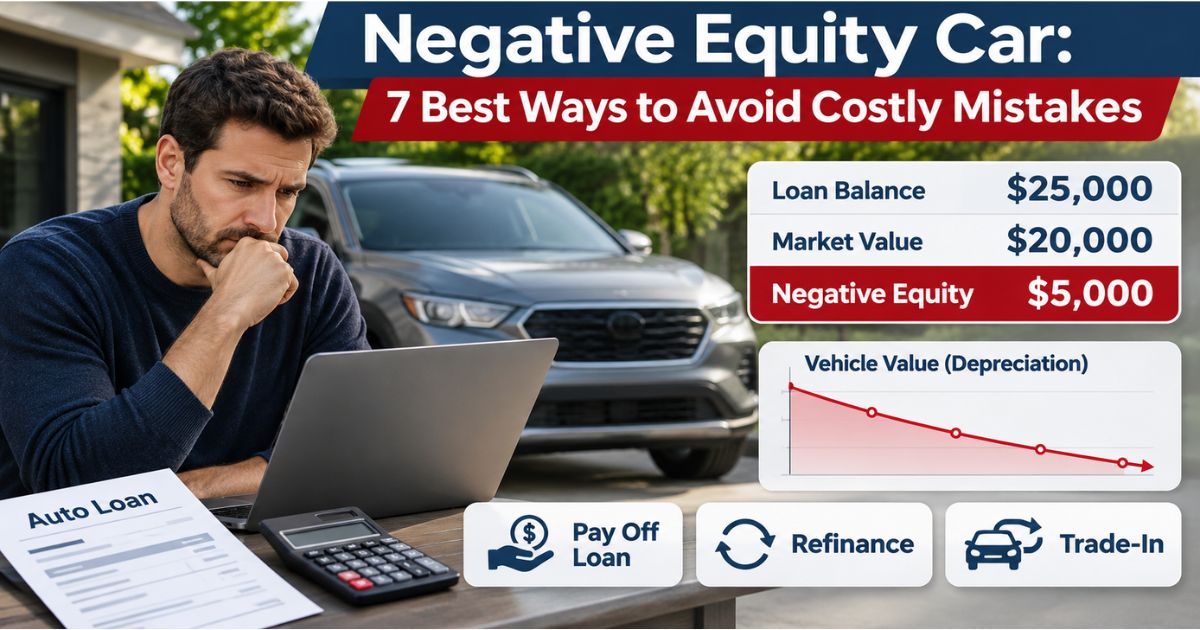
For example, if your lender’s payoff quote is $25,000 but your vehicle is worth only $20,000, you have $5,000 in negative equity. That shortfall becomes especially important when you want to sell, trade in, refinance, or replace the vehicle.
Having a negative equity car does not necessarily mean you should immediately sell it. Keeping the vehicle, making additional principal payments, or comparing refinancing options may be financially sensible depending on your circumstances.
This guide explains seven practical strategies to manage an upside-down loan, avoid rolling unnecessary debt into another vehicle, understand GAP insurance, and make better long-term borrowing decisions.
For more financial guidance, review our auto finance calculator, good car loan APR guide, and selling a financed car guide.
Key Takeaways
- Negative equity occurs when the car loan payoff exceeds the vehicle’s market value.
- Vehicle depreciation, small down payments, and long loan terms can increase the risk.
- Keeping your current vehicle may be more affordable than purchasing another car.
- Additional principal payments can help reduce the balance faster.
- Refinancing may improve some loan terms but does not automatically eliminate the equity shortfall.
- Rolling unpaid debt into another auto loan increases the amount financed.
- GAP coverage generally protects against certain total-loss shortfalls, not voluntary trade-ins.
1. What Is a Negative Equity Car?
A negative equity car is one whose market value is lower than the remaining loan payoff. In financial terms, the borrower owes more than the vehicle could reasonably bring in a sale.

Positive equity vs negative equity
Equity is calculated by subtracting your loan payoff from the vehicle’s value.
| Vehicle Value | Loan Payoff | Equity |
|---|---|---|
| $25,000 | $20,000 | +$5,000 |
| $20,000 | $20,000 | $0 |
| $18,000 | $23,000 | -$5,000 |
| $15,000 | $22,000 | -$7,000 |
In the first example, the borrower has positive equity. In the last two examples, the borrower has an upside-down auto loan.
Why does negative equity happen?
Several factors can contribute to a negative equity car situation:
- Rapid vehicle depreciation after purchase.
- A small or zero down payment.
- Long repayment terms, such as 72 or 84 months.
- Financing dealer add-ons and additional fees.
- Rolling unpaid debt from a previous vehicle into a new loan.
- High vehicle purchase prices or changing resale values.
- Vehicle damage, mileage, and maintenance conditions.
The Consumer Financial Protection Bureau’s auto loan glossary explains that longer loan terms can increase the risk of negative equity because principal repayment takes longer.
For additional context, see our 96-month auto loan guide.
Negative equity vs negative amortization
These are different financial concepts.
Negative equity means the vehicle is worth less than the amount owed.
Negative amortization occurs when unpaid interest is added to principal, causing a loan balance to grow.
A normal amortizing vehicle loan can have negative equity without experiencing negative amortization.
2. Calculate Your Negative Equity Car Balance
Before making decisions about a negative equity car, calculate the actual difference between the amount you owe and the amount your vehicle is worth.
Request your official loan payoff
Contact your auto lender and ask for a current payoff quote.
Your regular monthly statement may not show the exact amount required to close the loan because interest or other applicable charges may change through the payoff date.
Ask how long the quote remains valid.

Estimate the vehicle’s market value
Use reputable valuation resources, including:
- Kelley Blue Book.
- Edmunds.
- Written dealership trade-in offers.
- Comparable private-party vehicle listings.
- Other reputable local vehicle valuation services.
Remember that online estimates are not guaranteed purchase offers.
Calculate your equity shortfall
Use the following formula:
Negative Equity = Loan Payoff – Current Vehicle Value
For example:
| Item | Amount |
|---|---|
| Remaining Loan Payoff | $24,000 |
| Current Vehicle Value | $19,000 |
| Negative Equity | $5,000 |
The borrower would need to address the $5,000 shortfall when selling the vehicle at the estimated price and paying off the lender.
Understand loan-to-value ratio
The loan-to-value ratio, or LTV, compares your outstanding loan with the vehicle’s value.
LTV = Loan Payoff / Vehicle Value x 100
Using the previous figures:
$24,000 / $19,000 x 100 = approximately 126.3%.
An LTV ratio above 100% means the loan exceeds the vehicle’s value.
Use our auto finance calculator guide to understand how loan balances, interest rates, and repayment periods affect financing.
3. Keep Your Car and Make Extra Principal Payments
Keeping a reliable vehicle is often worth considering when managing a negative equity car.
Replacing an affordable vehicle can create additional expenses, including higher insurance, registration charges, taxes, dealer fees, and interest on a new loan.
When keeping your vehicle may make sense
Consider keeping your car when:
- The current monthly payment is affordable.
- The vehicle remains reliable.
- Repair costs are manageable.
- Your financing rate is reasonable.
- The equity shortfall is significant.
- You do not urgently need a different vehicle.
Continuing regular payments can gradually reduce the principal balance, although vehicle value may also continue declining.
Use additional principal payments
Making extra payments toward principal may reduce future interest and shorten the remaining loan term on a typical simple-interest contract.
For example, an additional $100 each month could help reduce the balance faster. The actual savings depend on the outstanding principal, interest rate, remaining term, and payment rules.
Check how extra payments are applied
Before sending additional money, ask your lender whether it will reduce principal or advance future payment due dates.
Also review whether any prepayment charge applies.
Our paying off a car loan early guide discusses important repayment considerations.
Protect your emergency savings
Do not use every available dollar to eliminate negative equity.
Maintain an emergency fund for unexpected repairs, medical expenses, insurance deductibles, and other essential costs.
Read our money management guide and financial tips for broader budgeting strategies.
4. Review Negative Equity Car Refinancing Options
Refinancing a negative equity car can be challenging because the amount owed may exceed the lender’s permitted loan-to-value ratio.
However, some borrowers may qualify for alternative financing depending on credit, income, vehicle condition, lender requirements, and the size of the shortfall.
When refinancing may help
Refinancing could be worth evaluating if:
- Your credit profile has improved.
- Your current APR is relatively high.
- You have stable income.
- You have reduced other debts.
- Competitive refinancing offers are available.
See our auto loan refinancing guide for additional information.
Refinancing does not eliminate the equity gap
Suppose your current loan payoff is $23,000 and your vehicle is worth $18,000.
Changing lenders does not automatically remove the $5,000 shortfall. The replacement loan must still address the balance required to satisfy your existing lender.
Compare complete refinancing costs
| Factor | What to Review |
|---|---|
| APR | Annual borrowing cost |
| Loan Term | Remaining number of months |
| Monthly Payment | Required monthly amount |
| Fees | Applicable refinancing costs |
| Total Interest | Expected future interest charges |
| LTV | Balance compared with vehicle value |
A lower payment may result from a longer term rather than a lower overall financing cost.
Review our affordable auto loans guide and good APR guide before comparing offers.
5. Understand the Risks of Trading In a Negative Equity Car
Trading in a negative equity car requires careful calculation.
The dealership may offer to arrange payment of your existing loan, but that does not necessarily mean the dealer absorbs your unpaid equity shortfall.
How a trade-in shortfall works
Consider this example:
| Transaction | Amount |
|---|---|
| Existing Loan Payoff | $25,000 |
| Dealer Trade-in Offer | $19,000 |
| Negative Equity | $6,000 |
| Replacement Vehicle Price | $30,000 |
| Combined Amount Before Adjustments | $36,000 |
If the $6,000 shortfall is included in the next loan, the borrower may finance $36,000 before taxes, fees, down payment, and other adjustments.
Why rolling debt increases borrowing costs
Rolling negative equity into a new loan means the old debt becomes part of your new financing.
This may increase:
- Amount financed.
- Monthly payment.
- Total interest.
- Loan-to-value ratio.
- Time needed to reach positive equity.
The Federal Trade Commission’s negative-equity trade-in guidance warns that dealers may roll old debt into a replacement loan rather than paying it themselves.
Negotiate the vehicle price separately
Determine the new vehicle’s out-the-door price before agreeing to trade-in and financing terms.
Review the buyer’s order and financing contract to identify how the existing payoff shortfall is being handled.
The CFPB’s trade-in guidance also explains why rolling unpaid debt into a new loan can make financing more expensive.
Confirm the old loan is paid off
After completing the transaction, contact your previous lender to verify that the payoff was received and the account has been satisfied.
Continue monitoring the account until the transaction is complete.
See our car financing options guide and new versus used interest rates guide.
6. Consider Selling Your Negative Equity Car Privately
A private-party sale can sometimes produce a higher selling price than a dealership trade-in.
However, selling a negative equity car privately may require additional coordination because the lender has a lien on the vehicle.
Compare private-sale and dealer offers
| Factor | Private Sale | Dealer Trade-in |
|---|---|---|
| Potential Sale Price | May be higher | Often lower |
| Convenience | More work | Usually easier |
| Timing | Variable | May be faster |
| Loan Payoff | Must coordinate | Dealer may arrange |
| Title Transfer | Seller and buyer coordinate | Dealer commonly assists |
Calculate the private-sale shortfall
Suppose your loan payoff is $22,000.
A dealer offers $17,000, while a private buyer offers $19,500.
The dealer transaction would leave a $5,000 shortfall.
The private sale would leave a $2,500 shortfall.
In this example, the private sale reduces the cash needed to satisfy the loan by $2,500.
Coordinate with your lender
Before accepting payment from a buyer, ask your lender about:
- Required payoff procedures.
- Lien release.
- Title transfer.
- Handling any unpaid shortfall.
- Acceptable payment methods.
State vehicle-title requirements differ, so follow the applicable motor vehicle agency’s procedures.
Our guide to selling a financed car covers this process.
7. Review GAP Insurance for a Negative Equity Car
GAP insurance or a GAP waiver may provide valuable protection in certain situations involving a negative equity car.
However, it should not be confused with a strategy for reducing an ordinary loan balance or covering a voluntary trade-in shortfall.

What does GAP cover?
GAP is an optional product designed to cover certain shortfalls between a qualifying vehicle insurance settlement and an outstanding auto loan after events such as theft or a total loss.
For example:
| Item | Amount |
|---|---|
| Outstanding Loan | $25,000 |
| Insurance Settlement | $20,000 |
| Potential Gap | $5,000 |
The actual payment depends on the GAP agreement, exclusions, limits, deductible provisions, and other applicable conditions.
The CFPB’s GAP insurance explanation describes the purpose and limitations of these products.
What GAP generally does not cover
GAP typically does not cover the shortfall resulting from:
- A voluntary trade-in.
- A private vehicle sale.
- Choosing a more expensive replacement vehicle.
- Refinancing without a qualifying covered loss.
Review coverage terms
Before purchasing GAP, check:
- Coverage exclusions.
- Maximum benefit limits.
- Deductible treatment.
- Eligibility requirements.
- Cancellation provisions.
- Refund eligibility.
GAP is generally optional, and financing its cost can increase total interest. Compare policies and prices before purchasing.
How Vehicle Depreciation Affects Your Loan
Vehicle depreciation is one of the main reasons borrowers develop negative equity.
A car’s value may decline because of age, mileage, market demand, condition, damage, or technological changes.
Depreciation and principal repayment
Vehicle value and loan principal do not necessarily decline at the same rate.
If your vehicle loses value faster than you repay the principal, the negative equity gap may increase.
Longer repayment periods
Long repayment terms can keep borrowers in debt for several years.
Although monthly payments may be lower, the total interest cost can be greater than with a shorter loan on otherwise identical terms.
See our average car payment 2026 guide and long-term vehicle loan guide.
What If You Cannot Afford the Payments?
A negative equity car can become particularly stressful when monthly payments no longer fit your budget.
If you expect difficulty making a payment, contact your lender promptly.
Ask about assistance
Depending on the lender and your circumstances, you may be able to discuss:
- Payment arrangements.
- Temporary hardship programs.
- Payment extensions.
- Other account-specific assistance.
These options are not guaranteed and may involve additional interest or other consequences.
Understand repossession risk
Missed payments may result in late fees, negative credit reporting, collection activity, or repossession, depending on the contract and applicable law.
Repossession does not necessarily eliminate the unpaid debt.
After the vehicle is sold, the borrower may still owe a deficiency balance if permitted by state law and the contractual terms.
Review FTC vehicle ownership guidance for additional consumer information.
How Credit Scores Affect Negative Equity Car Financing
Your credit score can influence refinancing eligibility and interest rates.
However, lenders may also consider:
- Income and employment.
- Existing financial obligations.
- Payment history.
- Loan-to-value ratio.
- Vehicle age and mileage.
- Remaining payoff amount.
Improve your borrowing position
Consistent on-time payments, responsible credit-card usage, and reducing outstanding balances may help strengthen your credit profile over time.
For additional guidance, read our how credit scores are calculated guide, credit score improvement guide, and highest credit score guide.
Negative Equity Car Action Plan
Use this checklist to decide what to do next.

Step 1: Request the payoff quote
Get the current payoff amount directly from your lender.
Step 2: Determine market value
Compare reputable vehicle valuation estimates with actual dealer or private-buyer offers.
Step 3: Calculate your equity shortfall
Subtract your vehicle’s value from the payoff balance.
Step 4: Review your budget
Determine whether keeping the vehicle is affordable.
Step 5: Compare available options
Evaluate keeping the car, additional principal payments, refinancing, private selling, and trading in.
Step 6: Review total borrowing costs
Compare APR, amount financed, term, fees, insurance expenses, and total repayment.
Step 7: Read all contracts
Confirm that every financing amount, payoff obligation, and agreed term appears correctly in the written documents.
Common Mistakes to Avoid
Borrowers dealing with a negative equity car should avoid several common problems.
Focusing only on monthly payments
A lower payment can result from extending the term while increasing total interest.
Assuming the dealership absorbs old debt
A dealer may roll the unpaid shortfall into new financing rather than eliminating it.
Ignoring optional products
Service contracts, GAP products, and other add-ons can increase the loan balance.
Relying on estimated vehicle values
Online valuations are helpful, but actual offers may be different.
Failing to confirm a payoff
After a sale or trade-in, verify that the original lender received the required payment.
Replacing a reliable car unnecessarily
Buying a different vehicle may create more debt than simply maintaining the existing one.
Related Best Finance Live Guides
- Auto Finance Calculator
- What Is a Good APR for a Car Loan?
- Average Car Payment 2026
- New vs Used Car Interest Rates
- Best Auto Finance Deals
- Affordable Auto Loans
- First-Time Auto Loan
- Subprime Auto Loans
- Refinance Auto Loan
- Car Finance Options
- 96-Month Auto Loan
- Paying Off a Car Loan Early
- How to Sell a Financed Car
- Finance Charges Explained
- How Credit Scores Are Calculated
- How Long to Raise Your Credit Score
- Master Your Money
- Driveway Finance
- Infiniti Finance
- Hyundai Finance Login
- CarMax Auto Finance
- Exeter Finance
- Capital One Auto Finance
- Fusion Auto Finance
- Ford Financing
- Nissan Auto Finance
- Charter One Auto Finance
- Big Motoring World Finance
- Top Auto Finance Options
- Complete Personal Finance Guide
Conclusion
Managing a negative equity car starts with knowing the difference between your current vehicle value and the total amount needed to satisfy your loan.
If the vehicle remains reliable and the monthly payment is affordable, keeping it while reducing the principal may be a practical choice.
Refinancing can sometimes improve financing terms, but it does not automatically eliminate the shortfall. Selling privately may increase the amount you receive, while trading in requires careful attention to how the dealer handles existing debt.
Before accepting any new financing, compare APR, term, amount financed, optional products, and total repayment. Review written lender information and applicable state requirements.
The goal is not simply to reduce the monthly payment. It is to resolve the equity gap without creating a larger long-term financial burden.