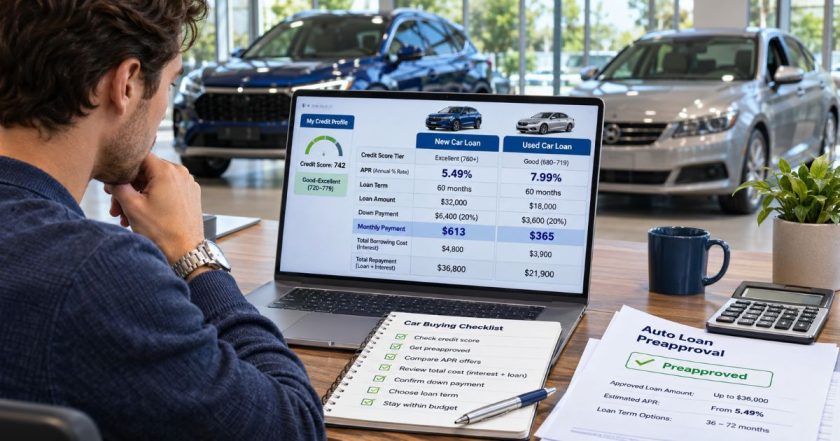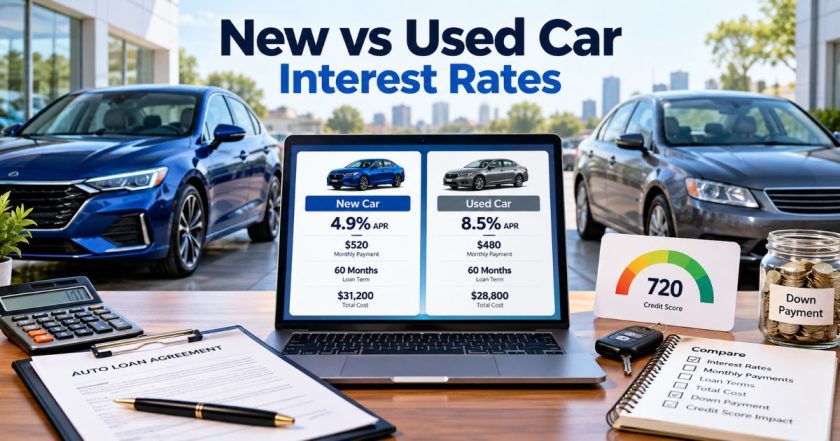
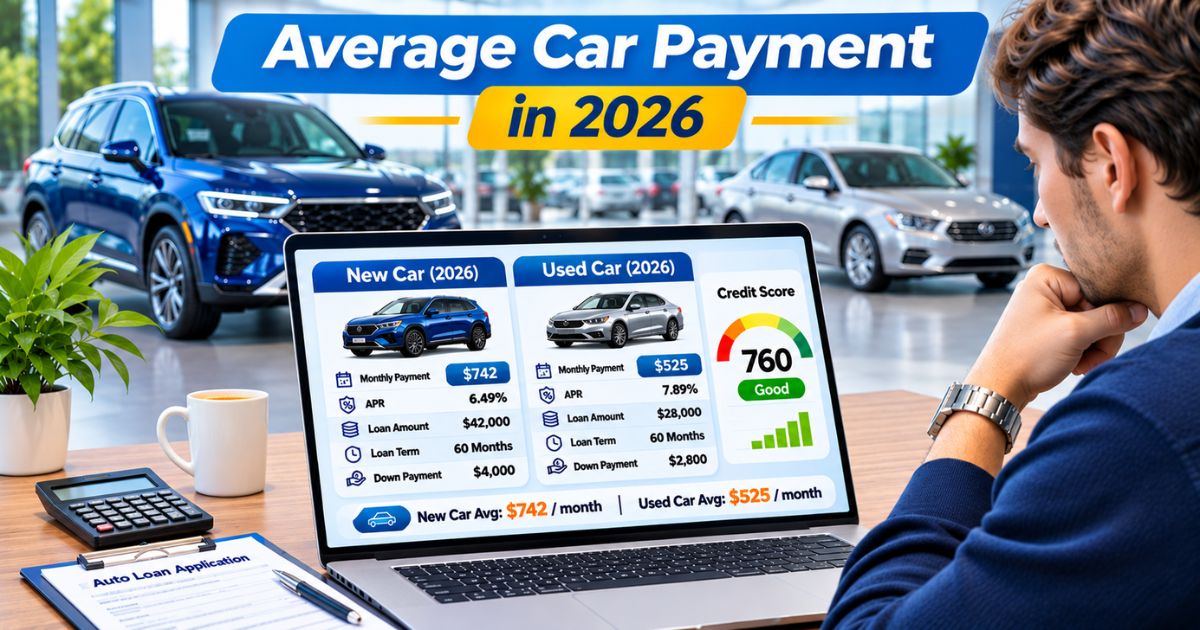
The average car payment 2026 provides a useful benchmark when planning a vehicle purchase, but it should not be treated as the payment every buyer should expect. Vehicle price, loan amount, APR, repayment term, credit history, down payment and lender policies can all change your monthly obligation.
According to Experian’s Q2 2026 automotive finance data, the average monthly payment was $765 for a new vehicle and $542 for a used vehicle. New-car buyers financed an average of $43,610, while used-car buyers financed $27,852.
Those figures help answer questions about the average car payment 2026, but your personal payment may be significantly higher or lower.
This guide explains current new-versus-used payment benchmarks, interest rates, credit-score differences, loan terms, down payments, total ownership costs and seven practical steps to evaluate an auto loan.
For related research, see our auto finance calculator, good APR for a car loan guide and new vs used car interest rates.
Key Takeaways
- Experian reported an average new-car payment of $765 in Q2 2026.
- The average used-car payment was $542.
- New vehicles carried an average loan amount of $43,610.
- Used vehicles averaged $27,852 financed.
- Average new-car interest rates were lower than used-car rates.
- Longer loan terms can reduce monthly payments while increasing total interest.
- Your own budget should matter more than a national payment average.
1. Average Car Payment 2026: Current New vs Used Benchmarks
Recent Experian data provides one of the clearest snapshots of the average car payment 2026 for U.S. consumers.
Q2 2026 auto loan averages
| Category | New Vehicle | Used Vehicle |
|---|---|---|
| Average Monthly Payment | $765 | $542 |
| Average Loan Amount | $43,610 | $27,852 |
| Average Interest Rate | 6.35% | 11.19% |
| Average Loan Term | 69.46 months | 67.86 months |
| Average Credit Score | 751 | 688 |
Source: Experian State of the Automotive Finance Market, Q2 2026. Experian uses VantageScore 4.0 for the credit-score figures.
You can review the current data on Experian’s average car payment report.
Why new-car payments are higher
Although new-car borrowers generally receive lower interest rates, they finance substantially larger amounts.
The difference between the average new- and used-vehicle loan amount in Q2 2026 was more than $15,000.
Why averages do not predict your payment
The average car payment 2026 mixes borrowers with different:
- credit profiles;
- vehicle prices;
- down payments;
- trade-in equity;
- terms;
- interest rates;
- and geographic markets.
Use averages as comparison points, not spending targets.
2. Average Car Payment 2026 by Credit Score
Credit profile can meaningfully change both your interest rate and monthly payment.
New and used payments by credit tier
| Credit Tier | Score Range | New Payment | Used Payment |
|---|---|---|---|
| Super Prime | 781–850 | $741 | $534 |
| Prime | 661–780 | $770 | $528 |
| Near Prime | 601–660 | $816 | $555 |
| Subprime | 501–600 | $805 | $567 |
| Deep Subprime | 300–500 | $779 | $570 |
These figures show why the average car payment 2026 cannot be explained by credit score alone.
For example, borrowers with weaker credit often finance less expensive vehicles, which can partially offset their much higher interest rates.
Interest rates by credit tier
| Credit Tier | New APR Average | Used APR Average |
|---|---|---|
| Super Prime | 4.41% | 6.29% |
| Prime | 6.15% | 8.81% |
| Near Prime | 9.71% | 13.93% |
| Subprime | 13.52% | 19.10% |
| Deep Subprime | 16.11% | 21.62% |
For more information about scoring, see our credit score calculation guide, credit score range guide and credit improvement guide.
3. Set a Monthly Transportation Budget Before Shopping
The average car payment 2026 is not a recommendation that you should spend $765 on a new vehicle or $542 on a used one.
Your budget should determine your maximum affordable payment.

Start with take-home income
List your reliable monthly take-home income and subtract major obligations such as:
- rent or mortgage;
- utilities;
- food;
- credit-card payments;
- student loans;
- personal loans;
- insurance;
- childcare;
- and savings.
Include the full transportation budget
Your vehicle payment is only one part of the cost.
Also budget for:
- auto insurance;
- fuel or charging;
- maintenance;
- tires;
- repairs;
- registration;
- parking;
- tolls;
- and depreciation.
A lender’s approval is not your budget
A lender determines whether a loan fits its underwriting standards.
It does not know every personal goal or expense in your household.
Being approved for a $750 monthly payment does not mean spending $750 each month is financially comfortable.
See our Master Your Money guide and financial tips guide for budgeting help.
4. Determine the Vehicle’s Out-the-Door Price
Before comparing your expected payment with the average car payment 2026, determine exactly how much vehicle you are buying.

Start with the out-the-door price
The Federal Trade Commission recommends getting the out-the-door price in writing before discussing financing.
This generally includes:
- vehicle price;
- taxes;
- title;
- registration;
- dealer fees;
- and other agreed charges.
Read the FTC’s official vehicle financing guidance.
Subtract your down payment
A larger down payment reduces your amount financed.
For example, putting $5,000 down rather than $1,000 reduces the loan principal by $4,000 before interest is calculated.
Account for trade-in equity
If your current car is worth more than its payoff balance, that positive equity can reduce the new amount financed.
Watch negative equity
If you owe more than your current vehicle is worth, the difference may be added to your next loan.
This can push your payment far above the average car payment 2026, even if the replacement vehicle itself is reasonably priced.
See our selling a financed car guide for more information.
5. Understand Optional Dealer Products
Dealer add-ons can increase both your loan balance and monthly payment.
Common add-ons
- GAP products;
- service contracts;
- extended warranties;
- tire and wheel coverage;
- credit insurance;
- theft products;
- and appearance protection.
The CFPB states that financed add-ons can become part of your monthly payment because their cost is added to the amount financed.
Ask for individual prices
Do not evaluate an add-on only by hearing that it increases your payment by “just $20 a month.”
Ask:
- What is the cash price?
- Is the product optional?
- How much interest will I pay if it is financed?
- Can it be cancelled?
- What exclusions apply?
6. Compare APR, Amount Financed and Loan Term
Your average car payment 2026 comparison becomes more meaningful when you understand how the loan itself is structured.
APR
Annual percentage rate is a standardized measure of borrowing cost that incorporates the interest rate and certain finance charges.
Amount financed
This is the amount of credit provided for the transaction after applicable calculations.
Loan term
The term determines how long you make scheduled payments.
Experian’s Q2 2026 data shows average terms of approximately 69.46 months for new cars and 67.86 months for used vehicles.
Why longer terms can be misleading
Longer financing lowers the required monthly payment by spreading repayment across more months.
However, the CFPB warns that longer terms generally increase total interest and can raise the risk of owing more than the vehicle is worth.
| Term | Monthly Payment | Total Interest | Negative Equity Risk |
|---|---|---|---|
| 36–48 Months | Higher | Lower | Generally lower |
| 60 Months | Moderate | Moderate | Moderate |
| 72+ Months | Lower | Higher | Generally higher |
See our 96-month auto loan guide and early payoff guide.
7. Get Multiple Auto Loan Offers
One of the best ways to determine whether your proposed payment compares favorably with the average car payment 2026 is to obtain several real financing quotes.
Possible financing sources
- banks;
- credit unions;
- online lenders;
- finance companies;
- manufacturer-affiliated lenders;
- and dealer-arranged financing.
Get preapproved first
The FTC recommends considering direct financing before visiting the dealership because preapproval gives you specific terms to compare with the dealer’s offer.
Compare identical scenarios
For a fair comparison, use the same:
- vehicle price;
- down payment;
- amount financed;
- term;
- and trade-in assumptions.
Compare our best auto finance deals, affordable auto loans and top auto finance options.
New Car Loan Payment in 2026
The average new-car payment is considerably higher than the overall payment on a used vehicle.
Why new vehicles cost more monthly
The primary reason is the amount financed.
Experian’s Q2 2026 average was $43,610 for new vehicles.
Lower rates do not always mean lower payments
New vehicles had an average interest rate of 6.35%, much lower than used vehicles.
Yet their larger balances resulted in an average payment of $765.
Manufacturer incentives can help
Manufacturers occasionally offer promotional APR financing or cash incentives.
Compare the full value of each offer because a low promotional rate may not always be combinable with another rebate.
See our new vs used interest-rate comparison.
Used Vehicle Financing in 2026
Used vehicles generally have lower purchase prices but higher borrowing rates.
Average used payment
Experian reported a Q2 2026 average of $542 per month.
Average used loan amount
The average financed amount was $27,852.
Average used interest rate
The Q2 2026 average was 11.19%.
This illustrates an important point: a cheaper vehicle can still have relatively expensive financing.
Vehicle age can matter
Some lenders restrict:
- vehicle age;
- mileage;
- loan term;
- or maximum loan-to-value ratio.
For higher-risk financing, read our subprime auto loan guide and in-house financing guide.
Calculate Your Personal Car Payment
Instead of trying to match the average car payment 2026, calculate your own expected payment.
Inputs you need
- out-the-door price;
- down payment;
- trade-in equity;
- negative equity;
- amount financed;
- APR;
- loan term;
- and financed add-ons.
Example comparison
| Scenario | Amount Financed | APR | Term |
|---|---|---|---|
| New Vehicle A | $40,000 | 6.0% | 60 months |
| New Vehicle B | $40,000 | 6.0% | 72 months |
| Used Vehicle A | $25,000 | 10.0% | 48 months |
| Used Vehicle B | $25,000 | 10.0% | 60 months |
Use our auto finance calculator guide to test actual monthly-payment scenarios.
Monthly Payment vs Total Cost
A monthly payment tells you what leaves your bank account each month. It does not tell you the complete cost of financing.
Compare these figures
- APR;
- finance charge;
- amount financed;
- term;
- monthly payment;
- and total of payments.
The CFPB advises borrowers to compare APR, loan length, amount financed and monthly payment rather than relying on the monthly figure alone.
Example of longer-term cost
CFPB provides an illustrative example of a $20,000 loan at 4.75%:
| Term | Monthly Payment | Total Interest |
|---|---|---|
| 36 months | $597 | $1,498 |
| 48 months | $458 | $1,999 |
| 60 months | $375 | $2,508 |
| 72 months | $320 | $3,024 |
The 72-month payment is much lower, but total interest is more than twice the 36-month example.
Total Cost of Vehicle Ownership
Even an average car payment 2026 figure does not represent the complete cost of owning a vehicle.
Insurance
Premiums vary by vehicle, driver, location, coverage limits and deductible.
Fuel or electricity
Annual mileage and efficiency can dramatically alter operating expenses.
Maintenance and repairs
Older cars may require larger repair budgets, while some newer vehicles include warranty coverage for certain repairs.
Registration and taxes
These costs can vary significantly by state and vehicle value.
Depreciation
Vehicle value can fall faster than your loan balance, particularly with a long repayment term.
| Cost | New Vehicle | Used Vehicle |
|---|---|---|
| Purchase Price | Usually higher | Usually lower |
| Average APR | Lower in Q2 2026 | Higher in Q2 2026 |
| Initial Depreciation | Generally higher | Generally lower |
| Repair Risk | Generally lower early on | Can be higher |
| Monthly Payment | Higher average | Lower average |
How a Down Payment Changes Your Payment
The average car payment 2026 does not tell you how much cash individual buyers put down.
Benefits of a larger down payment
A larger down payment can:
- reduce amount financed;
- reduce monthly payment;
- reduce interest paid;
- lower loan-to-value ratio;
- and reduce negative-equity risk.
Do not drain emergency savings
A large deposit is not beneficial if it leaves you without money for unexpected expenses.
Balance vehicle affordability with emergency savings.
Credit Score Impact on Your Car Payment
Credit history can create significant differences around the average car payment 2026.
Experian’s data shows used-car interest rates ranging from an average of 6.29% for super-prime borrowers to 21.62% for deep-subprime borrowers in Q2 2026.
Check your reports before applying
Use AnnualCreditReport.com to review your reports.
Look for inaccurate information
Check:
- unknown accounts;
- incorrect balances;
- wrong late-payment information;
- duplicate accounts;
- and identity-theft indicators.
Do not open unnecessary accounts immediately before applying
New applications can add hard inquiries and affect your overall credit profile.
Should You Delay Buying a Car?
If the available payment is well above what your budget supports, waiting can be a legitimate option.
Waiting may help you
- save a larger down payment;
- improve your credit;
- pay down other debts;
- increase emergency savings;
- or find a less expensive vehicle.
Do not chase the national average
The goal is not to force your payment to equal the average car payment 2026.
The goal is to choose a vehicle and financing structure that fit your finances.
Refinancing a Car Loan Later
If you already have an expensive loan, refinancing may become an option if circumstances improve.
Possible reasons to refinance
- credit score improves;
- income becomes more stable;
- market rates fall;
- other debts decline;
- or your original APR was unusually high.
Compare total remaining cost
Do not refinance merely because the new monthly payment is lower.
A longer new term can reduce the payment while increasing the time you remain in debt.
See our auto refinance guide.
Questions to Ask Before Signing an Auto Loan
- What is the out-the-door vehicle price?
- What is the APR?
- What is the finance charge?
- What is the amount financed?
- How much is the down payment?
- How much trade equity is being applied?
- Is negative equity being rolled into the loan?
- What is the loan term?
- What is the monthly payment?
- What is the total of payments?
- Which add-ons are included?
- Which products are optional?
- Can I repay the loan early?
- Is there a prepayment penalty?
- Who is the lender?
- Who will service the loan?
- Can I receive a copy of every signed document?
Related Best Finance Live Guides
- Auto Finance Calculator
- What Is a Good APR for a Car Loan?
- New vs Used Car Interest Rates
- Best Auto Finance Deals
- Affordable Auto Loans
- First-Time Auto Loan
- Subprime Auto Loans
- Refinance Auto Loan
- Car Finance Options
- Top Auto Finance Options
- 96-Month Auto Loan
- Paying Off a Car Loan Early
- How to Sell a Financed Car
- In-House Car Financing
- Finance Charges Explained
- How Credit Scores Are Calculated
- How Long to Raise Your Credit Score
- Highest Credit Score Guide
- Master Your Money
- Driveway Finance
- Hyundai Finance Login
- Infiniti Finance
- CarMax Auto Finance
- Exeter Finance
- Capital One Auto Finance
- Fusion Auto Finance
- Ford Financing
- Nissan Auto Finance
- Charter One Auto Finance
- Big Motoring World Finance
- Complete Personal Finance Guide
- Top Financial Tips
Conclusion
The average car payment 2026 provides a useful picture of today’s auto-finance market. Experian’s Q2 2026 data puts the average at $765 for a new vehicle and $542 for a used vehicle.
Those numbers should be used as benchmarks rather than targets. Your own payment depends on vehicle price, amount financed, credit profile, APR, down payment, trade equity, loan term and optional products.
Before buying, determine the out-the-door price, set a realistic transportation budget and obtain several financing offers. Compare APR, finance charge, amount financed, monthly payment and total payments rather than choosing a loan solely because the monthly figure looks affordable.
Finally, remember that the average car payment 2026 does not include every ownership expense. Insurance, fuel, maintenance, repairs, registration and depreciation should all fit comfortably within your household budget.