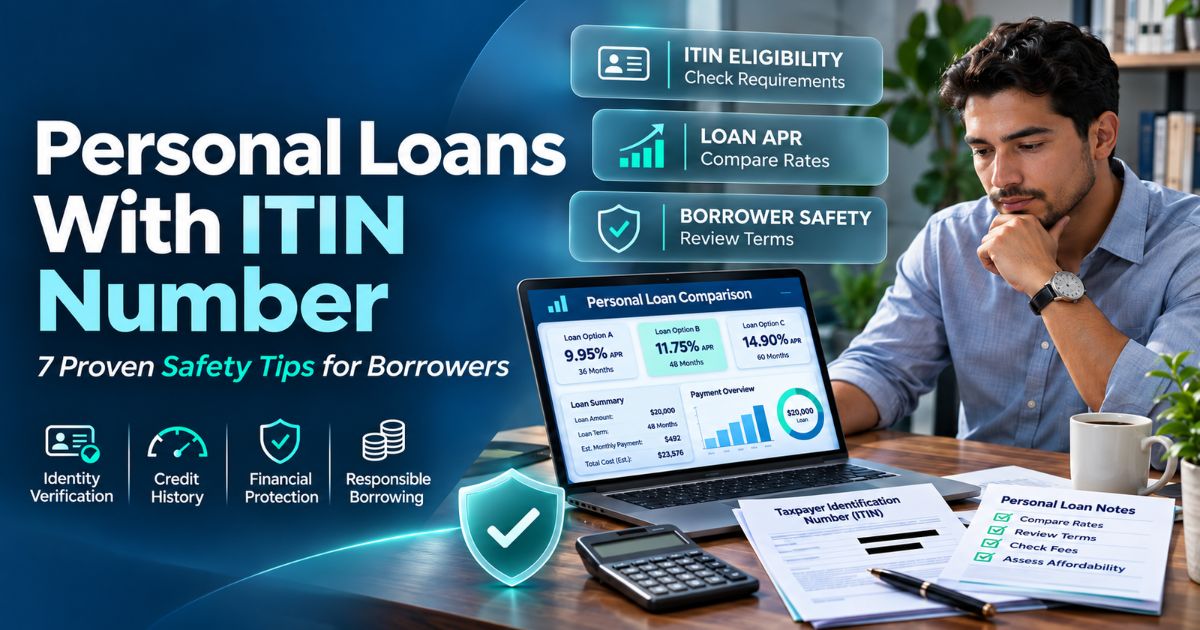
Some banks, credit unions, and community-focused lenders may consider applications from people who have an ITIN. Others require a Social Security number or impose separate residency, identification, income, and credit-history requirements.
When researching personal loans with ITIN number, the most important factors are lender eligibility, affordable repayment terms, trustworthy disclosures, and protection of sensitive personal information.
This guide covers seven practical steps for evaluating ITIN lending options, preparing documentation, reviewing credit reports, comparing interest rates, identifying suspicious lenders, and considering alternatives.
For additional borrowing guidance, review our minimum credit score for a personal loan guide and personal loan origination fee comparison.
Key Takeaways
- An ITIN is issued for federal tax purposes, not as a replacement for a Social Security number.
- Some lenders may consider ITIN holders, depending on their policies.
- Loan approval depends on creditworthiness, income, existing obligations, and other underwriting information.
- An ITIN does not provide immigration status or employment authorization.
- Some financial institutions consider alternative credit records.
- Secured financing can place pledged assets at risk.
- APR, fees, and total repayment costs deserve careful review.
- Consumers should verify lender legitimacy before sharing sensitive tax information.
1. Can You Get Personal Loans With ITIN Number?
Whether you qualify for personal loans with ITIN number depends primarily on the lender’s eligibility rules and your financial circumstances.

What is an ITIN?
An Individual Taxpayer Identification Number is a nine-digit tax processing number issued by the Internal Revenue Service to certain individuals who have a federal tax purpose but are not eligible for a Social Security number.
It allows eligible individuals to meet applicable federal tax reporting obligations.
What an ITIN does not provide
An ITIN does not:
- Establish lawful immigration status.
- Authorize employment in the United States.
- Replace a Social Security number for every purpose.
- Guarantee eligibility for financial products.
- Automatically create a credit score.
- Establish citizenship or permanent residency.
For official information, read the IRS Individual Taxpayer Identification Number guidance.
Why lenders have different requirements
Financial institutions develop underwriting standards based on their products, risk policies, applicable laws, and customer verification procedures.
One institution may accept an ITIN during a particular application process, while another may require an SSN.
Does having an ITIN guarantee approval?
No. Lenders may evaluate income, repayment history, existing debts, verified identity, and the requested amount.
An ITIN by itself does not demonstrate that the borrower can afford the loan.
Citizenship and residency considerations
Some lenders apply specific citizenship or immigration-related eligibility policies. Others may accept additional identification and residency documentation.
These policies must be evaluated in light of applicable federal and state laws.
ITIN versus SSN
| Feature | ITIN | SSN |
|---|---|---|
| Issuing Agency | IRS | Social Security Administration |
| Primary Purpose | Federal tax processing | Social Security administration and other authorized uses |
| Work Authorization | Does not authorize work | Depends on immigration and employment authorization status |
| Loan Eligibility | Depends on lender acceptance | Still subject to underwriting |
| Credit Approval | Not guaranteed | Not guaranteed |
Understanding these distinctions helps applicants evaluate personal loans with ITIN number without relying on misleading approval promises.
Our 650 credit score personal loan guide explains how credit profiles influence borrowing decisions.
2. Check ITIN Loan Eligibility Before Applying
The next step is evaluating whether you meet the lender’s stated requirements before providing sensitive financial information.

Check your ITIN information
Verify that your taxpayer identification records are accurate and review whether your ITIN is valid for an applicable federal tax filing purpose.
Under IRS rules, an ITIN generally expires after three consecutive tax years without being included on a qualifying federal income tax return.
Renewal is necessary when an expired ITIN must be used for federal tax filing. Whether a lender accepts particular tax documentation is a separate question.
Review lender eligibility rules
Look for written information about:
- Accepted taxpayer identification numbers.
- Identity verification requirements.
- Residency restrictions.
- Minimum qualifying income.
- Credit history requirements.
- Available loan amounts.
- Permitted loan purposes.
Check your credit reports
Some individuals without Social Security numbers may have credit information associated with their identity.
However, possessing an ITIN does not automatically create a traditional credit file.
Credit reporting companies may use several identity-matching factors, and report availability can vary.
Review alternative credit information
Some lenders may consider additional financial records when traditional credit information is limited.
Examples include qualifying rent payment records, utility bills, banking history, and other documented obligations.
Alternative data acceptance is not universal and should be confirmed with each lender.
Understand credit score requirements
There is no universal minimum credit score for every personal installment loan.
Applicants with limited histories may face fewer options, additional verification requirements, or higher financing costs.
Read our credit improvement timeline and credit prequalification guide.
Calculate your debt-to-income ratio
Debt-to-income ratio compares qualifying monthly debt payments with gross monthly income.
DTI = Monthly Debt Payments / Gross Monthly Income × 100
If your monthly qualifying debt payments equal $800 and gross monthly income equals $4,000, your DTI is 20%.
Lenders may use different calculations and acceptable limits.
Understand loan affordability
Being eligible for financing does not necessarily mean the loan is suitable for your household budget.
Before pursuing personal loans with ITIN number, evaluate housing costs, essential expenses, existing debt, and emergency savings.
Our personal finance planning guide explains related budgeting principles.
3. Prepare Documents for an ITIN Loan Application
Documentation requirements vary according to the lender, applicant, and type of financing.

Tax-related documentation
A lender may request tax returns or applicable taxpayer identification records as part of its financial review.
The IRS CP565 notice communicates an ITIN assignment, but an ITIN assignment notice does not independently establish identity for every non-tax purpose.
Government-issued identification
Depending on lender policy, accepted identification may include a passport or other qualifying government-issued documents.
Confirm acceptable documents before submitting an application.
Income documentation
Some lenders request recent pay statements, tax returns, banking records, or other evidence of income.
Requirements differ for salaried, hourly, self-employed, and variable-income applicants.
Self-employment records
Self-employed applicants may need additional documentation, such as filed tax returns, bank statements, and profit-and-loss records.
Accurately reporting income is essential. Borrowers should never provide falsified employment or earnings information.
Proof of address
Depending on lender rules, a lease, utility statement, or another qualifying document may help establish a current residential address.
Existing financial obligations
Applicants may need to disclose current loans, housing payments, and other financial obligations.
These details help lenders evaluate repayment capacity.
Document preparation checklist
| Document | Potential Purpose |
|---|---|
| Passport or Accepted ID | Identity verification |
| ITIN Tax Records | Taxpayer information where requested |
| Tax Returns | Financial history |
| Pay Statements | Income verification |
| Bank Statements | Financial activity review |
| Residential Records | Address verification |
| Existing Debt Statements | Repayment capacity |
When preparing for personal loans with ITIN number, ask the lender which documents are specifically required rather than sending unnecessary sensitive information.
For related lending considerations, review our personal loan income verification guide and international borrower financing guide.
4. Compare Lenders That May Consider ITIN Borrowers
Not every bank or online lending platform offers financing to applicants without Social Security numbers.

Credit unions
Some credit unions consider applicants using alternative identification information, subject to membership and underwriting rules.
Membership eligibility may depend on residence, employment, community affiliation, or other conditions.
Community banks
Community banks sometimes offer relationship-based lending products and local financial services.
However, ITIN acceptance should never be assumed merely because a bank serves a diverse community.
Community development financial institutions
Certain CDFIs focus on expanding financial access in underserved communities.
Programs, geographic restrictions, qualification standards, and available financing vary considerably.
Online personal loan lenders
Some online lenders may accept ITIN-based applications. Others explicitly require Social Security numbers.
Check the provider’s official eligibility information before entering taxpayer identification data.
Secured personal loans
Some lenders offer loans secured by savings or other eligible collateral.
Collateral may influence credit availability, but default can result in the loss of pledged assets.
Employer or community assistance
Certain employers and community organizations offer emergency assistance or small-dollar financial support.
These arrangements may have eligibility conditions and should be compared with ordinary borrowing.
Comparing lender categories
| Lender Type | Potential Benefit | Important Consideration |
|---|---|---|
| Credit Union | Member-based lending | Membership and identification rules |
| Community Bank | Local financial relationships | Product availability varies |
| CDFI | Community-focused services | Geographic and program eligibility |
| Online Lender | Digital applications | Verify ITIN acceptance and lender identity |
| Secured Lender | Collateral-supported financing | Possible asset loss |
When evaluating personal loans with ITIN number, obtain written product details rather than relying on generic lender recommendations.
For related comparisons, read our no-origination-fee loan guide, personal loan requirements guide, and bad-credit debt consolidation guide.
5. Compare APR, Fees, and Total Repayment Costs
Understanding borrowing costs is essential before accepting a loan.
Annual percentage rate
APR reflects the annualized cost of borrowing, incorporating interest and certain applicable finance charges.
It is usually more informative than comparing advertised interest rates alone.
Origination fees
Some lenders charge an origination fee to establish the loan.
If a $5,000 loan has a 5% fee deducted from the proceeds, the borrower may receive $4,750 while remaining responsible for the contractual principal and interest.
Other potential charges
- Late payment fees.
- Returned-payment charges.
- Permitted application or processing charges.
- Applicable prepayment charges.
- Optional credit-related products.
Monthly payment example
Consider a hypothetical $5,000 fixed-rate personal loan repaid over 24 months, with monthly amortization and no additional fees.
| Annual Interest Rate | Approximate Monthly Payment |
|---|---|
| 10% | $230.72 |
| 15% | $242.43 |
| 25% | $266.86 |
These figures are rounded illustrative calculations, not current lender offers.
Fixed versus variable interest
Fixed-rate loans generally provide predictable scheduled payments under the agreed terms.
Variable-rate products may change according to contractual conditions, potentially affecting repayment costs.
Longer loan terms
A longer repayment period often reduces the required monthly installment but can increase cumulative interest.
Compare total scheduled payments instead of relying only on monthly affordability.
Protect your emergency budget
Even an affordable installment should leave room for essential bills and unexpected expenses.
Borrowing to cover routine household shortages can create financial stress when the underlying budget problem remains unresolved.
Our loan finance charges guide, credit card debt loan comparison, and personal loan interest tax guide provide additional cost-related information.
When considering personal loans with ITIN number, ensure the written agreement clearly identifies the amount financed, APR, payment schedule, fees, and total repayment.
6. Apply Safely and Protect Personal Information
Protecting sensitive information is particularly important when an application requests taxpayer identification records.
Use verified lender channels
Access the lender’s official website or verified application system.
A secure connection is helpful but does not independently establish that the business is legitimate.
Check lender registration
Review applicable state licensing information, company identity, physical contact details, and other available regulatory information.
Registration requirements vary by institution and jurisdiction.
Avoid guaranteed approval promises
Be cautious of advertisements claiming that every applicant will receive financing regardless of income, repayment ability, or credit history.
Beware of suspicious advance payments
Requests for unexplained payments to unlock guaranteed financing are warning signs.
Some legitimate loans involve disclosed fees, but paying an advance charge does not guarantee loan approval.
Confirm the credit inquiry
Some lenders offer preliminary eligibility checks through soft inquiries, which do not affect credit scores.
Formal applications may involve hard inquiries. Ask the lender about its procedures.
Review consumer rights
Federal fair-lending rules prohibit certain types of credit discrimination, including discrimination based on national origin.
Lenders may consider immigration and residency information under applicable rules, but that does not authorize unlawful discrimination.
The Consumer Financial Protection Bureau’s fair-lending guidance explains relevant protections and complaint options.
Keep application records
Retain signed contracts, disclosures, payment confirmations, and important communications.
Never submit false information or documents to meet lender requirements.
Safe applications for personal loans with ITIN number should use legitimate financial institutions and transparent written agreements.
See our soft versus hard credit inquiry guide, loan fee comparison guide, and credit history improvement guide.
7. Understand Loan Risks and Alternatives
Obtaining a loan should not be the only strategy considered when facing a financial shortfall.
High-interest borrowing
Some products marketed to applicants with limited credit histories involve expensive financing.
High APRs can make repayment difficult even when the initial principal is relatively small.
Secured loan risks
Using savings or another asset as collateral can expose the borrower to property loss after default.
Never assume secured financing is automatically safer because approval may be easier.
Late payments and credit consequences
Missed installments can result in fees, collection activity, and negative credit reporting where the lender reports to credit bureaus.
Credit-builder loans
Some institutions offer credit-builder products that hold loan funds while the borrower makes scheduled payments.
These products may help establish payment history when the institution reports the account, but they can involve fees and interest.
Secured credit cards
A secured card generally requires an eligible security deposit.
Responsible use may help establish credit when account activity is reported to the relevant bureaus.
Payment arrangements
For medical bills, utilities, or existing debts, ask the creditor whether a direct payment arrangement is available.
This may avoid taking on a new high-cost loan.
Nonprofit assistance
Local nonprofit organizations may provide financial counseling or certain forms of emergency assistance.
Eligibility, funding availability, and geographic restrictions vary.
Waiting or borrowing less
For nonessential expenses, saving before purchasing may reduce interest costs.
A smaller loan can also reduce monthly payments and total borrowing obligations.
Before accepting personal loans with ITIN number, compare these alternatives with the proposed loan’s cost and risks.
For related planning, explore our money management guide, debt management alternatives, and financial planning strategies.
Personal Loans With ITIN Number: Application Checklist
Use this checklist when preparing for personal loans with ITIN number and comparing legitimate borrowing opportunities.
- Confirm that the lender accepts ITIN-based applications.
- Check current residency and identity requirements.
- Review your financial records.
- Gather acceptable identification documents.
- Prepare accurate income information.
- Calculate existing debt obligations.
- Determine an affordable loan amount.
- Confirm the type of credit inquiry.
- Compare APR and origination fees.
- Review the total repayment amount.
- Verify applicable lender registration.
- Check secured collateral requirements.
- Understand late-payment consequences.
- Evaluate alternative financial assistance.
- Keep copies of final loan disclosures.
Related Best Finance Live Guides
- Minimum Credit Score for a Personal Loan
- Personal Loan With a 650 Credit Score
- Personal Loans for Credit Card Debt
Conclusion
Personal loans with ITIN number may be available through certain financial institutions, but eligibility is not automatic.
An ITIN is a federal tax processing number. It does not establish immigration status, provide employment authorization, or independently demonstrate creditworthiness.
Before applying, confirm that the lender accepts your documentation, review income and credit requirements, and calculate whether the proposed installment is affordable.
Compare APR, origination fees, repayment terms, and total borrowing costs rather than focusing solely on advertised approval opportunities.
Credit unions, community lenders, secured borrowing products, and nonprofit assistance may provide alternatives depending on eligibility and local availability.
Ultimately, choosing personal loans with ITIN number responsibly requires careful lender verification, accurate documentation, realistic budgeting, and a clear understanding of repayment risks.