Choosing debt consolidation with bad credit requires careful attention to interest rates, eligibility, monthly affordability, origination fees, and repayment terms. A loan that makes your monthly payment smaller may still cost more over time if it extends the repayment period.
This guide explains seven practical steps for evaluating debt consolidation options, understanding the risks, avoiding scams, and choosing a responsible repayment strategy.
Before considering another loan, review our money management guide and personal finance planning guide.
Key Takeaways
- Debt consolidation can combine several payments but does not automatically eliminate principal.
- Bad credit can make qualifying for competitive borrowing rates more difficult.
- Personal consolidation loans may include origination fees and other charges.
- Nonprofit credit counseling may be useful before applying for new credit.
- Debt management plans differ from debt settlement services.
- Secured loans can put your home, vehicle, or savings at risk.
- Compare total repayment costs rather than monthly payments alone.
- Be cautious of guaranteed-approval promises and companies that pressure you to stop paying creditors.
1. Can Debt Consolidation With Bad Credit Work?
Debt consolidation with bad credit may be possible when a lender determines that your income, existing obligations, credit history, and requested loan amount satisfy its underwriting requirements.

How consolidation works
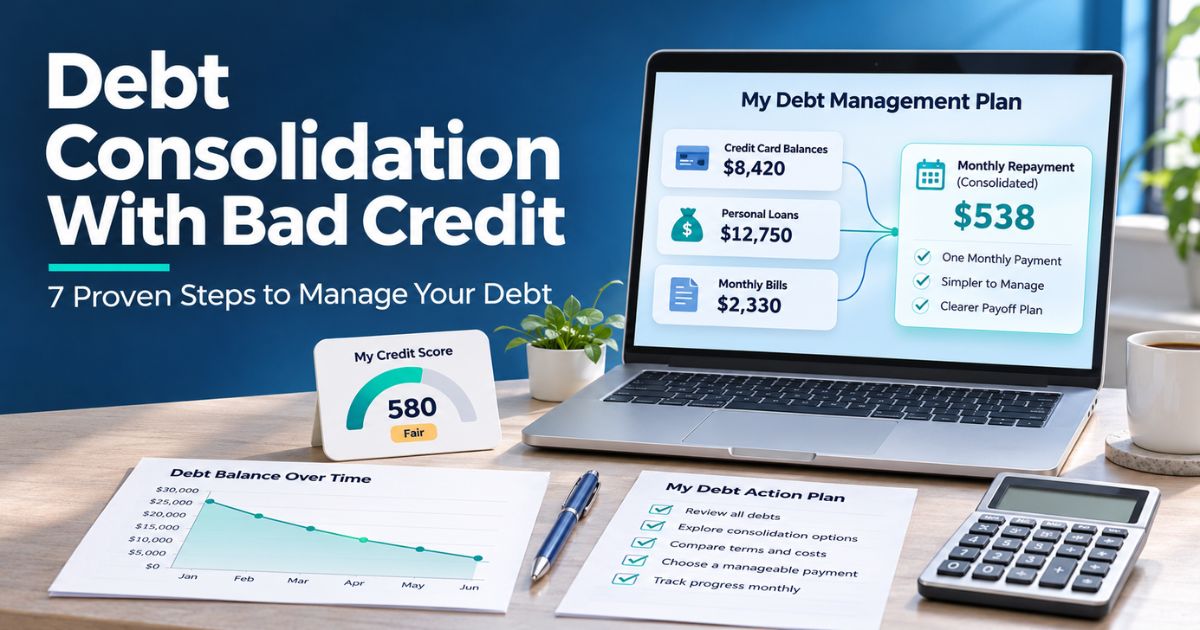
Traditional loan consolidation replaces several existing balances with a new loan. The borrower uses the proceeds to repay eligible debts and then makes payments on the replacement loan.
For example, suppose you have three unsecured debts:
| Debt | Outstanding Balance |
|---|---|
| Credit Card A | $3,000 |
| Credit Card B | $2,000 |
| Personal Loan | $5,000 |
| Total Debt | $10,000 |
A new $10,000 loan could pay off these balances, assuming the full amount is available for repayment and no additional funds are needed for fees or payoff adjustments.
You would then repay the new lender according to its contract.
Does consolidation erase debt?
No. The principal generally remains owed unless it is repaid or otherwise legally reduced.
Consolidating existing obligations changes the repayment structure, not the fundamental requirement to repay borrowed money.
Why bad credit affects loan terms
Lenders use credit information to evaluate repayment risk. A history of late payments, collections, high revolving balances, or defaults may affect available APRs and approval decisions.
Some lenders accept applicants with fair or poor credit, but approval is not guaranteed.
When consolidation may help
This approach can be useful if it provides a manageable scheduled payment, reasonable fees, and a lower total cost than continuing with existing obligations.
When consolidation may be unsuitable
A replacement loan may be financially harmful if it has a higher APR, excessive charges, unaffordable payments, or a lengthy repayment term that greatly increases total interest.
Before pursuing debt consolidation with bad credit, examine whether the new arrangement offers a genuine improvement.
For further reading, see our personal loans without origination fees and 650 credit score personal loan guide.
2. Compare Your Main Debt Consolidation Options
There is more than one approach to debt consolidation with bad credit. The appropriate choice depends on the type of debts involved, your creditworthiness, monthly budget, and available financial resources.

Unsecured personal consolidation loans
These loans do not require specific collateral. Instead, lenders assess factors such as income, credit history, and outstanding debt.
Fixed-rate installment loans generally have scheduled payments over an agreed period, making repayment planning easier.
However, lower credit scores may result in less competitive APRs.
Debt management plans
A debt management plan, or DMP, is typically organized through a credit counseling agency.
Rather than borrowing new money, the consumer makes a scheduled payment to the agency, which distributes funds to participating creditors.
Creditors may agree to reduce interest charges or certain fees, although specific concessions are not guaranteed.
Balance transfer credit cards
Some credit cards offer promotional APR periods on eligible transferred balances.
These arrangements can be useful when a borrower qualifies and can repay the balance during the promotional period.
But balance transfer fees, credit limits, and post-promotional APRs need careful review.
Secured personal loans
A secured loan requires collateral, such as qualifying savings or a vehicle.
Collateral may affect lender pricing, but default can put the pledged asset at risk.
Replacing unsecured credit card debt with debt secured by your home or vehicle is a significant decision.
Creditor hardship programs
Some creditors offer temporary payment arrangements, reduced rates, or modified due dates to borrowers experiencing financial hardship.
You may be able to negotiate directly without taking out another loan.
Debt settlement is different
Debt settlement involves negotiating to repay less than the balance owed. It is not the same as consolidation or a standard debt management plan.
Settlement may involve serious consequences, including additional fees, collection activity, lawsuits, credit damage, and potential tax issues.
Compare available options
| Option | Potential Benefit | Main Risk |
|---|---|---|
| Personal Loan | Single scheduled payment | High APR and fees |
| Debt Management Plan | Structured creditor repayment | Fees and account restrictions |
| Balance Transfer | Promotional interest savings | Fees and later APR increases |
| Secured Loan | Possible financing access | Loss of collateral |
| Creditor Hardship Plan | Potential payment relief | Depends on creditor agreement |
For debt consolidation with bad credit, the lowest advertised rate is not necessarily the best overall solution.
3. Calculate Your Debts and Debt-to-Income Ratio
Before applying for new financing, prepare a complete list of your financial obligations.
Understanding existing debts helps you determine whether consolidation is necessary and whether a replacement payment is affordable.

List every outstanding debt
For each account, record the balance, interest rate, minimum payment, and due date.
Include credit cards, personal loans, store cards, and other relevant obligations.
Example of a debt inventory
| Account | Balance | APR | Monthly Payment |
|---|---|---|---|
| Credit Card A | $2,500 | 24.99% | $75 |
| Personal Loan | $5,000 | 18.00% | $150 |
| Store Card | $1,200 | 29.99% | $40 |
These figures are hypothetical. Actual minimum payments and terms vary by creditor.
Calculate debt-to-income ratio
Debt-to-income ratio, or DTI, compares monthly debt obligations with gross monthly income.
DTI = Monthly Debt Payments / Gross Monthly Income × 100
Suppose you have $1,500 in qualifying monthly debt payments and $5,000 in gross monthly income.
Your DTI would be 30%.
Why DTI matters
Lenders may use DTI to evaluate the ability to repay additional obligations.
However, specific maximum ratios and underwriting standards vary by product and lender.
Separate secured and unsecured debts
Credit cards and many personal loans are unsecured.
Mortgages and most conventional auto loans are secured by assets that may be subject to foreclosure or repossession if borrowers default.
Mixing these debts into one arrangement can change the risks you face.
Check debts requiring separate treatment
Federal student loans, taxes, secured debts, and some medical obligations may have repayment or assistance options different from ordinary consumer credit.
In particular, refinancing federal student debt into a private loan can eliminate valuable federal protections.
Before choosing debt consolidation with bad credit, determine which debts should realistically be included.
4. Review Credit Scores and Loan Eligibility
Credit scores are important, but they are not the only factors considered during consolidation loan underwriting.
Income, payment history, existing debt, requested amount, and repayment capacity can influence eligibility.

Check your credit reports
Review information reported by Equifax, Experian, and TransUnion.
Look for inaccurate balances, unfamiliar accounts, payment history errors, and other incorrect information.
Genuine errors can be disputed through the appropriate credit-reporting procedures.
Understand credit score requirements
No single minimum credit score applies to all consolidation loans.
Some lenders consider applicants with lower scores, while others require stronger credit profiles.
Higher-risk borrowers may receive higher APRs, smaller approved amounts, or additional conditions.
Use soft-inquiry prequalification when offered
Some lenders offer preliminary rate estimates using a soft credit inquiry.
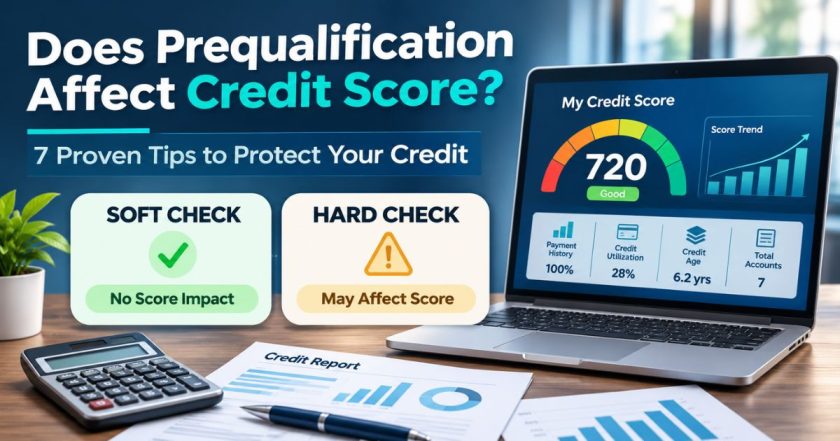
Soft inquiries do not lower credit scores, but formal loan applications may involve hard credit inquiries.
Always verify the inquiry type before submitting an application.
Prepare proof of income
Depending on the lender, you may need pay statements, tax documents, bank records, or evidence of qualifying alternative income.
Keep your request realistic
Applying for more than you can afford may result in rejection or repayment difficulties.
A consolidation loan should support a sustainable repayment plan rather than create another unmanageable obligation.
For more information about debt consolidation with bad credit, see our credit score calculation guide, credit improvement guide, and credit score ranges explainer.
5. Compare Consolidation Loan APRs and Total Costs
When evaluating a consolidation loan, do not focus only on the advertised interest rate.
The annual percentage rate, or APR, generally reflects the interest rate plus certain required financing charges.
Check origination fees
Some lenders deduct an origination fee before releasing the loan proceeds.
For example, a $10,000 loan with a 5% origination fee deducted upfront provides $9,500 in proceeds, while the borrower may still owe the full principal under the contract.
Compare repayment terms
Longer repayment terms generally reduce the scheduled monthly payment at the same interest rate but increase total interest.
Example: $10,000 consolidation loan
The following estimates assume a fixed annual interest rate of 12%, monthly amortizing payments, and no additional fees.
| Term | Approx. Monthly Payment | Approx. Total Interest |
|---|---|---|
| 24 Months | $470.73 | $1,297.63 |
| 36 Months | $332.14 | $1,957.15 |
| 48 Months | $263.34 | $2,640.24 |
These are hypothetical educational calculations. Actual lender offers, APR disclosures, and payment schedules may differ.
Why a longer loan may be expensive
The 48-month loan provides a smaller monthly payment than the 24-month option.
However, it also results in substantially more total interest.
Whether debt consolidation with bad credit helps depends partly on how the replacement terms compare with your existing debts.
Check fixed versus variable rates
A fixed interest rate generally remains unchanged during the agreed fixed-rate term.
A variable rate may change according to contractual conditions, potentially affecting future payments.
Review prepayment and late-payment terms
Understand whether the lender charges fees for missed payments or early repayment.
Compare the amount financed, amount disbursed, monthly payment, term, and total payments before signing.
Read our finance charge guide and no-origination-fee loan comparison.
6. Consider Nonprofit Credit Counseling
For some borrowers, professional credit counseling may be more appropriate than applying for another loan.
Nonprofit counselors can review household income, expenses, debts, and available repayment options.
What credit counselors do
A qualified counselor may assist with:
- Household budgeting.
- Debt assessment.
- Credit report education.
- Repayment planning.
- Creditor communication.
- Debt management plan evaluation.
How a debt management plan works
Under an accepted plan, the consumer typically makes one scheduled payment to the counseling organization.
The organization distributes payments to participating creditors.
Some creditors may agree to reduced rates, waived fees, or different repayment arrangements.
Does a DMP require new borrowing?
Usually no. A debt management plan generally organizes repayment of existing debts without issuing a new consolidation loan.
Does a DMP reduce principal?
A debt management plan generally aims to repay the debt according to negotiated terms rather than forgive the principal.
That makes it different from debt settlement.
Are counseling agencies always free?
No. Many offer free or low-cost initial counseling, but some services involve setup or monthly fees.
Ask about charges before enrolling.
How to choose an agency
Verify its qualifications, services, written terms, fees, and complaint history.
Ask whether creditors must approve the proposed arrangement and whether existing credit cards may be closed.
The Consumer Financial Protection Bureau explains the differences between credit counseling, consolidation loans, debt management plans, and debt settlement.
If debt consolidation with bad credit would involve an expensive loan, a nonprofit budget review may be a useful alternative.
7. Understand Balance Transfers and Secured Loan Risks
Balance transfer credit cards and secured loans provide additional options, but both require caution.
Balance transfer cards
A balance transfer allows a borrower to move eligible debt from one account to another.
Some offers include a temporary promotional APR, potentially reducing interest during that period.
Why eligibility matters
Applicants with damaged credit may find it difficult to qualify for favorable introductory offers or sufficiently high credit limits.
Review transfer fees
Balance transfers may involve a fee calculated as a percentage of the transferred balance.
That charge should be included when comparing costs.
Calculate a promotional payoff plan
Suppose you transfer $6,000 and pay a 3% fee.
The resulting balance would be $6,180, assuming the fee is added to the account.
To repay that balance over 18 months at a 0% promotional APR, you would need to pay approximately $343.34 monthly, assuming no additional purchases or fees.
What happens when the promotion ends?
Any remaining balance may accrue interest at the applicable standard APR after the introductory period.
Read the card agreement carefully, including rules concerning new purchases and grace periods.
Secured personal loans
Some borrowers consider pledging savings, a vehicle, or other eligible collateral to obtain a secured loan.
While this may influence approval and rates, default can result in the loss of pledged property.
Home equity borrowing
Using home equity to repay unsecured debt can expose your home to foreclosure risk if the new secured debt is not repaid.
That risk deserves serious consideration before converting unsecured obligations into home-secured borrowing.
Debt consolidation with bad credit should not solve one repayment problem by creating a greater threat to essential assets.
Warning Signs of Debt Consolidation Scams
Borrowers experiencing financial difficulties can be vulnerable to misleading debt relief offers.
Be cautious when companies promise immediate debt elimination or guaranteed loan approval.
Common warning signs
- Guaranteed approval regardless of creditworthiness.
- Promises to erase all debts immediately.
- Pressure to stop contacting creditors.
- Demands for suspicious upfront payments.
- Refusal to provide written terms.
- Unverified business addresses.
- Requests for banking passwords.
- Claims that all debts can be settled for a guaranteed percentage.
Debt settlement risks
Settlement companies may suggest stopping payments while funds accumulate for possible negotiations.
During that period, creditors may assess additional charges, report missed payments, pursue collections, or file lawsuits.
Verify company information
Check business identification, applicable state licensing requirements, contact details, and written disclosures.
A nonprofit designation alone does not guarantee that an organization is reputable or inexpensive.
Understand fees and legal protections
Certain debt relief services sold through telemarketing are subject to restrictions on collecting fees before specified settlement requirements are met.
Not every type of legitimate counseling or lending fee is prohibited, so evaluate the specific service and applicable rules.
Use official consumer guidance
The Federal Trade Commission’s debt relief guidance explains how consumers can evaluate credit counseling, debt management, and debt relief offers.
Before choosing debt consolidation with bad credit, make sure the company is providing the service it actually advertises.
How Consolidation May Affect Your Credit Score
A consolidation loan can influence a credit profile in several ways.
Hard credit inquiries
A formal application may result in a hard inquiry, which can temporarily affect credit scores.
Opening a new account
The new loan may change the age and mix of credit accounts.
Credit utilization
Repaying revolving balances can lower credit utilization, but the effect depends on the overall credit report.
Closing credit cards
Closing accounts may reduce available revolving credit and potentially increase utilization.
However, closed accounts in good standing can remain on credit reports for years and may continue contributing to account-age measures while reported.
Payment history
Making required payments on time can support responsible credit management.
Missed payments can cause further damage regardless of whether the debt has been consolidated.
Long-term financial habits
For debt consolidation with bad credit to support lasting improvement, borrowers should avoid accumulating new balances after paying off old accounts.
Review our credit score improvement guide, credit score information, and credit card debt guide.
Alternatives When Consolidation Is Too Expensive
If available loan offers have high APRs or unaffordable payments, new borrowing may not be the best answer.
Contact existing creditors
Ask whether your creditors offer hardship programs, temporary interest reductions, adjusted payment arrangements, or alternative due dates.
Use a nonprofit budget review
A counselor can help you evaluate your income, expenses, and potential repayment strategies without necessarily enrolling you in a formal debt management plan.
Consider the debt avalanche method
With this approach, you generally make required payments on all accounts while directing additional available money toward the debt with the highest interest rate.
After paying off that debt, you redirect the extra payment toward the next-highest rate.
Consider the debt snowball method
This approach prioritizes the smallest balances first while maintaining required payments elsewhere.
Some borrowers find this motivational, although it may cost more interest than prioritizing the highest APR.
Understand bankruptcy as a separate legal option
If repayment is genuinely unaffordable, speak with a qualified bankruptcy attorney about possible legal options and consequences.
Bankruptcy is not simply another consolidation product, and its effects depend on the type of case and the borrower’s circumstances.
Prioritize essential obligations
Protect housing, utilities, food, necessary transportation, and other essential needs while evaluating legal obligations and the consequences of missed payments.
Consider individualized professional advice when you face collection lawsuits, foreclosure, repossession, or other urgent legal issues.
Sometimes debt consolidation with bad credit is less effective than negotiating directly with creditors and developing a sustainable repayment plan.
Seven Proven Steps for a Safer Consolidation Decision
Step 1: List every debt
Record balances, APRs, minimum payments, and due dates.
Step 2: Prepare a household budget
Calculate income, essential expenses, and the amount realistically available for repayment.
Step 3: Review credit reports
Check account accuracy and correct genuine reporting errors.
Step 4: Compare available solutions
Review consolidation loans, nonprofit counseling, creditor hardship arrangements, and other suitable alternatives.
Step 5: Calculate total repayment
Compare APR, fees, repayment periods, monthly payments, and overall costs.
Step 6: Verify the provider
Confirm the company’s identity and carefully read written terms before authorizing payments or sharing sensitive information.
Step 7: Maintain a long-term repayment plan
Track due dates, reduce unnecessary spending, and monitor account balances.
These steps can help make debt consolidation with bad credit a considered financial decision rather than a rushed response to collection pressure.
Final Debt Consolidation Checklist
- List total outstanding debt.
- Check existing interest rates.
- Calculate current monthly payments.
- Review your credit reports.
- Determine monthly repayment capacity.
- Compare more than one written offer.
- Check origination fees.
- Compare total interest.
- Confirm whether collateral is required.
- Review loan terms and early repayment rules.
- Verify counseling agency credentials.
- Understand creditor participation requirements.
- Avoid guaranteed debt-relief promises.
- Keep existing payments current while payoff arrangements are pending.
- Confirm old balances have actually been paid.
- Maintain a sustainable spending plan.
Related Best Finance Live Guides
These articles cover credit history, borrowing costs, financial planning, and related financing decisions.
- Personal Loans Without Origination Fees
- 650 Credit Score Personal Loans
- How Long to Raise a Credit Score
- How Credit Scores Are Calculated
- Highest Credit Score
- Finance Charges Explained
- Average Credit Card Debt in 2026
- Complete Personal Finance Guide
- Master Your Money
- Top Financial Tips
- First-Time Business Loans
- Good APR for a Car Loan
- Auto Finance Calculator
- Negative Equity Car Loans
- Auto Loan Refinancing
Conclusion
Debt consolidation with bad credit may simplify repayment, but it is not a guaranteed solution to financial difficulties.
Borrowers should compare the full cost of a replacement loan with the cost of maintaining existing accounts. Interest rates, origination fees, repayment length, and monthly affordability can determine whether consolidation is financially helpful.
Nonprofit credit counseling and creditor hardship arrangements may provide alternatives without requiring another expensive loan.
Secured borrowing deserves particular caution because missed payments may put important assets at risk. Debt settlement also carries distinct legal and credit consequences.
Before making a decision, confirm all charges, compare written offers, verify the provider, and establish a repayment plan that fits essential household expenses.
Successful debt consolidation with bad credit is ultimately about improving financial stability, not simply moving existing debt to a different account.