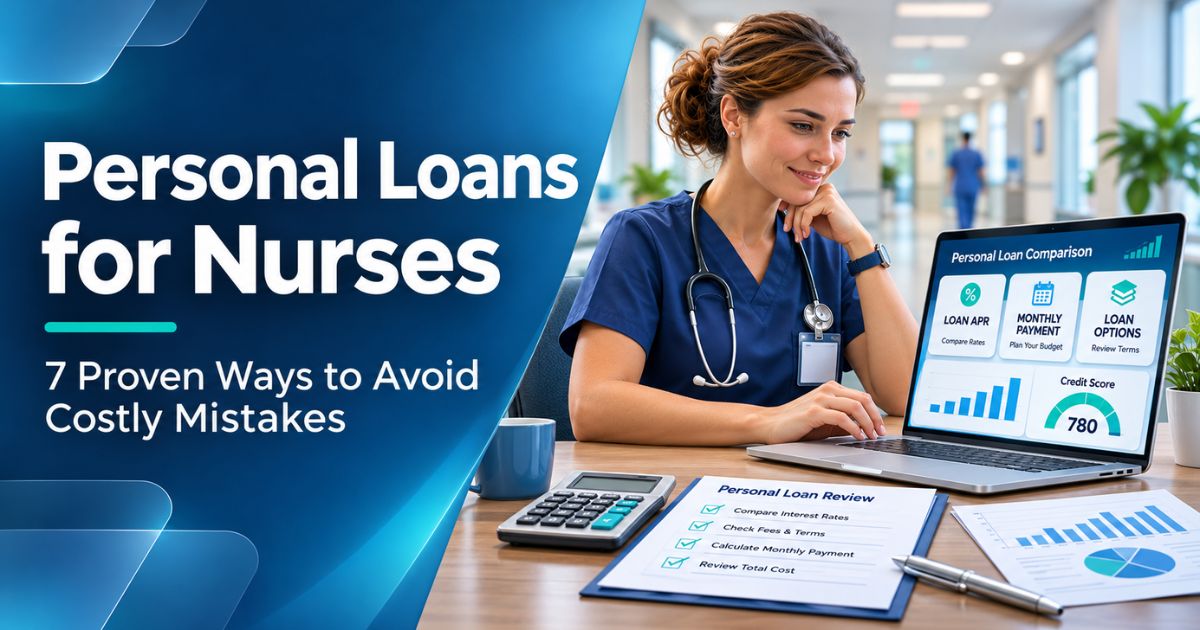
When comparing personal loans for nurses, review the annual percentage rate (APR), loan amount, origination fees, repayment period, and total borrowing costs. A loan offering a small monthly installment may still be expensive if it involves a longer repayment term.
This guide explains seven practical steps for comparing nurse-focused financing, preparing documents, reviewing lender requirements, calculating monthly payments, avoiding scams, and identifying alternatives to unnecessary debt.
For related guidance, explore our personal loan credit score guide, no-origination-fee loan guide, and personal finance planning guide.
Key Takeaways
- Most personal loan providers evaluate credit history, income, and existing debt rather than nursing job titles alone.
- Some financial institutions advertise healthcare professional benefits, but special pricing must be confirmed in writing.
- Travel nurses and contract workers may need additional income documentation.
- APR, fees, and total repayment provide a clearer comparison than monthly payment alone.
- Soft-inquiry prequalification may help borrowers compare preliminary offers.
- Unsecured loans do not require specific collateral, while secured loans may place assets at risk.
- Employer assistance and nonprofit credit counseling may provide alternatives.
- Federal student loan forgiveness programs are separate from ordinary personal loans.
1. How Personal Loans for Nurses Work
Personal loans for nurses generally operate like other consumer installment loans. An eligible borrower receives an approved amount and agrees to repay the obligation according to a defined schedule.

What is a personal installment loan?
A personal installment loan provides a specific principal amount that the borrower repays through scheduled payments.
Many unsecured personal loans have fixed interest rates and fixed repayment periods. Other products may have different structures, so the contract should always be reviewed.
What can nurses use personal loans for?
Permitted uses depend on lender policies. Common examples may include:
- Consolidating eligible credit card debt.
- Paying for necessary home repairs.
- Managing unexpected household expenses.
- Covering certain relocation expenses.
- Financing approved personal purchases.
- Addressing eligible medical expenses.
Some lenders restrict particular uses, including education-related expenses, certain business activities, or investments.
Are there special nurse loan programs?
Some lenders advertise financing products or benefits for healthcare professionals.
These may include professional discounts, alternative income documentation, or particular membership opportunities.
However, a nurse-focused advertisement does not necessarily mean the product has lower borrowing costs than standard personal loans.
Does nursing employment guarantee approval?
No. Financial institutions generally evaluate the applicant’s ability and willingness to repay the requested credit.
Income, existing monthly obligations, credit history, loan amount, and other underwriting factors may determine approval.
When may borrowing make sense?
A personal loan may be worth considering when it finances a necessary expense or replaces more expensive debt at a genuinely lower total cost.
It may be unsuitable when monthly household spending consistently exceeds income.
Before applying for personal loans for nurses, determine whether the expense is necessary and whether the scheduled payments remain affordable during periods of reduced income.
2. Understand Credit Score and Income Requirements
Lenders assess several financial factors when determining eligibility.
Although nursing can provide a source of employment income, borrowers should not assume lenders use identical approval requirements.

Credit score requirements
No universal minimum credit score applies to every unsecured personal loan.
Some lenders prefer established credit histories, while others consider applicants with fair credit or limited credit records.
However, a lower credit score may result in a higher APR, reduced borrowing limits, or additional conditions.
Review your credit reports
Before submitting formal applications, check your credit reports for inaccurate balances, unfamiliar accounts, and incorrectly reported payments.
If you discover genuine reporting errors, follow the appropriate credit bureau dispute process.
Calculate debt-to-income ratio
Your debt-to-income ratio, or DTI, compares qualifying monthly debt obligations with gross monthly income.
DTI = Monthly Debt Payments / Gross Monthly Income × 100
For example, a nurse earning $5,500 in gross monthly income with $1,650 in qualifying debt payments has a 30% DTI.
Lenders may calculate DTI differently depending on their underwriting procedures.
Document regular nursing income
Full-time nurses with regular salaries may be asked for recent pay statements, employer verification, bank records, or tax documents.
Exact requirements depend on the financial institution.
How lenders treat overtime
Overtime earnings may increase reported income, but lenders do not necessarily treat every overtime payment as recurring.
Some review historical earnings to determine whether additional income is reasonably consistent.
Travel nursing income
Travel nurses often work through temporary assignments or staffing agencies.
Lenders may request contracts, historical earnings records, tax returns, and information about gaps between assignments.
There is no universal rule requiring all travel nurses to provide exactly two years of employment records.
Multiple employers and variable shifts
If you work at multiple hospitals or nursing agencies, document each income source accurately.
Distinguish regular wages from reimbursements and stipends, because underwriting treatment can differ.
Licensure verification
Some professional-specific lending programs may request evidence of active nursing licensure or current healthcare employment.
General-purpose personal loan providers may not require license verification.
When evaluating personal loans for nurses, confirm whether professional credentials affect eligibility or merely appear in promotional materials.
Read our credit score calculation guide and credit improvement guide.
3. Compare Nurse Loan Programs and Lender Types
Different lending institutions may provide different rates, fees, application procedures, and borrower protections.

Traditional banks
Some banks provide unsecured installment loans with online applications and established account servicing.
Existing customers may qualify for particular relationship benefits, depending on bank policies.
Credit unions
Credit unions may provide personal loans to eligible members.
Some serve particular communities, workplaces, or professional associations.
Membership qualifications, APRs, fees, and underwriting requirements vary.
Online personal loan lenders
Online lenders may offer digital prequalification, application tracking, and electronic funding procedures.
However, funding speed and advertised convenience should not outweigh borrowing costs or lender legitimacy.
Healthcare professional financing
Some institutions market financing toward nurses, doctors, or other medical workers.
Verify whether a professional program provides a measurable benefit such as a lower APR, reduced fee, or different qualification standard.
Employer-linked financial assistance
Certain employers offer employee assistance, emergency grants, payroll advances, or access to third-party financial services.
Availability, eligibility, taxation, repayment conditions, and employment-related restrictions vary significantly.
Secured personal loans
A secured loan requires eligible collateral, such as a savings account or another asset.
Collateral may improve access to credit, but missed payments can put pledged property at risk.
Unsecured personal loans
An unsecured loan does not require a specific pledged asset.
However, default can still lead to collections, credit reporting consequences, or legal action.
Compare financing sources
| Lender Type | Potential Advantage | Important Consideration |
|---|---|---|
| Bank | Established servicing and account access | Eligibility varies |
| Credit Union | Member-focused lending | Membership may be required |
| Online Lender | Digital applications | Compare APR and fees |
| Healthcare Program | Possible professional benefits | Verify discounts in writing |
| Secured Lender | Collateral-backed financing | Risk of losing collateral |
When comparing personal loans for nurses, request written offers using similar amounts and repayment periods.
For related borrowing information, see our origination fee comparison and personal loan eligibility guide.
4. Understand APR, Interest Rates, and Borrowing Costs
The interest rate and annual percentage rate are related but different measurements.
Understanding these figures is essential before accepting a financing agreement.

Interest rate
The interest rate determines how interest is charged under the contract.
Depending on the product, interest may be calculated using a fixed or variable rate.
Annual percentage rate
APR represents the annualized cost of credit and includes certain applicable finance charges.
Two loans with similar stated interest rates may have different APRs because of additional fees.
Origination fees
Some lenders charge a fee to originate or process a loan.
This charge may be deducted from the loan proceeds or handled according to the financing contract.
Origination fee example
Suppose a lender approves a $12,000 loan and deducts a 5% origination fee.
The fee would be $600, leaving $11,400 in disbursed proceeds if deducted upfront.
The borrower may still owe the contractual loan principal and interest.
Other potential charges
- Late payment fees.
- Returned-payment fees.
- Permitted documentation charges.
- Optional credit-related insurance.
- Other disclosed contractual fees.
Review official fee guidance
The Consumer Financial Protection Bureau’s personal installment loan fee guidance explains common charges and why borrowers should review loan disclosures before signing.
Fixed versus variable rates
A fixed-rate installment loan generally provides predictable payments under the agreed terms.
Variable-rate borrowing may result in changes to interest charges or payments according to the contract.
Prepayment terms
Some borrowers pay off loans early to reduce future interest.
Check whether the contract includes applicable prepayment charges and how the lender calculates early payoff.
When assessing personal loans for nurses, compare total borrowing costs rather than relying on a single advertised interest rate.
5. Calculate Monthly Payments Before Borrowing
A loan should fit your budget during ordinary working months and periods when income may be lower.
Monthly payment example
Assume a $10,000 unsecured installment loan with a fixed annual interest rate of 12%, standard monthly amortization, and no additional fees.
| Repayment Term | Approximate Monthly Payment | Approximate Total Interest |
|---|---|---|
| 24 Months | $470.73 | $1,298 |
| 36 Months | $332.14 | $1,957 |
| 48 Months | $263.34 | $2,640 |
These figures are hypothetical, rounded estimates, not available lender offers.
Why longer terms increase interest
Spreading the same principal over more months generally reduces the scheduled payment while increasing cumulative interest.
A smaller installment may therefore produce a higher total repayment amount.
Prepare a nursing household budget
List regular take-home income and essential expenses.
Include housing, transportation, insurance, groceries, childcare, existing debt, and planned savings.
Budget for reduced overtime
Do not base a permanent loan payment solely on exceptionally high overtime earnings.
Estimate how much you can afford if overtime decreases or your work schedule changes.
Travel nurse budget considerations
Travel assignments may involve housing costs, relocation expenses, contract gaps, and changes in reimbursed expenses.
Separate reliable earnings from temporary reimbursements when calculating available money for repayment.
Emergency reserves
Maintaining accessible savings may help cover unexpected household costs without requiring additional expensive borrowing.
Before seeking personal loans for nurses, consider whether the proposed installment leaves sufficient room for emergencies.
6. Use Debt Consolidation Carefully
Some nursing professionals consider personal loans to consolidate high-interest credit card balances or other unsecured debts.
How consolidation works
A borrower obtains a new loan and uses the proceeds to pay eligible existing obligations.
The borrower then repays the replacement financing according to its contract.
Potential benefits
Debt consolidation may simplify payment management or reduce interest costs when the replacement terms are favorable.
However, savings are not guaranteed.
Example consolidation comparison
Suppose a nurse has $8,000 in existing credit card debt carrying a relatively high APR.
A new installment loan may offer a lower APR, but fees and repayment length must be included in the comparison.
A lower monthly payment does not automatically mean a lower total cost.
Consider origination fees
A loan with an origination fee may provide less usable funding than the face amount borrowed.
Confirm that the disbursement is sufficient to repay the intended balances.
Avoid rebuilding old balances
After consolidating credit card debt, continued spending on those cards can create another repayment burden.
A sustainable household budget remains important.
Understand debt management plans
Nonprofit credit counseling organizations may help eligible consumers establish structured repayment arrangements with participating creditors.
Debt management plans generally do not require a replacement personal loan.
When evaluating personal loans for nurses for debt consolidation, compare them with available nonprofit counseling and creditor hardship options.
See our debt consolidation guide and credit card debt guide.
7. Follow Seven Proven Steps Before Applying
A structured application process helps borrowers avoid unnecessary credit inquiries, misleading offers, and unaffordable financing.
Step 1: Determine the exact borrowing need
Identify the expense, calculate the necessary amount, and consider whether savings or other resources can cover part of it.
Avoid borrowing additional money simply because the lender offers a higher maximum amount.
Step 2: Check credit reports
Review your credit information for inaccuracies and verify that existing payments are correctly reported.
Dispute genuine errors through the relevant credit reporting organization.
Step 3: Prepare income documentation
Collect recent pay statements, tax documents where required, employment information, and records of regular overtime or assignment income.
Variable income may require additional verification.
Step 4: Prequalify when appropriate
Some lenders provide preliminary eligibility checks using soft credit inquiries.
Soft inquiries do not lower credit scores, but formal applications may generate hard inquiries.
Always verify the inquiry procedure before submitting information.
Step 5: Compare written loan offers
Review APR, origination fees, repayment term, monthly payment, and total scheduled payments.
Compare similar loan amounts and terms whenever possible.
Step 6: Verify the lender
Check the business’s identity, applicable licensing or registration information, contact details, and written disclosures.
Be cautious of guaranteed-approval claims or suspicious payment requests.
Step 7: Review and sign carefully
Read the complete agreement before accepting the funds.
Confirm the first payment date, interest rate structure, fees, and procedures for hardship assistance.
Using these steps when comparing personal loans for nurses can help you select financing based on affordability and transparent contractual terms.
Documents Nurses May Need for a Personal Loan
Required documents vary by lender, loan amount, employment arrangement, and underwriting method.
| Document | Possible Purpose |
|---|---|
| Government ID | Identity verification |
| Recent Pay Statements | Current income verification |
| Bank Statements | Financial review |
| W-2 or Tax Returns | Historical income verification |
| Travel Nursing Contracts | Assignment income documentation |
| Nursing License | Professional eligibility when required |
| Address Verification | Residency confirmation |
Full-time salaried nurses
Applicants with regular earnings may be able to provide standard pay and employment records.
Hourly nursing employees
Hourly employees should document normal working hours, shift differentials, and any recurring additional earnings.
Agency and travel nurses
Contract-based workers may need historical income records or documentation from several assignments.
Self-employed nurses
Self-employed professionals may need business records, tax returns, or other qualifying evidence of income.
Verify current lender requirements
No single document checklist applies to every institution.
Before applying for personal loans for nurses, ask which specific records are required for your employment arrangement.
Alternatives to Personal Borrowing for Nursing Professionals
A personal loan is not necessarily the most affordable solution to every financial problem.
Employer hardship assistance
Some hospitals and healthcare organizations offer employee assistance programs or emergency support.
Review eligibility, repayment conditions, and tax implications before accepting assistance.
Hospital education benefits
Employers may offer tuition reimbursement, continuing education support, or professional development benefits.
These programs may reduce the need to finance eligible education costs through consumer loans.
Nonprofit credit counseling
Qualified nonprofit credit counselors can help borrowers review budgets, debts, and possible repayment options.
Medical provider payment plans
For certain healthcare expenses, providers may offer installment arrangements or financial assistance programs.
Compare any fees and terms before deciding to borrow.
Emergency savings
Accessible savings may provide a lower-cost option for manageable unexpected expenses.
However, maintain adequate reserves for essential household needs.
Federal student loan repayment and forgiveness
Nurses with qualifying federal student loans may be eligible for federal repayment assistance or forgiveness programs.
Public Service Loan Forgiveness generally depends on eligible Direct Loans, qualifying payments, and qualifying public-service employment, rather than nursing job title alone.
Visit the official Federal Student Aid PSLF guidance to review current requirements.
Ordinary unsecured personal loans are not eligible for PSLF simply because the borrower works as a nurse.
Evaluate refinancing carefully
Refinancing federal student loans into private loans can eliminate access to federal borrower protections and forgiveness programs.
Review current federal options before converting eligible federal debt into private financing.
When waiting may help
If the planned expense is not urgent, delaying borrowing may provide time to improve credit or save additional funds.
Before choosing personal loans for nurses, compare these alternatives with the total cost and consequences of taking on new debt.
How to Identify Risky or Misleading Loan Offers
Borrowers should carefully evaluate lenders that promise unusual benefits or approval without meaningful financial review.
Guaranteed approval claims
Be cautious of advertisements suggesting that every applicant qualifies regardless of credit or income.
Unexplained advance payments
Requests for suspicious upfront fees as a condition of guaranteed financing can indicate fraud.
Legitimate application-related charges may exist, but payment should never be treated as a guarantee that a loan will be issued.
Unclear interest rates
Do not accept an offer without reviewing the APR and relevant loan disclosures.
Pressure to sign immediately
A reputable lender should provide appropriate contractual information and an opportunity to review terms.
Unverified nursing discounts
A lender claiming healthcare-worker benefits should identify the actual eligibility rules and financial advantage.
Requests for sensitive passwords
Do not provide personal banking passwords through suspicious messages or unverified websites.
Unaffordable payment schedules
Even a legitimate lender may offer terms that are unsuitable for your household budget.
When comparing personal loans for nurses, affordability and lender credibility are more important than promotional wording.
Personal Loan Comparison Checklist for Nurses
- Confirm the lender accepts your employment and income arrangement.
- Review credit eligibility requirements.
- Verify current nursing income documentation.
- Determine the amount actually needed.
- Compare APR across suitable lenders.
- Check origination fees.
- Review repayment term length.
- Calculate total scheduled payments.
- Confirm fixed or variable interest.
- Review prepayment conditions.
- Ask about hardship assistance.
- Verify any professional discounts.
- Compare secured and unsecured alternatives.
- Evaluate nonprofit and employer resources.
- Read all disclosures before signing.
- Keep copies of the agreement and payment records.
Related Best Finance Live Guides
Explore these resources for additional information about personal loans, credit scores, household budgets, and responsible borrowing.
- Minimum Credit Score for a Personal Loan
- Personal Loans With No Origination Fee
- Personal Loan With a 650 Credit Score
- Debt Consolidation With Bad Credit
- Does Prequalification Affect Credit Score?
- How Credit Scores Are Calculated
- How Long to Raise Your Credit Score
- Highest Credit Score Guide
- What Is a Finance Charge?
- Complete Personal Finance Guide
- Master Your Money
- Top Financial Tips
- Average Credit Card Debt
Conclusion
Personal loans for nurses may provide financing for eligible healthcare workers, but borrowing decisions should be based on affordability, clear lender disclosures, and long-term financial stability.
Nursing employment alone does not guarantee a lower interest rate or automatic approval. Lenders may consider credit history, income consistency, debt-to-income ratio, loan amount, and other financial information.
Before applying, compare APR, origination fees, repayment terms, and total borrowing costs. Nurses with irregular schedules, travel assignments, or changing overtime earnings should also test affordability during lower-income periods.
Employer assistance, nonprofit credit counseling, and eligible education-related programs may provide alternatives worth reviewing.
Ultimately, choosing personal loans for nurses responsibly means borrowing only what is necessary and selecting repayment terms that fit your household budget without creating unnecessary financial pressure.