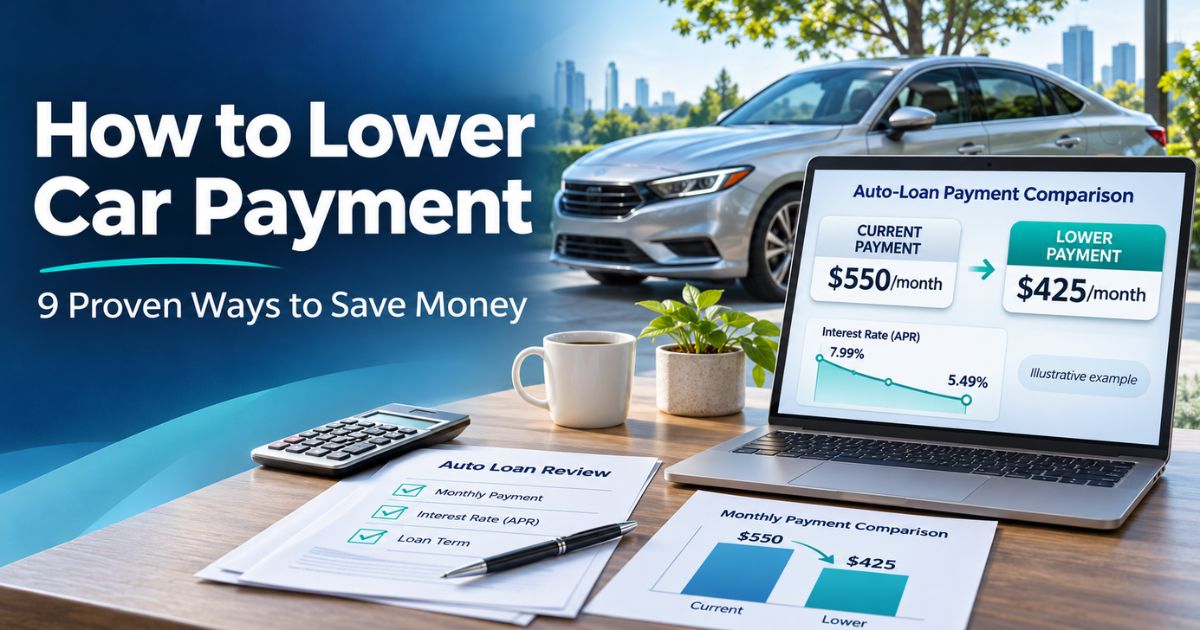
Some strategies directly reduce the required monthly installment. Others lower total borrowing costs, create temporary breathing room, or reduce overall transportation expenses without changing your contracted payment.
Understanding how to lower car payment requires distinguishing these outcomes. A smaller monthly payment is not always a better financial deal, particularly when the change extends your loan or increases total interest.
This guide explains nine practical options, including lender modifications, hardship plans, payment deferment, term extensions, principal reductions, optional product cancellations, credit improvement, vehicle sales, and trading down.
You can also compare alternatives using our auto finance calculator, auto refinancing guide, and car loan APR guide.
Key Takeaways
- Contact your lender early if you expect difficulty making a payment.
- Loan modifications and extensions may reduce required installments, subject to lender approval.
- Deferment usually provides temporary relief rather than permanent payment reduction.
- Extra principal payments generally reduce interest or repayment time, not the scheduled monthly bill.
- Canceling eligible add-ons may reduce principal but can also eliminate valuable coverage.
- Improving credit may help you qualify for better financing offers later.
- Selling or trading down may reduce transportation costs if the numbers support the decision.
- Compare total interest, fees, loan term, and negative-equity risk.
How to Lower Car Payment Without Refinancing
If you want to know how to lower car payment without immediately applying for a replacement loan, begin with the financial institution currently servicing your auto loan.

Your existing lender may have specific hardship or account-assistance programs. Availability depends on the loan contract, account status, lender policy, and applicable state law.
Compare the nine options
| Option | Potential Benefit | Important Limitation |
|---|---|---|
| 1. Rate modification | May lower installment and interest | Not universally offered |
| 2. Hardship arrangement | Temporary or revised payment support | May require repayment later |
| 3. Payment deferment | Short-term payment pause | Interest may continue |
| 4. Term extension | Smaller scheduled installment | Potentially higher total interest |
| 5. Principal payment | Lower balance and interest | Usually does not change installment |
| 6. Cancel eligible add-ons | Potential loan balance refund | Coverage may be lost |
| 7. Improve credit | Potential future rate eligibility | No immediate payment reduction |
| 8. Sell the vehicle | May eliminate the existing installment | Loan payoff still required |
| 9. Trade down | Potentially smaller replacement loan | Taxes, fees and negative equity |
Know the difference between payment relief and real savings
A deferment may let you skip a payment temporarily. A term extension may reduce each future installment while increasing the amount of interest paid overall.
Paying down principal generally improves the debt balance without altering the required installment unless the lender agrees to recalculate payments.
That distinction is essential when deciding how to lower car payment responsibly.
Review Your Loan and Household Budget First
Before requesting a change, collect the figures that determine your current loan obligation.

Gather your loan information
Find your latest account statement and original financing contract. Record:
- Current principal balance.
- Interest rate and APR.
- Scheduled monthly installment.
- Remaining number of payments.
- Next payment due date.
- Current payoff amount.
- Late payment provisions.
- Prepayment conditions.
- Optional financed products.
Principal balance vs payoff amount
Your principal balance is the outstanding loan amount before certain additional charges.
The payoff amount may include interest accrued through a specified date and other amounts due under the contract.
Always request an official payoff quote when considering a sale or refinancing transaction.
Calculate total transportation expenses
Your monthly vehicle costs include more than the car installment.
Consider insurance, fuel, electricity, maintenance, repairs, parking, tolls, and registration.
Example monthly vehicle budget
| Expense | Monthly Cost |
|---|---|
| Auto Loan Payment | $525 |
| Insurance | $165 |
| Fuel | $150 |
| Maintenance Reserve | $70 |
| Parking and Other Costs | $40 |
| Total | $950 |
These figures are hypothetical, but they demonstrate why a loan installment alone does not measure affordability.
Check your available income
Subtract essential household expenses from your take-home income. Include housing, food, utilities, healthcare, existing debts, and reasonable savings.
Identify a sustainable transportation budget rather than focusing exclusively on the smallest payment a lender might offer.
For how to lower car payment planning, accurate financial records are more useful than estimates.
Read our average car payment 2026 guide, money management guide, and personal finance planning guide.
Option 1: Request an Interest Rate Reduction
One possible way to reduce your installment is to ask your existing lender whether it offers an interest rate modification.
Not all auto finance companies provide this option, and lenders generally are not required to reduce a contract rate simply because a borrower requests it.

Contact your current lender
Use the phone number on an official statement or your authenticated account portal.
Ask whether a permanent rate adjustment, formal modification, or revised repayment arrangement is available.
Explain your financial circumstances
Describe changes affecting affordability, such as reduced income, unexpected essential expenses, or other financial hardship.
Have accurate income and budget documents available if requested.
Compare the old and new terms
If the lender offers a modification, review the interest rate, required payment, remaining term, fees, and total repayment amount.
For example, a reduced interest rate may create savings, but extending the term at the same time can offset some or all of that benefit.
Request written confirmation
Do not assume that a phone conversation automatically changes your legal payment obligation.
Obtain written approval detailing the new agreement and its effective date.
If you are exploring how to lower car payment through a rate change, verify the new amortization schedule before accepting it.
Option 2: Ask About a Formal Hardship Arrangement
Many borrowers experience temporary financial difficulties during periods of job instability, reduced working hours, illness, or unexpected family expenses.
Some lenders offer programs designed to help eligible borrowers manage these situations.
Contact your lender early
Reach out before missing a payment whenever possible.
Explain how much you can currently afford and whether the hardship is expected to last weeks, months, or longer.
Available hardship arrangements
Depending on lender policies, options may include:
- Temporary reduced payments.
- A revised due date.
- A catch-up repayment plan.
- Payment extension.
- Other written servicing arrangements.
Ask about missed payments
If you are already behind, ask how any overdue amount will be handled.
A hardship arrangement may require missed installments to be repaid later, and additional interest or fees may apply.
Review potential credit reporting effects
Ask whether the account will continue to be reported as current during the approved arrangement.
A hardship notation does not automatically mean a lower credit score, but missed payments and actual reporting details can influence the outcome.
Obtain the terms in writing
Confirm exactly what you must pay, when the next installment is due, and whether the existing contract is being formally modified.
The Consumer Financial Protection Bureau’s car payment guidance recommends contacting your lender promptly and obtaining any agreement in writing.
This is especially important when considering how to lower car payment during a financial emergency.
Option 3: Request a Payment Deferment
A deferment allows eligible borrowers to postpone one or more scheduled payments under an approved agreement.
It is usually a temporary solution rather than a permanent reduction in loan payments.

How deferment works
Depending on the agreement, the lender may postpone certain payments or extend the contract’s maturity date.
Other arrangements may require deferred amounts to be repaid under a separate schedule.
Interest may continue accruing
Interest often continues to accumulate during a payment pause.
That can increase total borrowing costs even if the deferment provides immediate cash-flow relief.
Questions to ask your lender
- How many payments can be postponed?
- Will interest continue accruing?
- Will the final payoff date change?
- Are additional fees charged?
- When will skipped payments become due?
- Will the arrangement affect credit reporting?
When deferment may make sense
A short-term arrangement may help someone facing a temporary income interruption with a realistic plan to resume payments.
However, if the loan is permanently unaffordable, postponement alone will not solve the underlying problem.
When evaluating how to lower car payment pressure, distinguish a payment pause from genuine long-term affordability.
Option 4: Extend Your Remaining Loan Term
A loan extension spreads repayment across additional months, potentially reducing the required installment.
The trade-off is that you may pay interest for longer and remain exposed to vehicle depreciation and negative equity.
How an extension affects payments
Suppose a lender allows the remaining balance to be repaid over 36 months instead of 24.
At the same interest rate, the longer schedule generally reduces the monthly payment but increases the total interest paid from that point forward.
Illustrative comparison
Assume $12,000 remains outstanding at a fixed 10% annual interest rate with standard monthly amortization and no additional charges.
| Remaining Term | Approx. Payment | Approx. Total Interest |
|---|---|---|
| 24 months | $553.74 | $1,289.75 |
| 36 months | $387.21 | $1,939.42 |
| 48 months | $304.35 | $2,608.71 |
These hypothetical estimates illustrate the effect of changing repayment length. Actual modification offers may use different rates, fees, or methods.
Understand negative equity
A vehicle has negative equity when its outstanding loan balance exceeds its current market value.
Longer repayment can extend the period in which you owe more than the vehicle is worth.
Check your long-term plans
If you intend to sell or trade the car soon, a longer payoff period may create difficulties.
Compare the vehicle’s likely value against the loan balance at the expected sale date.
Check whether your lender permits extensions
Not every lender offers repayment restructuring, and some modifications have eligibility requirements or additional charges.
For how to lower car payment decisions involving extensions, compare total scheduled payments and the new maturity date.
Read our long-term auto loan guide, negative equity car guide, and early loan payoff guide.
Option 5: Make an Extra Principal Payment
If you have additional cash available, paying down principal may reduce future interest expense and shorten the repayment period.
However, an ordinary principal-only payment generally does not automatically reduce your required monthly installment.
Understand payment allocation
Auto loan payments may be applied to fees, accrued interest, and principal according to the contract.
Ask your lender how additional funds will be allocated.
Principal-only payment example
Suppose your remaining principal balance is $15,000 and you make an approved additional principal payment of $2,000.
Your principal would decrease to approximately $13,000, assuming no other adjustments.
On a typical simple-interest loan, that lower balance can reduce future interest accrual.
Will the required installment change?
Usually not without a separate lender-approved recalculation or modification.
A lender may continue requiring the original scheduled payment, allowing you to pay off the balance sooner.
Ask about re-amortization
Some financial institutions may permit payment recalculation under specific programs, but this is not a standard feature of every auto loan.
Ask directly rather than assuming an extra payment qualifies for automatic recasting.
Protect your emergency savings
Do not use money needed for essential expenses or emergencies solely to reduce principal.
The best approach depends on cash reserves, interest rates, and household stability.
Understanding how to lower car payment means knowing when principal reduction creates real savings without immediately changing cash flow.
Option 6: Cancel Eligible Optional Financed Products
Some auto financing contracts include optional products that were purchased during the vehicle transaction.
Depending on the contract and state law, certain products may qualify for cancellation and a partial refund.
Examples of financed add-ons
- GAP protection products.
- Extended service contracts.
- Prepaid maintenance agreements.
- Credit-related protection products.
- Other optional dealership packages.
Review your purchase agreement
Find each optional product’s price, cancellation requirements, benefit limitations, and potential refund method.
Some products have already provided benefits or may not be eligible for cancellation under the applicable conditions.
Ask who processes cancellation
Contact the dealer, product administrator, lender, or insurer as appropriate for the specific contract.
Request written confirmation showing cancellation eligibility and the calculated refund.
Where does the refund go?
If a product was financed, an eligible refund may be credited directly toward the outstanding loan balance rather than paid to you in cash.
This may reduce principal and future interest without lowering the scheduled monthly installment.
Do not cancel required coverage
Maintain insurance required by state law and your financing contract.
Before canceling optional protection, consider whether the benefit remains valuable for your situation.
The Federal Trade Commission’s car financing guide explains how optional add-ons can increase financing costs and why borrowers should review them carefully.
For borrowers researching how to lower car payment, add-on cancellation is primarily a balance-reduction opportunity, not a guaranteed payment reduction.
Option 7: Improve Your Credit Before Seeking Better Loan Terms
A stronger credit profile may improve your eligibility for favorable loan offers, though no particular APR or approval result is guaranteed.
Review your credit reports
Look for inaccurate balances, incorrect payment histories, unfamiliar accounts, and other information that should be investigated.
Dispute genuine errors
Follow the official dispute process for inaccurate credit reporting.
Removing legitimately incorrect negative information may improve the accuracy of your credit profile, but there is no guaranteed point increase.
Make payments on time
Payment history is a significant factor in commonly used credit scoring models.
Use reminders or automatic payments where appropriate and affordable.
Manage credit utilization
Credit utilization generally compares revolving account balances with available credit limits.
Reducing high credit-card balances may help improve this part of a credit profile.
Compare future refinancing offers
After your credit improves, compare actual written refinance offers rather than assuming you will automatically qualify for a better rate.
Check APR, fees, loan term, total repayment, and any prepayment conditions on your existing contract.
Improving credit may support a future how to lower car payment strategy, but it does not directly change the terms of your current contract.
For more information, see our credit score improvement guide, credit score factors, credit score ranges, and loan prequalification guide.
Option 8: Sell Your Current Car
Selling the vehicle may eliminate the existing installment after the loan is fully satisfied.
However, this strategy works only when the sale proceeds, payoff obligations, and replacement transportation arrangements make financial sense.
Request the current payoff amount
Contact your lender for an official payoff quote valid through a specified date.
This figure may differ from the balance shown on a monthly statement.
Estimate the vehicle’s market value
Compare private-party listings, dealer offers, and credible valuation information.
Actual offers may vary according to condition, mileage, location, and demand.
Positive equity example
| Item | Amount |
|---|---|
| Vehicle Sale Price | $18,000 |
| Existing Loan Payoff | $13,000 |
| Potential Positive Equity | $5,000 |
In this example, the $5,000 difference is positive equity before transaction expenses.
Negative equity example
If the payoff amount is $18,000 but the vehicle sells for only $15,000, the owner generally must address the remaining $3,000 obligation.
Selling the car does not automatically erase the unpaid loan balance.
Arrange a proper title transfer
When the lender holds a lien, coordinate the payoff and release process before completing the sale.
Follow your state’s applicable title-transfer requirements.
Read our selling a financed vehicle guide and private-party car loans guide.
Consider replacement transportation
Compare the cost of another vehicle, public transportation, ridesharing, or other practical options.
For some households, selling the current vehicle may be an effective how to lower car payment solution if suitable transportation remains available.
Option 9: Trade Down to a Less Expensive Vehicle
Trading down means replacing your current vehicle with a lower-cost alternative.
This can reduce borrowing needs when the transaction is structured carefully, but a cheaper car does not automatically guarantee a better financial result.
Calculate your available equity
Subtract the current payoff amount from the trade-in offer.
Positive equity may be applied toward the replacement vehicle.
Compare the replacement price
Review the full purchase price, including taxes, title fees, registration, and dealership charges.
Also compare insurance and expected maintenance expenses.
Avoid rolling negative equity unnecessarily
If your current loan balance exceeds the trade-in value, that shortfall may be added to the replacement loan if the lender permits it.
This increases the amount financed and can undermine the goal of reducing debt.
Check replacement loan APR and term
A smaller monthly payment may simply result from a longer repayment period.
Compare total future payments, interest expense, and loan maturity dates.
Consider vehicle reliability
A less expensive used vehicle may require more repairs or maintenance.
Consider an independent inspection and realistic repair reserve before purchasing.
Example replacement decision
Suppose you have $4,000 in positive equity and choose a vehicle with a total purchase cost of $15,000.
If the equity is applied as the only contribution, the amount financed could be approximately $11,000 before other adjustments.
The resulting payment depends on the actual APR, term, and fees.
Before deciding how to lower car payment through a trade, compare the new total transportation budget with your current one.
Additional reading includes our down payment guide, new versus used car rates, and affordable auto loans guide.
When Is Auto Loan Refinancing a Better Option?
After reviewing alternatives, refinancing may still be appropriate if a new lender offers terms that meaningfully improve your situation.
What refinancing does
Refinancing replaces the existing auto loan with a new financing contract.
The new lender generally pays off the previous loan and establishes a different repayment schedule.
When a lower APR may help
A reduced APR may lower required payments or total interest depending on the loan amount, term, and fees.
Compare the full repayment cost rather than focusing only on the new monthly installment.
Watch for longer loan terms
A refinance offer with a lower payment may be more expensive if the remaining debt is stretched across substantially more months.
Review prepayment penalties
Some existing loan contracts contain prepayment provisions, subject to applicable law.
Check whether paying off the current loan early would create additional charges.
Compare vehicle eligibility
Refinancing lenders may restrict vehicle age, mileage, loan balance, or loan-to-value ratio.
A borrower’s credit qualifications alone do not guarantee the vehicle meets eligibility requirements.
Compare actual offers
| Factor | Existing Loan | Replacement Loan |
|---|---|---|
| APR | Check contract | Check offer |
| Principal | Current payoff | New amount financed |
| Term | Remaining months | Proposed months |
| Fees | Existing payoff terms | New charges |
| Total Interest | Remaining cost | Projected cost |
If you are still researching how to lower car payment, our refinancing guide, good car loan APR guide, and financing comparison guide provide additional context.
Common Mistakes When Trying to Reduce Car Payments
Accepting the smallest monthly payment
A low installment can conceal a longer repayment period and increased total interest.
Assuming deferment is free
Interest or other contractual costs may continue during an approved payment pause.
Confusing principal reduction with payment modification
Extra principal payments usually do not automatically reduce the amount due every month.
Canceling valuable protection without reviewing risks
Removing certain optional products may create future repair or total-loss exposure.
Ignoring negative equity
Rolling unpaid debt into another loan can increase principal and make future vehicle sales more difficult.
Skipping written lender confirmation
Never rely on an informal promise to stop making a contractually required payment.
Falling for guaranteed refinancing offers
Be skeptical of companies promising automatic approval, guaranteed credit score increases, or unusually large savings without reviewing your financial circumstances.
Ignoring insurance and maintenance expenses
Reducing the loan installment does not necessarily reduce the total cost of keeping the car.
These mistakes can make a how to lower car payment strategy less effective than expected.
Step-by-Step Action Plan
Step 1: Review your loan statement
Record the balance, interest rate, remaining term, and current installment.
Step 2: Set a realistic budget
Calculate how much your household can afford each month while covering essential needs.
Step 3: Contact the loan servicer
Ask about hardship assistance, payment modifications, and formal deferment programs.
Step 4: Compare written terms
Review proposed changes in APR, fees, loan term, and total repayment.
Step 5: Evaluate principal reduction
Consider whether additional cash can reduce future interest without jeopardizing emergency savings.
Step 6: Review financed add-ons
Identify eligible cancellations and determine whether refunds would be credited toward the loan.
Step 7: Check vehicle value
Compare the current market value with your official payoff quote.
Step 8: Explore replacement options
If necessary, compare selling the vehicle, trading down, and refinancing.
Step 9: Finalize only affordable terms
Keep signed documents and confirm that the lender’s system reflects any approved changes.
This process helps turn how to lower car payment research into a practical plan based on real figures.
Related Best Finance Live Guides
- Auto Finance Calculator
- Auto Loan Refinancing
- Good APR for a Car Loan
- New vs Used Car Loan Rates
- Average Car Payment 2026
- Car Down Payment Guide
- Negative Equity Car Loans
- 96-Month Auto Loans
- Paying Off a Car Loan Early
- How to Sell a Financed Car
- Private Party Car Loans
- First-Time Auto Loan Guide
- Best Auto Finance Deals
- Affordable Auto Financing
- Car Financing Options
- Subprime Auto Loans
Conclusion
Learning how to lower car payment involves more than searching for a smaller monthly bill.
Start by reviewing your loan documents, calculating your household budget, and contacting your existing lender to discuss available assistance.
Hardship arrangements and payment deferments may help temporarily, while approved rate modifications and term extensions may change the scheduled installment.
Extra principal payments and refunds from eligible financed products can reduce outstanding debt without necessarily changing the required payment.
If the existing vehicle remains unaffordable, selling it or trading down may provide a more sustainable solution, depending on your equity and replacement costs.
Refinancing can also be worth comparing if you qualify for favorable terms. However, always consider APR, fees, repayment length, and total interest.
The most effective how to lower car payment approach is one that improves monthly affordability without creating unnecessarily expensive long-term obligations.