
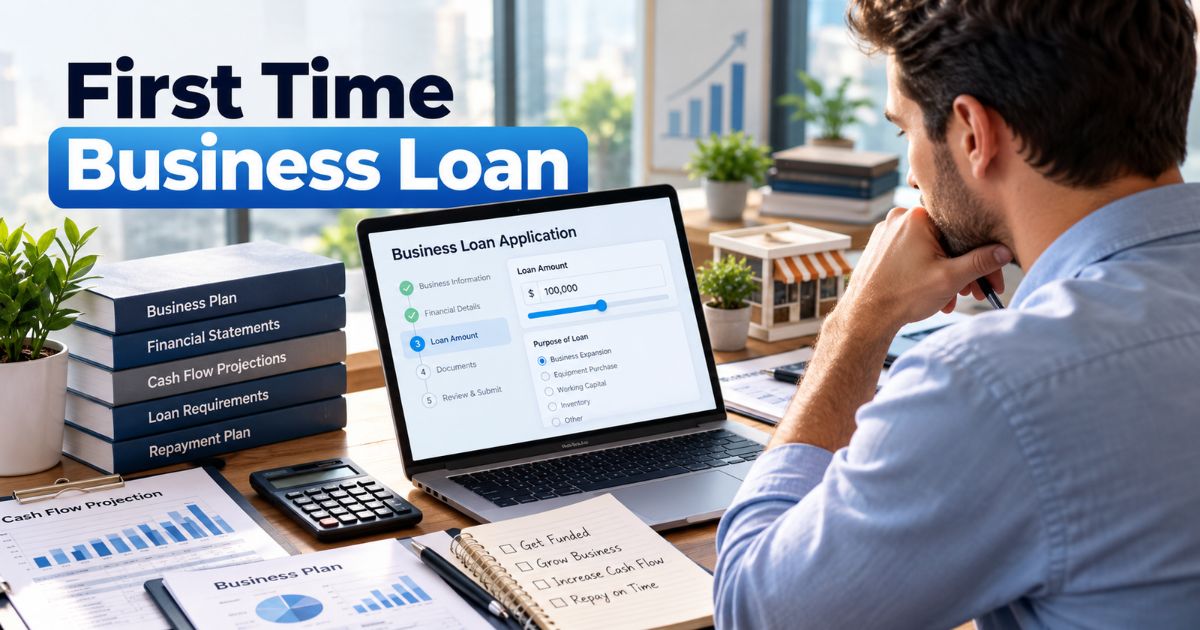
A first time business loan can provide capital for equipment, inventory, working capital, expansion, or another legitimate business need. But getting approved is only part of the decision. The loan must also fit your cash flow and remain affordable if sales slow down.
New businesses often face more scrutiny because lenders have less historical financial information to review. Your personal credit, business plan, projected cash flow, available collateral, industry, experience, and repayment strategy can therefore become especially important.
This guide explains how to prepare for a first time business loan, compare startup financing options, organize documents, understand SBA programs, evaluate costs, and submit a stronger application without taking on unnecessary debt.
If you are building your financial foundation, also review our business finance guide, business finance success guide, and business loans guide.
Key Takeaways
- Borrow for a clearly defined business purpose rather than simply because financing is available.
- Lenders may review personal and business credit, revenue, cash flow, collateral, and repayment ability.
- Startups may rely more heavily on owner credit, experience, projections, and a business plan.
- SBA 7(a), Microloan, equipment financing, term loans, and lines of credit serve different needs.
- Compare total borrowing cost, not only the monthly payment or advertised rate.
- Personal guarantees and collateral can create significant owner risk.
- Accurate and consistent application documents can reduce unnecessary underwriting delays.
1. Decide Why You Need a First Time Business Loan

Before contacting a lender, identify exactly what the money will accomplish.
A loan is easier to evaluate when the funding purpose is specific and measurable.
Good reasons to consider financing
Borrowing may make sense when capital supports a productive business purpose, such as:
- buying revenue-producing equipment;
- purchasing inventory for confirmed demand;
- opening or improving a business location;
- funding a planned expansion;
- covering predictable seasonal working-capital needs;
- or financing a business acquisition.
Be cautious about borrowing to cover recurring losses
A first time business loan should not automatically become a substitute for a sustainable business model.
If operating expenses consistently exceed revenue, adding another required payment may increase financial pressure.
Before borrowing, identify whether the problem is temporary cash timing or a deeper profitability issue.
Match the financing term to the purpose
Short-term needs should generally not be financed with unnecessarily long debt.
Likewise, a long-lived asset may be difficult to finance with a very short repayment schedule because the monthly payment may become too large.
| Funding Need | Possible Financing Type | Why It May Fit |
|---|---|---|
| Equipment | Equipment loan or term loan | Repayment can be aligned with asset use |
| Seasonal inventory | Line of credit | Flexible borrowing and repayment |
| Small startup expenses | SBA Microloan | Designed for smaller funding needs |
| Expansion | Term loan or SBA 7(a) | Can support longer-term growth |
Use our business loan payment calculator to estimate how loan amount, rate, and term can affect payments.
2. Calculate How Much Your Business Can Afford
A lender may be willing to approve more debt than your business should comfortably take on.
Your own affordability analysis should therefore come before the application.

Calculate the actual funding need
Build a detailed project budget.
Include expenses such as:
- purchase price;
- shipping;
- installation;
- taxes;
- licenses;
- professional fees;
- insurance;
- initial payroll;
- and contingency costs.
A precise request can be easier to justify than simply asking for the maximum amount available.
Build realistic cash flow projections
Cash flow projections help show whether your company can meet the proposed payment schedule.
SBA business-plan guidance recommends including financial projections with a funding request and explaining the assumptions behind them.
Your projections should consider:
- sales;
- cost of goods sold;
- payroll;
- rent;
- utilities;
- taxes;
- insurance;
- existing debt payments;
- and the proposed new payment.
Stress-test the numbers
Do not rely only on your most optimistic scenario.
Test what happens if:
- sales decline 10% to 20%;
- customers pay later than expected;
- supplier prices increase;
- an important customer leaves;
- or a major expense occurs unexpectedly.
If the business cannot manage the proposed payment under a modest slowdown, consider borrowing less or delaying the project.
Watch debt-service capacity
Lenders may evaluate how much operating cash is available relative to existing and proposed debt obligations.
Exact formulas and minimums vary by lender and product.
For broader business borrowing considerations, see our business loan interest rates guide.
3. Understand First Time Business Loan Requirements
The requirements for a first time business loan vary significantly among banks, credit unions, SBA lenders, community organizations, and online lenders.

Personal credit
For a new business, the owner’s personal credit can play a significant role because the company may not yet have a long borrowing history.
Review your personal credit before applying and correct inaccurate information where appropriate.
Our credit score guide explains payment history, credit utilization, inquiries, credit age, and account mix.
Business credit
An established business may have its own commercial credit history.
Business credit reporting is not identical to consumer credit reporting, and different commercial bureaus use different models.
Time in business
There is no single universal minimum age that applies to every commercial loan.
Some products are available to startups, while others require an operating history.
For example, SBA’s current 7(a) Working Capital Pilot specifically states that participating businesses should have at least one year of operating history. That requirement should not be generalized to every SBA or business loan.
Revenue and profitability
Lenders may review business bank statements, tax returns, income statements, and other documents to verify revenue.
An established business can usually provide historical results, while a startup may rely more heavily on projections and owner resources.
Collateral
Some loans are secured by business assets such as:
- equipment;
- vehicles;
- inventory;
- accounts receivable;
- or real estate.
The collateral requirements depend on the loan program and lender.
Personal guarantee
A personal guarantee can make an owner personally responsible for repayment if the business does not pay according to the agreement.
Read guarantee language carefully before signing.
Industry and business type
Certain lenders avoid industries they consider too risky or outside their lending policy.
SBA programs also have eligibility rules governing which businesses can participate.
4. Prepare Your Business Loan Application Documents
A well-organized application can help the lender understand your company without repeatedly asking for missing information.

Business formation records
Possible documents include:
- articles of incorporation or organization;
- operating agreement;
- partnership agreement;
- business licenses;
- Employer Identification Number documentation;
- and ownership records.
Financial statements
An established company may need to provide:
- profit and loss statements;
- balance sheets;
- cash flow statements;
- business tax returns;
- bank statements;
- accounts receivable aging;
- and accounts payable aging.
Personal financial information
Owners may also be asked for personal tax returns, financial statements, identification, or authorization for a credit review.
Business plan
A startup applying for a first time business loan may need a stronger business plan because historical operating results are limited.
Your plan should clearly explain:
- what the business does;
- target customers;
- competitive position;
- management experience;
- sales strategy;
- funding request;
- use of proceeds;
- and repayment strategy.
SBA guidance specifically recommends explaining how much funding is needed, how it will be used, and providing supporting financial projections.
Keep figures consistent
If your application says annual revenue is $400,000 but your financial statements show a materially different figure, the lender may ask for an explanation.
Review every document before submission.
5. Compare Startup Financing Options
There is no single best startup financing option for every new company.
The correct product depends on the funding purpose, amount, repayment ability, business age, and owner profile.
Business term loan
A term loan generally provides a lump sum followed by scheduled repayments.
It can work well for planned purchases with a clear cost.
Business line of credit
A line of credit provides revolving access to capital up to an approved limit.
It can be useful for:
- seasonal inventory;
- short-term payroll needs;
- temporary cash gaps;
- and recurring working-capital requirements.
SBA 7(a) loan
The SBA 7(a) program is the agency’s primary business-loan program.
SBA currently states that the maximum 7(a) loan amount is $5 million. Permitted uses include working capital, equipment, certain real-estate costs, business acquisitions, supplies, and eligible debt refinancing.
The SBA does not normally lend the 7(a) money directly to the borrower. Participating lenders originate the loans and SBA provides a guaranty subject to program rules.
Review current information through the official SBA 7(a) program.
SBA Microloan
An SBA Microloan can be useful when a business needs a smaller amount of capital.
The current SBA program provides loans of up to $50,000 through approved nonprofit intermediary lenders. SBA says the average microloan is approximately $13,000.
Eligible uses include:
- working capital;
- inventory;
- supplies;
- furniture;
- fixtures;
- machinery;
- and equipment.
SBA states that Microloan proceeds cannot be used to purchase real estate or repay existing debt.
The current SBA page lists a maximum repayment term of seven years.
See the official SBA Microloan program.
Equipment financing
Equipment financing is designed to purchase machinery, vehicles, computers, or other business assets.
The purchased equipment often helps secure the financing.
Business credit cards
A business credit card can be convenient for small recurring expenses and short-term purchases.
However, carrying balances can become expensive, especially when the APR is high.
Do not use credit-card debt automatically as a substitute for appropriate long-term financing.
Online lenders
Online lenders may offer faster application processes and different underwriting models.
Convenience should still be weighed against:
- rates;
- fees;
- repayment frequency;
- term;
- personal guarantees;
- and total repayment.
See our unsecured small business loans guide for another financing category.
6. Compare the True Cost of a First Time Business Loan
Do not choose a first time business loan only because it has the smallest monthly payment.
Commercial financing can be priced in different ways, making direct comparisons difficult unless you examine the full cost.
Interest rate
The interest rate affects how much you pay for borrowing the principal.
Fixed vs variable rate
A fixed rate generally remains unchanged according to the contract.
A variable rate may change with a benchmark or other contractually defined factor.
APR and annualized cost
Some business lenders provide APR or another annualized cost metric, but commercial-credit disclosure requirements are not identical to consumer-loan disclosure rules.
Do not assume every business loan will present costs in exactly the same format.
When APR is available, compare it alongside fees and total repayment.
Origination fees
Some loans deduct an origination fee from proceeds.
For example, a $50,000 nominal loan with a fee deducted upfront may result in less than $50,000 actually reaching the business.
Closing and documentation fees
Depending on the product, additional charges may apply for:
- documentation;
- valuation;
- legal work;
- filing;
- closing;
- or other services.
Repayment frequency
Business financing may require:
- monthly;
- weekly;
- or, in some products, more frequent payments.
A payment that appears manageable monthly may affect cash flow differently if collected weekly.
Prepayment provisions
Check whether paying the debt off early:
- reduces interest;
- creates a prepayment charge;
- or requires another calculation method.
Late and default charges
Understand what happens after a missed payment.
Default can trigger fees, collection activity, collateral enforcement, or enforcement of a personal guarantee depending on the contract.
For more on borrowing costs, read our finance charge guide.
7. Submit a Strong First Time Business Loan Application
Once you have selected a lender and product, prepare a complete and accurate application.
Use consistent information
Business name, ownership percentages, revenue, expenses, addresses, and tax information should match supporting records.
Explain unusual items
If your bank statements show a large one-time expense or revenue declined temporarily, consider providing a clear explanation.
Respond quickly to underwriting requests
The lender may request:
- updated statements;
- additional tax documents;
- proof of ownership;
- vendor quotes;
- leases;
- licenses;
- or clarification of financial information.
Do not hide financial problems
Material inconsistencies discovered later can undermine the application.
Accurate disclosure gives the lender a clearer basis for making a decision.
Read the final agreement
Before signing, verify:
- principal;
- amount actually disbursed;
- interest rate;
- fees;
- payment amount;
- payment frequency;
- term;
- collateral;
- personal guarantee;
- prepayment terms;
- late fees;
- default provisions;
- and total expected repayment.
Personal Guarantees: Understand the Risk
A personal guarantee can be especially important for a new business.
If the company does not have enough assets or operating history, lenders may look to the owner for additional repayment support.
What a guarantee means
Depending on the agreement, the lender may pursue the guarantor personally after a business default.
This can put personal finances at risk.
Read the scope
Do not assume every guarantee is identical.
Review:
- who is guaranteeing;
- how much is guaranteed;
- whether the guarantee is limited or unlimited;
- when it can be enforced;
- and how it may be released.
If the commitment is material, consider obtaining professional legal advice before signing.
Collateral and Secured Business Loans
Collateral gives the lender a security interest in designated assets.
Possible collateral
- equipment;
- inventory;
- accounts receivable;
- vehicles;
- real estate;
- or other eligible assets.
Collateral can lower lender risk
Secured lending may sometimes provide more favorable terms because the lender has additional protection.
However, the borrower risks losing pledged assets after default according to applicable law and contract terms.
How to Compare Business Loan Offers
Compare offers using the same funding amount and similar repayment periods whenever possible.
| Factor | Offer A | Offer B | Offer C |
|---|---|---|---|
| Amount Financed | Compare | Compare | Compare |
| Rate / APR | Compare | Compare | Compare |
| Fees | Compare | Compare | Compare |
| Payment Frequency | Compare | Compare | Compare |
| Term | Compare | Compare | Compare |
| Total Repayment | Compare | Compare | Compare |
| Personal Guarantee | Compare | Compare | Compare |
| Collateral | Compare | Compare | Compare |
Do not compare only advertised rates
The lowest advertised rate may be available only to applicants meeting specific qualifications.
Your actual offer can differ.
Use SBA Lender Match when appropriate
SBA provides a Lender Match tool that can connect eligible businesses with participating SBA lenders.
Use the official SBA Lender Match resource when exploring SBA-backed financing.
Can a Startup Get a Business Loan?
Yes, some startups can obtain financing, but there is no universal approval rule.
A company with little or no operating history may need to rely more heavily on:
- owner creditworthiness;
- industry experience;
- personal financial resources;
- collateral;
- a strong business plan;
- detailed financial projections;
- and a credible repayment strategy.
Do all banks require two years in business?
No.
Some lenders or specific products do require an operating history, but it is incorrect to say every traditional bank universally requires two years.
Eligibility must be checked product by product.
SBA Microloan vs SBA 7(a)
| Feature | SBA Microloan | SBA 7(a) |
|---|---|---|
| Maximum Loan | $50,000 | $5 million |
| Lender | Approved nonprofit intermediary | Participating SBA lender |
| Good For | Smaller startup/growth needs | Broader business financing |
| Real Estate Purchase | Not permitted with Microloan proceeds | Can be eligible |
| Existing Debt Refinancing | Not permitted | Can be eligible in qualifying situations |
Program rules can change, so check current SBA information before applying.
Alternatives to a First Time Business Loan
Debt is not the only way to fund a business.
Bootstrapping
Bootstrapping uses owner resources and business revenue rather than outside financing.
The benefit is avoiding required debt payments.
The tradeoff can be slower growth.
Owner investment
An owner can contribute personal savings to the company.
This avoids lender interest but puts personal capital at risk.
Business grants
Some government agencies, nonprofits, competitions, and private organizations provide grants.
Grant programs are often highly specific and competitive.
Be cautious of businesses promising guaranteed government grants in exchange for upfront fees.
Trade credit
Suppliers may allow approved businesses to purchase goods and pay later.
Trade credit can reduce immediate cash needs but should still be managed carefully.
Customer deposits
Some businesses can legitimately collect deposits or advance payments before delivering products or services.
This can help finance production without borrowing.
Equity financing
Investors provide capital in exchange for ownership.
Unlike a traditional loan, the business generally does not make scheduled principal-and-interest payments.
However, the founders give up part of the company’s ownership and potentially some control.
Common First-Time Borrowing Mistakes
Borrowing too much
Additional unused capital still creates interest and repayment obligations.
Choosing based only on approval speed
Fast financing can be useful, but speed should not replace a cost comparison.
Ignoring payment frequency
Weekly repayment can affect cash flow differently from monthly repayment.
Signing a personal guarantee without reading it
The guarantee can expose personal assets to business debt risk.
Submitting unrealistic projections
Projections should be supported by reasonable assumptions.
Using unrelated personal debt to finance the business
Mixing personal and business borrowing can complicate accounting and increase personal risk.
Failing to compare lenders
Rates, fees, collateral requirements, and repayment structures can vary substantially.
Questions to Ask Before Accepting Financing
- What is the exact amount the business will receive?
- What is the interest rate?
- Is the rate fixed or variable?
- Is an APR or comparable annualized cost disclosed?
- What fees apply?
- How frequently are payments due?
- What is the repayment term?
- What is the total expected repayment?
- Can I repay early?
- Does a prepayment charge apply?
- What collateral is pledged?
- Is a personal guarantee required?
- What happens after a late payment?
- What constitutes default?
- Does the lender report payment history to commercial credit bureaus?
Related Best Finance Live Guides
- Business Loans Guide
- Business Loan Interest Rates
- Business Loan Payment Calculator
- Unsecured Small Business Loans
- What Is Business Finance?
- How to Succeed in Business Finance
- Finance Charges Explained
- Master Your Money
- Top Financial Tips
- Complete Personal Finance Guide
- How Credit Scores Are Calculated
- Highest Credit Score Guide
- How to Get a Personal Loan
- Personal Loan Rates
- Secured Personal Loans
- Secured vs Unsecured Personal Loans
- Auto Finance Calculator
- New vs Used Car Interest Rates
- First-Time Auto Loan
- Best Auto Finance Deals
- Auto Loan Refinancing
- Paying Off a Car Loan Early
Conclusion
A first time business loan can help a new company buy equipment, increase inventory, manage working capital, or pursue expansion, but debt should always be matched with a realistic repayment plan.
Start by defining exactly how much capital you need and what the money will accomplish. Build conservative cash flow projections, check your personal and business credit, and prepare consistent financial documentation.
Then compare business term loans, lines of credit, equipment financing, SBA programs, and non-debt alternatives.
SBA’s current 7(a) program can provide eligible financing up to $5 million, while the SBA Microloan program provides smaller loans up to $50,000 through approved intermediaries.
Before signing any agreement, understand the interest rate, fees, repayment frequency, collateral, personal guarantee, prepayment rules, default provisions, and total repayment.
The best financing is not simply the loan with the fastest approval or lowest advertised rate. It is the financing structure your business can repay while continuing to operate, invest, and grow.