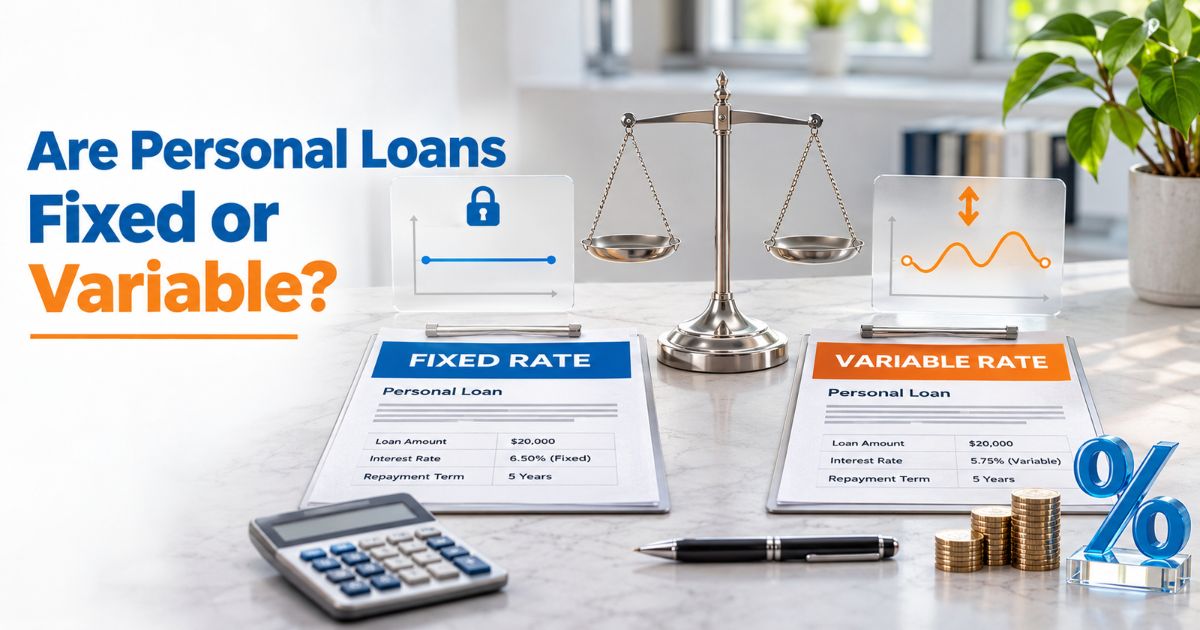
A fixed-rate personal loan generally provides predictable principal and interest payments throughout the agreed repayment period. A variable-rate loan may initially offer an attractive rate, but that rate can rise or fall according to a benchmark and the terms of your agreement.
Understanding are personal loans fixed or variable is an important part of evaluating borrowing options. Before accepting an offer, compare annual percentage rates (APRs), origination fees, repayment terms, payment schedules, and possible interest-rate adjustments.
This 2026 guide explains seven practical considerations for comparing personal loan structures, calculating monthly costs, understanding variable-rate risks, reviewing lender requirements, and making an informed borrowing decision.
For additional information, read our personal loan application guide and personal loan interest rate comparison.
Key Takeaways
- Many U.S. personal installment loans offer fixed interest rates.
- Some lenders provide variable-rate personal loans.
- A fixed rate does not normally change because of market interest-rate movements.
- Variable rates may adjust according to an index and contractual margin.
- A stable interest rate generally supports predictable scheduled payments on a conventional amortizing loan.
- Variable-rate borrowing may become more expensive if the benchmark increases.
- APR provides a broader borrowing-cost measure than the interest rate alone.
- Origination fees and repayment periods can significantly affect total costs.
- Early repayment rules, late charges, and lender disclosures should be reviewed before signing.
- The most appropriate rate structure depends on affordability, risk tolerance, and expected repayment timing.
1. Are Personal Loans Fixed or Variable? Understanding the Difference
When comparing personal loans, the primary distinction is whether the contractual interest rate remains unchanged or can adjust during repayment.

What is a fixed-rate personal loan?
A fixed-rate personal loan uses a contractual interest rate that normally remains unchanged throughout the original repayment period.
For a standard fully amortizing loan with equal monthly installments, the scheduled principal and interest payment remains the same.
This structure makes future repayment obligations easier to estimate.
What is a variable-rate personal loan?
A variable-rate personal loan has an interest rate that can change according to an external benchmark or another contractually specified adjustment method.
If the applicable index rises, the borrowing rate may increase. If the index decreases, the rate may fall, subject to contractual limits.
Why most borrowers consider fixed rates
Predictability can help borrowers maintain household budgets and reduce exposure to unexpected interest-rate increases.
However, fixed-rate financing is not automatically cheaper than every variable-rate offer.
Why some borrowers consider variable rates
A variable-rate product might initially offer a lower rate or other attractive terms.
Nevertheless, future costs may increase if market conditions change.
Fixed versus variable comparison
| Feature | Fixed Rate | Variable Rate |
|---|---|---|
| Interest Rate | Normally unchanged | May change |
| Monthly Payments | Generally predictable | May increase or decrease |
| Market Rate Exposure | Limited under fixed contract | Depends on benchmark |
| Budget Planning | More predictable | Requires flexibility |
| Total Interest | Calculable under original schedule | Depends on future rates |
| Important Risk | Possibly higher initial pricing | Possible future rate increases |
The question are personal loans fixed or variable cannot be answered for every product without examining the individual lender’s terms.
Compare our secured versus unsecured personal loans guide and secured personal loan requirements for related borrowing structures.
2. How Fixed-Rate Personal Loans Work
A fixed-rate personal loan typically combines a predetermined interest rate, repayment period, and installment schedule.

How fixed interest rates affect payments
On a conventional fixed-rate installment loan, the required principal and interest payment is calculated using the original interest rate, financed amount, and repayment period.
Market interest-rate movements generally do not change that contractual rate.
Understanding principal
Principal represents the outstanding borrowed amount before applicable interest and other charges.
Repaying principal reduces the remaining debt balance.
Understanding interest
Interest is the amount charged for borrowing money.
For a common simple-interest amortizing loan, interest is calculated using the outstanding balance and applicable rate.
What is amortization?
Amortization distributes loan repayments over the agreed schedule.
Early installments generally allocate a larger portion to interest, while later payments allocate more toward principal.
Why the payment stays constant
The scheduled installment remains constant because the amortization formula accounts for the original loan balance, rate, and repayment term.
Late fees, missed payments, optional products, or other contract events can still affect amounts due.
Illustrative fixed-loan calculation
Consider a $10,000 loan at a fixed 10% annual interest rate with 36 monthly payments.
| Item | Illustrative Amount |
|---|---|
| Loan Principal | $10,000 |
| Annual Interest Rate | 10% |
| Repayment Period | 36 months |
| Approximate Monthly Payment | $322.67 |
| Approximate Total Interest | $1,616 |
These estimates assume ordinary monthly amortization, no additional fees, and all payments made on time.
Benefits of a fixed rate
- Predictable scheduled principal and interest installments.
- Reduced exposure to benchmark-rate changes.
- More straightforward repayment planning.
- Known interest costs under the original schedule.
Limitations of fixed-rate financing
A fixed rate does not automatically guarantee the lowest available APR.
If comparable market rates decline, the original contractual rate generally remains unchanged unless the loan is refinanced or modified.
Refinancing may involve new fees and underwriting requirements.
For additional cost planning, review our personal loans without origination fees and paying off personal loans early.
For borrowers asking are personal loans fixed or variable, a fixed-rate offer provides greater certainty about scheduled interest costs.
3. How Variable-Rate Personal Loans Work
Variable-rate financing allows the contractual interest rate to respond to changes in a specified financial benchmark.

Understanding the interest-rate index
An index is a benchmark used to determine the variable interest rate.
Some financial products reference the prime rate or another published benchmark.
What is a lender margin?
The margin is the additional percentage specified in the agreement.
It may be added to the benchmark to determine the applicable contractual rate.
Variable interest formula
Interest Rate = Benchmark Index + Contractual Margin
For example, an illustrative benchmark of 7% plus a 4% margin results in an 11% contractual interest rate.
This is a hypothetical calculation, not a current quoted market rate.
How frequently can rates change?
The loan agreement determines when adjustments occur.
Possible schedules include monthly, quarterly, or annual adjustments, depending on the product.
What happens when the benchmark rises?
If the benchmark increases and the agreement permits a corresponding adjustment, the borrower may face higher interest charges.
Depending on the repayment structure, the lender may increase scheduled payments or apply another contractually specified adjustment.
What happens when the benchmark falls?
A decrease may reduce the contractual rate, although rate floors, adjustment restrictions, and timing rules can limit the benefit.
What are interest-rate caps?
Some variable-rate agreements establish limitations on certain rate increases.
However, such caps should never be assumed without checking the actual contract.
What is an interest-rate floor?
A floor limits how low the contractual rate may fall.
If the benchmark declines below the relevant level, the borrower may not receive the full reduction.
Variable-rate risk example
| Scenario | Index | Margin | Rate |
|---|---|---|---|
| Initial | 7% | 4% | 11% |
| Index Rises | 9% | 4% | 13% |
| Index Falls | 5% | 4% | 9% |
These examples assume the index and margin formula applies without caps, floors, or other adjustments.
Why variable rates can complicate budgeting
The uncertainty of future interest expenses can make it harder to estimate total borrowing costs.
Before choosing a variable-rate loan, examine how much payments could rise under realistic adverse scenarios.
For broader rate comparisons, see our personal loan rate comparison guide and personal loans for a 650 credit score.
Understanding are personal loans fixed or variable is especially important when a small increase in monthly expenses could disrupt your budget.
4. Compare Fixed and Variable Monthly Payments
Monthly affordability should be considered alongside total repayment costs and interest-rate risks.

Illustrative fixed-rate payments
Suppose a borrower takes a $12,000 personal loan with a 36-month repayment term.
At a hypothetical fixed 10% annual interest rate, the monthly principal and interest payment would be approximately $387.
Illustrative variable-rate payments
If a comparable variable-rate loan initially charges 8%, its starting monthly payment could be lower.
However, payment adjustments would depend on the agreement’s provisions and subsequent rate changes.
Compare the starting rate
A variable-rate offer may start below a fixed-rate offer, but the initial rate should not be treated as a guaranteed full-term rate.
Compare future payments
Ask the lender to explain how a two-percentage-point increase in the contractual rate would affect monthly payments.
For a variable product, understand whether the adjustment applies immediately or at the next scheduled review.
Compare total repayment
Review total interest, fees, and other charges over the expected borrowing period.
Two loans with the same starting monthly installment may have different lifetime costs.
Do rates always change?
No. A variable-rate agreement permits adjustments under specified circumstances; it does not guarantee that the rate will change.
If the underlying benchmark remains unchanged, the contractual rate may remain stable during that period.
Comparison checklist
| Factor | Fixed Loan | Variable Loan |
|---|---|---|
| Starting APR | Check disclosed APR | Check initial APR |
| Rate Movement | Normally none | Index-dependent |
| Payment Planning | More predictable | Less predictable |
| Future Interest Costs | Known under original schedule | Potentially uncertain |
| Origination Fees | May apply | May apply |
| Early Repayment | Agreement-specific | Agreement-specific |
To evaluate overall affordability, see our finance charge explanation and personal loan borrowing checklist.
The question are personal loans fixed or variable should be considered alongside total repayment and household financial flexibility.
5. Understand APR, Origination Fees and Repayment Terms
Interest-rate type is only one component of personal loan pricing.
What is annual percentage rate?
APR is an annualized measure of borrowing cost that incorporates interest and certain finance charges required under applicable disclosure rules.
APR may differ from the stated interest rate when qualifying fees apply.
Why APR matters
Comparing advertised interest rates alone can overlook origination charges that reduce loan proceeds or increase the overall cost.
The Consumer Financial Protection Bureau’s explanation of interest rates and APR provides official background.
Origination fees
An origination fee may be charged when the loan is established.
For example, a $10,000 loan with a 5% fee deducted from proceeds would provide $9,500 before any other deductions, even though the contractual debt may begin at $10,000.
Loan repayment period
A longer repayment term normally lowers scheduled installments for an otherwise identical fixed-rate amortizing loan.
However, extending the term often increases total interest expenses.
Late-payment fees
Some lenders charge a fee when payments are received after the applicable deadline or grace period.
Review the fee amount and when it may legally be assessed.
Returned-payment fees
A lender may charge an additional fee if an authorized payment fails, subject to the agreement and applicable rules.
Prepayment penalties
Some loans include early repayment restrictions or charges.
Many personal loan products permit early payoff without a penalty, but that policy should be verified rather than assumed.
Autopay discounts
Some lenders offer a rate reduction when borrowers enroll in qualifying automatic payments.
Check whether the discount can be removed and how that would affect the contractual rate.
Loan cost comparison
| Cost | What to Verify |
|---|---|
| Interest Rate | Fixed or adjustable |
| APR | Disclosed annualized borrowing cost |
| Origination Fee | Upfront charge and net proceeds |
| Repayment Term | Number of scheduled installments |
| Late Fee | Amount and applicable conditions |
| Prepayment | Early payoff restrictions |
| Autopay Discount | Eligibility and continuation conditions |
Additional guides include personal loan origination fee comparisons and personal loan early repayment rules.
When researching are personal loans fixed or variable, compare APR and total payment obligations rather than selecting a product using the advertised rate alone.
6. Review Credit Scores, Income and Lender Eligibility
Lenders evaluate whether borrowers meet their underwriting requirements and can reasonably repay the requested loan.
Credit history
Consumer credit reports provide information about past payment activity, outstanding balances, account history, and other relevant factors.
Different lenders may evaluate credit information differently.
Credit score requirements
There is no single universal score required by every personal loan provider.
Some lenders primarily serve applicants with strong credit histories, while others consider borrowers with weaker scores.
Income verification
Lenders may request documentation establishing the applicant’s income and ability to make scheduled payments.
Acceptable sources and required records vary.
Debt-to-income ratio
DTI compares qualifying monthly debt obligations with gross monthly income.
DTI = Monthly Debt Payments ÷ Gross Monthly Income × 100
For example, $800 in monthly debt payments divided by $4,000 in gross monthly income produces a 20% ratio.
Employment and income stability
Consistent income may strengthen an application, but employment type alone does not determine approval.
Self-employed borrowers may need to provide different documentation.
Loan purpose
Personal loan agreements may restrict certain uses of funds.
Always confirm that the intended expense is permitted.
Prequalification
Some lenders offer preliminary rate estimates using a soft credit inquiry.
Prequalification is not the same as guaranteed approval, and final terms may change after verification.
Final approval
A formal application may involve a hard credit inquiry and additional checks.
Review the final rate structure, APR, repayment schedule, and fees before accepting the agreement.
See our minimum credit score for personal loans, personal loans for bad credit, and 650 credit score personal loan guide.
Understanding are personal loans fixed or variable is important, but the actual price offered depends on the lender’s assessment of the complete application.
7. Choose the Right Loan Structure for Your Financial Situation
Neither interest-rate structure is universally appropriate for every borrower.
When fixed rates may be useful
Fixed-rate loans may suit borrowers who want predictable scheduled payments and do not want their contractual interest rates to move with financial benchmarks.
When variable rates require extra caution
A variable-rate offer requires careful evaluation when household income is irregular or limited.
Borrowers should estimate whether they could continue making payments after a significant rate increase.
Short repayment periods
For a shorter term, borrowers may have less exposure to future rate adjustments, although the actual risk depends on the contract.
Long repayment periods
Longer terms increase the period during which a variable benchmark may change.
A lower starting rate therefore does not guarantee lower overall borrowing costs.
Debt consolidation
Personal loans may be used to consolidate eligible debts.
However, a replacement loan should be compared against existing obligations using APR, fees, repayment length, and total cost.
Review our personal loans for credit card debt and debt consolidation with bad credit.
Emergency expenses
Before borrowing for an unexpected expense, consider whether the new payment fits within essential household spending.
Borrowing to resolve a temporary shortage may create longer-term obligations.
Existing loan balances
If the purpose is replacing a current loan, calculate the remaining cost of the original agreement and compare it with the proposed replacement.
Home equity products
Some homeowners consider home equity loans or lines of credit because they may offer different rate structures.
However, borrowing secured by a home creates foreclosure risk if the required obligations are not met.
Credit card balance transfers
Introductory balance-transfer offers may provide temporary promotional rates, but transfer fees and the rate after expiration can affect total costs.
Nonprofit credit counseling
Qualified nonprofit credit counseling organizations may help borrowers review budgets and repayment strategies without automatically taking out another loan.
For additional comparisons, read our credit card debt management guide and secured versus unsecured borrowing comparison.
The answer to are personal loans fixed or variable is only one part of choosing financing that fits your actual repayment capacity.
8. How to Compare Personal Loan Offers Step by Step
Step 1: Identify the borrowing need
Calculate the actual expense and avoid requesting unnecessary additional funds.
Step 2: Review available savings
Determine whether using a portion of existing funds would avoid excessive interest expenses while preserving appropriate emergency liquidity.
Step 3: Check your credit reports
Review reported information and dispute material inaccuracies.
Step 4: Request preliminary estimates
Consider prequalification options that disclose whether credit inquiries are soft or hard.
Step 5: Compare rate structures
Identify whether each quoted offer uses a fixed rate, adjustable rate, or a different financing structure.
Step 6: Compare APR
Review the disclosed annual percentage rate rather than relying on a promotional interest-rate figure.
Step 7: Compare repayment terms
Calculate monthly affordability and total repayment costs under the proposed schedule.
Step 8: Review variable-rate adjustment provisions
Ask about the index, margin, adjustment schedule, rate floors, caps, and possible payment changes.
Step 9: Identify additional fees
Review origination charges, late fees, returned-payment fees, and early repayment provisions.
Step 10: Read final loan documents
The signed agreement should accurately reflect the financial terms you intend to accept.
Step 11: Verify lender identity
Confirm the lender’s legal identity and relevant licensing or regulatory status before sharing sensitive information.
Step 12: Compare complete written offers
Use a standard comparison worksheet and avoid evaluating one offer using interest rates while evaluating another using APR.
| Comparison Factor | Offer A | Offer B |
|---|---|---|
| Rate Structure | Fixed | Variable |
| Illustrative Initial Rate | 10% | 8% |
| Loan Amount | $10,000 | $10,000 |
| Term | 36 months | 36 months |
| Origination Fee | Check contract | Check contract |
| Future Rate Exposure | Normally none | Possible adjustments |
| Total Repayment | Calculate from disclosure | Scenario-dependent |
These offers are hypothetical and do not represent current lender quotations.
Consult the CFPB’s official fixed versus variable APR explanation for additional background. Its discussion focuses on credit cards, so always consult your personal loan’s specific documents.
For guidance on comparing financing, read our steps to get a personal loan and personal loan APR comparison article.
9. Common Personal Loan Mistakes to Avoid
Assuming all personal loans have fixed rates
Although many installment products use fixed pricing, the rate structure must be verified for each offer.
Comparing interest rate with APR
These measures are not identical when applicable fees affect the annualized borrowing cost.
Ignoring variable-rate adjustments
A low starting rate does not guarantee the same payment throughout the loan.
Choosing the longest available term
Long repayment periods may lower installments but increase cumulative interest expense.
Overlooking origination fees
A deducted fee may reduce the amount of money actually received while leaving the original contractual principal unchanged.
Ignoring early repayment provisions
Check whether paying off the loan before maturity affects fees or interest calculations.
Borrowing beyond affordability
The approved loan amount may exceed what a borrower can comfortably repay.
Accepting unclear lending promises
Be cautious when a provider does not clearly disclose rate calculations, charges, or payment obligations.
Assuming prequalification guarantees approval
Preliminary estimates can change after the lender verifies financial and credit information.
Relying on verbal statements
Always review the final documents and request clarification of any differences.
For additional borrower protections, review our bad-credit personal loan risks guide and early loan payoff considerations.
Before accepting a product, ensure the question are personal loans fixed or variable has been clearly answered in the written agreement.
Final Personal Loan Comparison Checklist
- Confirm the actual loan purpose.
- Calculate the borrowing amount needed.
- Review available savings.
- Check current credit reports.
- Understand lender eligibility requirements.
- Confirm whether the interest rate is fixed or variable.
- Review the disclosed APR.
- Check origination fees.
- Compare net loan proceeds.
- Calculate scheduled monthly payments.
- Review total repayment costs.
- Check the repayment period.
- Understand variable-rate benchmarks.
- Review the applicable margin.
- Confirm rate adjustment frequency.
- Check for rate caps and floors.
- Estimate possible higher payments.
- Review early repayment rules.
- Check late fees and grace periods.
- Understand autopay discounts.
- Review the consequences of default.
- Confirm the lender’s identity.
- Compare multiple written offers.
- Verify the final contract terms.
- Ensure payments fit the household budget.
Conclusion
Are personal loans fixed or variable? Many U.S. personal installment loans use fixed interest rates, while certain lenders and products offer adjustable-rate alternatives.
Fixed-rate financing generally provides predictable scheduled principal and interest payments. Variable-rate financing may allow borrowing costs to rise or fall as the underlying benchmark changes.
Neither type automatically guarantees the lowest total cost. Origination fees, APR, repayment terms, prepayment conditions, and lender policies can influence the financial outcome.
Borrowers should compare complete written offers, calculate realistic payment scenarios, and consider whether future rate increases would create financial pressure.
The final decision should reflect both the total borrowing cost and the borrower’s ability to maintain essential expenses throughout repayment.
Frequently Asked Questions
Are personal loans fixed or variable?
Many traditional personal installment loans use fixed interest rates, but some products offer variable rates. Confirm the rate structure in the lender’s agreement before borrowing.
Can a fixed personal loan rate increase?
A genuine fixed contractual rate normally does not increase because market benchmark rates rise. Other charges or special contract events may still affect the amount due.
Can a variable personal loan rate decrease?
Yes. A variable rate may decline when its benchmark decreases, subject to contractual adjustment dates, floors, and other limitations.
What is the difference between APR and interest rate?
Interest represents the cost charged for borrowing principal. APR is an annualized measure that includes interest and certain applicable financing charges.
Are fixed-rate loans always better?
No. Fixed rates provide greater predictability, but the most suitable option depends on APR, fees, repayment terms, affordability, and personal risk tolerance.
Why do some lenders offer variable rates?
Variable-rate products allow pricing to adjust with an agreed financial benchmark. Starting rates and adjustment rules depend on the agreement.
Can a variable rate affect monthly payments?
Yes. Depending on the repayment structure, a benchmark adjustment may change required installments or other loan terms.
What determines personal loan APR?
APR depends on the contractual interest rate and qualifying finance charges. Offered pricing can also depend on credit history, income, loan amount, term, and lender policies.
Can I repay a personal loan early?
Many agreements permit early repayment. Review the contract for any applicable restrictions, fees, or interest calculation rules.
Are origination fees included in APR?
Origination charges that qualify as finance charges under applicable rules are generally reflected in the APR calculation.
Does prequalification guarantee approval?
No. Preliminary estimates may change after verification of income, identity, credit history, and other underwriting information.
Can I use a personal loan for debt consolidation?
Many borrowers use eligible personal loans for consolidation. Compare total costs, fees, and terms against the existing debts before proceeding.
How do I compare fixed and variable loan offers?
Compare APR, fees, net proceeds, repayment term, payment affordability, and the potential effect of future benchmark changes.
What should I check before signing?
Confirm the rate structure, APR, payment schedule, total borrowing cost, fees, adjustment provisions, and default conditions in the written agreement.