Quick answer: In the debate of personal loans vs payday loans, a personal loan is almost always cheaper and safer. A personal loan is repaid in monthly installments over months or years, usually at APRs from single digits to about 36%. A payday loan is a small, two-to-four-week loan repaid in one lump sum, and a typical $15 fee per $100 equals an APR of almost 400%, according to the CFPB.
This guide compares personal loans vs payday loans on cost, approval, credit impact and risk, shows real dollar examples, and lists safer options if you need cash fast or have bad credit. It is educational information for U.S. borrowers, not financial advice.
Key Takeaways
- In personal loans vs payday loans comparisons, the biggest difference is total cost, not speed.
- Payday loans are usually $500 or less, due on your next payday, and often cost $10 to $30 per $100 borrowed.
- A $400 payday loan at $15 per $100 costs $60 for two weeks; rolling it over four times adds $240 more in fees while you still owe the $400.
- A $1,000 personal loan at 25% APR over 12 months costs about $95 a month and about $141 in total interest.
- Credit union payday alternative loans (PALs) are capped at 28% APR with an application fee of no more than $20.
- Personal loans usually require a credit check; payday loans usually do not, which is why they cost so much more.
- Active-duty service members and dependents are protected by a 36% rate cap under the Military Lending Act.
Personal Loans vs Payday Loans: Side-by-Side Comparison
The table below sums up personal loans vs payday loans at a glance.
| Feature | Personal loan | Payday loan |
|---|---|---|
| Typical amount | $1,000 to $50,000 | $500 or less (state limits vary) |
| Repayment | Fixed monthly installments, 12 to 84 months | One lump sum in 2 to 4 weeks |
| Typical cost | APR roughly 7% to 36% | $10 to $30 per $100; often near 400% APR |
| Credit check | Usually yes | Usually no traditional check |
| Builds credit | Often, if the lender reports on-time payments | Rarely reported unless it goes to collections |
| Access to your bank account | Optional autopay | Post-dated check or debit authorization required |
| Funding speed | Same day to a week | Same day |
| Rollover risk | None; balance falls each month | High; fees repeat if you cannot repay in full |
What Is a Payday Loan?
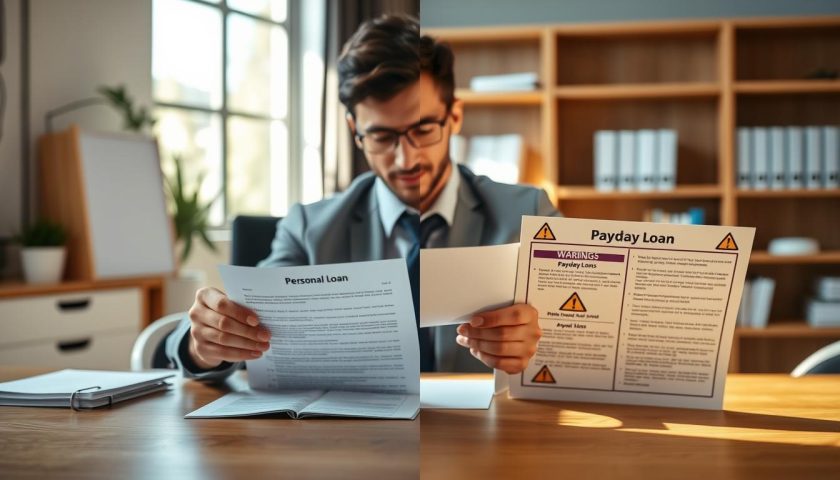
A payday loan is a short-term, high-cost loan, often for $500 or less, that is due on your next payday. To get one, you usually write a post-dated check or authorize the lender to withdraw the full balance from your checking account on the due date. Finance charges commonly range from $10 to $30 for every $100 borrowed, depending on state law.
The bigger risk is the rollover. If you cannot repay in full, some states let you pay only the fee and extend the loan, so you pay another fee and still owe the entire original amount. Payday lending is banned or heavily restricted in a number of states, so availability depends on where you live.

What Is a Personal Loan?
On the other side of personal loans vs payday loans, a personal loan is an installment loan: you receive a lump sum and repay it in equal monthly payments that include interest, so the balance drops to zero by the end of the term. Most are unsecured and come from banks, credit unions and online lenders. Approval and price depend on your credit score, income and debt-to-income ratio. Start with our guide on how to get a personal loan and how personal loan rates are set.

Personal Loans vs Payday Loans: The Real Cost
APR makes the difference clear because it puts both loans on a yearly basis. The CFPB explains that a $15 fee per $100 on a two-week loan works out to an APR of almost 400%. Here is what that looks like in dollars. These are illustrative calculations, not lender quotes.
| Scenario | Amount | Cost | What you still owe |
|---|---|---|---|
| Payday loan, repaid in 2 weeks ($15 per $100) | $400 | $60 fee | $0 after paying $460 |
| Same payday loan, rolled over 4 times (10 weeks) | $400 | $300 in fees | Still $400 |
| Credit union PAL, 28% APR, 3 months | $400 | About $19 interest + up to $20 fee | $0 after 3 payments of about $140 |
| Personal loan, 25% APR, 12 months | $1,000 | About $141 interest | $0 after 12 payments of about $95 |
| Personal loan, 36% APR, 12 months | $1,000 | About $206 interest | $0 after 12 payments of about $100 |
This is the core of personal loans vs payday loans: the payday borrower in the rollover example pays $300 for ten weeks of access to $400. The personal loan borrower pays less than that to borrow more than twice as much for a full year. Watch for origination fees on personal loans, which are deducted from the money you receive; see personal loans with no origination fee.
Personal Loans vs Payday Loans: Which Is Easier to Get?
Payday loans are easier to get: lenders typically need ID, an active checking account and proof of income, and they rarely run a traditional credit check. That convenience is exactly why the price is so high.
Personal loans usually need fair or better credit, verifiable income and a manageable debt load. Many lenders let you prequalify with a soft credit check, which does not affect your score; read whether prequalification affects your credit score and the minimum credit score for a personal loan. If your score is low, compare personal loans for bad credit and the options at a 650 credit score.
Personal Loans vs Payday Loans: Credit Impact
An installment loan that the lender reports to the credit bureaus can help your credit when every payment is on time, because payment history is the largest factor in most scores. See how credit scores are calculated.
Payday lenders usually do not report on-time payments, so the loan does nothing to build credit. If the loan goes unpaid and is sold to a collector, the collection account can hurt your score. Failed withdrawals can also trigger bank overdraft or returned-payment fees. Learn what happens when a loan goes into default.
Safer Alternatives to Payday Loans

If neither side of personal loans vs payday loans fits your situation, these options usually cost less than a payday loan:
- Credit union payday alternative loans (PALs): federal credit unions can offer PALs from $200 up to $2,000, with terms of 1 to 12 months, APRs capped at 28% and an application fee of $20 or less. You can have only one at a time.
- Small personal loans: some banks and credit unions offer loans of a few hundred to a few thousand dollars.
- Payment plans: utilities, hospitals and many landlords will set up a plan if you ask before the bill is overdue.
- Employer paycheck advance: some employers advance earned wages at low or no cost; read the fee terms of any app carefully.
- Local assistance: 211.org connects you with nonprofit help for rent, utilities and food.
- Credit counseling: a nonprofit counselor can help if payday loans are already stacking up. Our guide to debt consolidation with bad credit explains the trade-offs.
Personal Loans vs Payday Loans: Which Should You Choose?
For most people, the personal loans vs payday loans decision comes down to whether you can qualify and afford the monthly payment.
- Choose a personal loan or PAL if you can qualify and the monthly payment fits your budget. You pay far less and build credit.
- Consider a payday loan only as a last resort, for a small amount you are certain you can repay in full on the due date, after checking every alternative above.
- Avoid both if the need is recurring every month; the gap needs a budget fix, not new debt.
Military borrowers comparing personal loans vs payday loans should know that the Military Lending Act limits most consumer loans to active-duty service members and their dependents to a 36% military annual percentage rate.
Frequently Asked Questions
Personal loans vs payday loans: which is better?
For most borrowers, yes. Personal loans cost far less, spread repayment over months and can build credit. Payday loans are faster and easier to get but much more expensive.
What is the APR on a payday loan?
A common $15 fee per $100 on a two-week loan equals an APR of almost 400%, according to the CFPB. Fees and limits vary by state.
Can I get a personal loan with bad credit instead of a payday loan?
Often, yes. Credit unions, secured loans and co-signers can help. Expect a higher APR than prime borrowers, but it is still usually far below payday pricing.
Do payday loans build credit?
Usually not, because most payday lenders do not report on-time payments. Unpaid payday loans sent to collections can hurt your score.
Can I use a personal loan to pay off payday loans?
Yes. Using a lower-APR personal loan or PAL to pay off payday loans can stop the rollover cycle, as long as you do not take new payday loans afterward.
Are personal loans vs payday loans regulated differently?
Yes. Personal loans follow state lending laws and federal Truth in Lending disclosure rules; payday loans face extra state limits on size, fees and rollovers, and some states ban them.
How fast can I get a personal loan?
Some online lenders fund the same or next business day after approval; banks and credit unions may take several days.
Bottom Line
When you compare personal loans vs payday loans, the personal loan wins on cost, repayment structure and credit building for almost every borrower who can qualify. If you need cash quickly, check a credit union PAL, a small personal loan or a payment plan first, and treat payday loans as a true last resort.
Sources
- CFPB: What are the costs and fees for a payday loan?
- NCUA final rule: Payday Alternative Loans (PALs II)
- CFPB: Military Lending Act
Fees, state laws and loan terms change. Figures were checked in November 2026; confirm current terms with the lender or your state regulator.