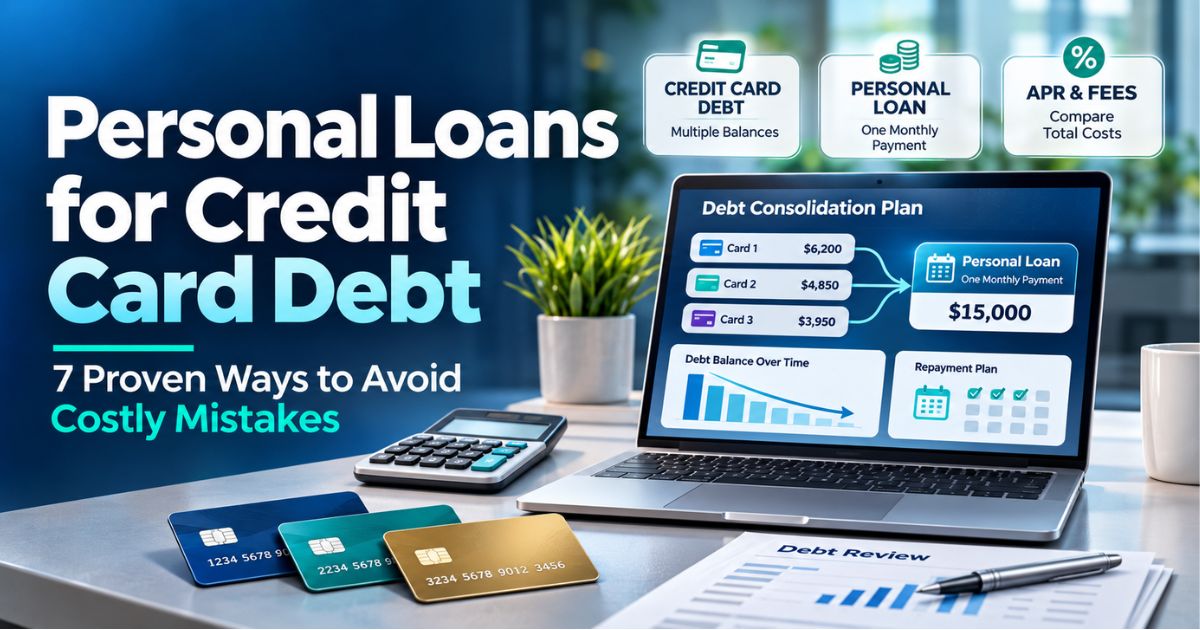
Credit card balances can become difficult to manage when several accounts have different interest rates, minimum payments, and due dates. A consolidation loan replaces selected balances with a new repayment obligation, usually involving scheduled monthly installments.
Before considering personal loans for credit card debt, compare the new loan’s annual percentage rate (APR), origination fees, repayment term, and total cost against your existing credit card agreements.
A lower monthly installment does not always mean lower borrowing costs. Extending repayment over additional years may increase total interest even when the new APR is lower.
This guide explains seven practical steps for evaluating debt consolidation, comparing loan offers, understanding credit score effects, examining alternatives, and avoiding costly borrowing mistakes.
For additional guidance, explore our debt consolidation guide, personal loans without origination fees, and money management guide.
Key Takeaways
- Consolidating credit card balances may simplify repayment.
- A lower APR can potentially reduce borrowing costs.
- Origination fees may offset expected savings.
- Longer repayment terms can increase total interest.
- Loan applications may temporarily affect credit scores.
- Balance transfer cards and credit counseling offer alternatives.
- Rebuilding credit card balances after consolidation creates additional financial risk.
- Compare written offers and total repayment costs before borrowing.
1. Are Personal Loans for Credit Card Debt a Good Idea?
Whether personal loans for credit card debt make financial sense depends on the cost of existing obligations, available lending terms, repayment capacity, and spending habits.

When consolidation may help
A personal installment loan may be beneficial when it offers a lower total borrowing cost than existing credit card obligations.
For example, replacing several high-APR revolving balances with a reasonably priced fixed-rate loan could make repayment more predictable.
Consolidation may also simplify budgeting by combining multiple due dates into one scheduled payment.
When consolidation may be expensive
A replacement loan might increase costs when it includes a high APR, substantial origination fees, or a much longer repayment period.
Even when the new monthly payment is smaller, the total interest paid over the loan’s lifetime may increase.
The risk of accumulating new balances
Paying off credit cards creates available credit, but the cards may remain open.
If you resume spending heavily while repaying the installment loan, you can end up owing both the new loan and additional card debt.
When an alternative may be better
If you can repay existing balances quickly without borrowing, a self-directed repayment plan may be less expensive.
If payments are already unaffordable, nonprofit credit counseling or creditor hardship assistance may be more appropriate than taking on another loan.
Choosing personal loans for credit card debt should involve a realistic evaluation of your finances rather than relying on advertised savings.
2. Calculate the Full Cost Before Borrowing
Understanding the total cost of a personal loan requires more than comparing monthly installments.

Compare APR instead of interest rate alone
The annual percentage rate provides an annualized measure of borrowing costs, including interest and certain required financing charges.
Two loans may advertise similar interest rates but have different APRs because of fees.
For authoritative information, read the Consumer Financial Protection Bureau’s debt consolidation guidance.
Understand origination fees
Some lenders charge origination fees to establish a loan.
For example, consider a $10,000 loan with a 5% origination fee deducted from the proceeds.
The lender may disburse $9,500 while the borrower remains responsible for repaying the contractual principal and interest.
Compare repayment terms
Longer loan terms generally produce smaller scheduled payments but greater cumulative interest at the same rate.
Shorter terms may reduce borrowing costs while requiring higher monthly installments.
Illustrative loan comparison
Assume a $10,000 loan with a fixed 12% annual interest rate, monthly amortization, and no additional fees.
| Loan Term | Approx. Monthly Payment | Approx. Total Interest |
|---|---|---|
| 24 Months | $470.73 | $1,297.63 |
| 36 Months | $332.14 | $1,957.15 |
| 48 Months | $263.34 | $2,640.24 |
These are hypothetical educational calculations, not actual available loan offers. Payments and interest are approximate.
Check other charges
Review late fees, returned-payment charges, potential prepayment provisions, and optional insurance products.
Before applying for personal loans for credit card debt, request the complete repayment disclosures from each prospective lender.
3. Inventory Your Existing Credit Card Balances
Successful repayment planning begins with knowing exactly how much money you owe.

List every outstanding account
For each credit card, record the current balance, purchase APR, minimum payment, and payment due date.
Also identify promotional balance transfer rates, cash advance balances, and other amounts subject to different interest terms.
Example credit card debt inventory
| Account | Balance | APR | Minimum Payment |
|---|---|---|---|
| Credit Card A | $2,500 | 24.99% | $75 |
| Credit Card B | $4,000 | 19.99% | $120 |
| Credit Card C | $1,500 | 22.99% | $45 |
| Total | $8,000 | Varies | $240 |
These numbers are hypothetical. Actual minimum payments depend on issuer rules, outstanding balances, and applicable charges.
Calculate the consolidation amount
Add the balances you intend to repay. Confirm whether loan fees will reduce available proceeds.
For example, an $8,000 loan with an upfront origination fee deducted may provide less than $8,000 for creditor payoffs.
Calculate debt-to-income ratio
Debt-to-income ratio compares qualifying monthly debt payments with gross monthly income.
DTI = Monthly Debt Payments ÷ Gross Monthly Income × 100
For example, $1,500 in monthly debt payments divided by $5,000 in gross monthly income results in a 30% DTI.
Set an affordable monthly payment
Review take-home income, housing, groceries, transportation, insurance, healthcare, and other essential expenses.
Leave room for emergencies rather than committing every available dollar to debt repayment.
Before choosing personal loans for credit card debt, determine the monthly payment you can reasonably maintain throughout the repayment term.
4. Compare Personal Loan Offers Carefully
Different banks, credit unions, and online lenders may offer different financing terms to the same borrower.

Review credit eligibility requirements
Each lender establishes its own underwriting standards. Credit history, income, existing obligations, and requested amount may affect approval.
There is no universal credit score that guarantees personal loan eligibility.
Compare fixed and variable interest rates
A fixed-rate installment loan generally maintains the same interest rate throughout the agreed period.
A variable-rate loan may change according to its contractual conditions.
Use prequalification when available
Some lenders offer preliminary eligibility checks using soft credit inquiries.
Soft inquiries do not affect credit scores, while formal applications may involve hard inquiries.
Verify the inquiry type before submitting an application.
Review the final loan offer
Prequalification is not guaranteed approval. The final offer may change after the lender verifies financial information.
Check the APR, amount financed, origination fees, loan term, and total payment obligations.
Compare consistent repayment periods
Comparing the same loan amount across different terms can create misleading results.
Whenever possible, compare offers using similar principal amounts and repayment durations.
Confirm how creditors receive payment
Some lenders deposit proceeds into the borrower’s bank account. Others may send funds directly to participating credit card issuers.
Ask how long disbursement and creditor payoff processing may take.
Review lender credibility
Verify company identity, applicable registration, customer service contact information, and contractual disclosures.
Be cautious of guaranteed-approval claims or unexplained payment demands.
When evaluating personal loans for credit card debt, choose terms that support sustainable repayment instead of focusing only on funding speed.
5. Compare Alternatives to Debt Consolidation Loans
A personal loan is not the only way to address expensive revolving debt.
Balance transfer credit cards
Some cards offer promotional introductory APR periods for eligible balance transfers.
These offers may reduce interest costs when the borrower qualifies and can repay the balance before the promotion ends.
However, balance transfer fees and post-promotional interest rates must be included in the calculation.
Credit card hardship programs
Some card issuers provide temporary assistance to borrowers experiencing financial hardship.
Possible arrangements include reduced interest rates, modified payments, or other creditor-approved support.
Benefits and eligibility depend on the issuer.
Nonprofit credit counseling
Reputable nonprofit credit counselors may help consumers assess budgets, creditor obligations, and repayment options.
Some agencies administer debt management plans that distribute scheduled payments to participating creditors.
Debt management plans
A debt management plan generally organizes repayment of existing obligations without creating a new consolidation loan.
Creditors may agree to particular concessions, but reductions in interest or fees are not guaranteed.
Debt avalanche method
The avalanche approach prioritizes additional payments toward the highest-interest debt while maintaining required payments elsewhere.
This can reduce total interest compared with some other repayment orders.
Debt snowball method
The snowball method prioritizes smaller balances first while maintaining minimum payments on other accounts.
It may provide motivation through quicker account payoffs, although total interest can be higher than with the avalanche method.
Debt settlement risks
Debt settlement differs from consolidation. Settlement involves negotiating repayment of less than the amount owed.
It may involve fees, credit damage, collection actions, lawsuits, and possible tax consequences.
Read the Federal Trade Commission’s debt relief guidance before paying any debt relief company.
Secured borrowing risks
Some consumers consider home equity borrowing to repay credit card balances.
However, converting unsecured obligations into home-secured debt creates foreclosure risk if payments are missed.
Before selecting personal loans for credit card debt, compare at least one realistic alternative based on your budget and financial circumstances.
6. Understand the Credit Score Impact
Debt consolidation may influence your credit profile in several ways.
Hard credit inquiries
Formal personal loan applications may generate hard inquiries, which can temporarily affect credit scores.
New installment account
Opening a loan changes your credit profile by adding an installment account and potentially changing account-age factors.
Reduced credit utilization
Paying down credit card balances may reduce revolving credit utilization.
However, the effect on your score depends on your overall credit file and the scoring model used.
Payment history
Making scheduled loan payments on time can support responsible credit management.
Missed payments may result in late fees, negative credit reporting, and collection activity.
Should you close paid-off cards?
Closing an account can reduce available revolving credit and affect utilization.
However, keeping cards open may increase the temptation to accumulate new balances.
Consider fees, spending habits, and personal circumstances before deciding.
Credit score improvements are not guaranteed
No lender can guarantee that consolidation will increase a particular credit score by a specific number of points.
When considering personal loans for credit card debt, focus primarily on affordability and total repayment costs rather than short-term score changes.
See our credit score improvement guide and credit prequalification guide.
7. Apply, Repay Credit Cards, and Manage Your New Loan
Once you decide that consolidation is appropriate, follow a structured process to avoid unnecessary financial complications.
Prepare application documents
Depending on the lender, required information may include:
- Government-issued identification.
- Proof of income.
- Residential address.
- Employment information.
- Existing debt details.
- Requested loan amount.
- Bank account information for approved funding.
Verify final financing disclosures
Check the APR, payment schedule, fees, first payment date, and total repayment amount.
Do not rely solely on an advertised rate or preliminary quote.
Pay the intended credit card balances
If funds are disbursed to your account, use them for the planned creditor payoffs.
Confirm each payoff amount before sending payment because interest may continue accumulating until the creditor receives the funds.
Check account balances afterward
Review credit card statements to confirm payments were applied correctly.
Small residual interest charges may appear after a payoff, depending on the card’s terms and timing.
Keep payment confirmations
Retain records of creditor payments, loan disbursements, and the signed financing agreement.
Set up installment reminders
Use calendar reminders or automatic payments when appropriate.
Ensure adequate funds are available to avoid overdrafts or returned-payment charges.
Maintain a sustainable budget
Track essential expenses and avoid accumulating new credit card balances.
Revisit your repayment plan when income or household expenses change.
Contact the lender during hardship
If financial difficulties arise, contact your lender before missing a scheduled installment when possible.
Ask about available hardship arrangements, repayment modifications, or other assistance.
Successful use of personal loans for credit card debt requires consistent repayment habits and attention to the complete debt picture.
Common Mistakes to Avoid
Choosing the smallest monthly payment
A lower installment may result from a longer loan term that increases total interest.
Ignoring origination fees
Upfront charges can reduce expected savings or leave insufficient funds for creditor payoffs.
Applying to too many lenders unnecessarily
Unrelated hard inquiries can affect credit scores. Consider suitable soft-inquiry prequalification when available.
Continuing heavy credit card spending
Accumulating additional balances after consolidation can increase overall debt instead of reducing it.
Accepting guaranteed savings promises
Any savings depend on actual borrowing costs, repayment timing, fees, and behavior.
Ignoring creditor hardship programs
Some borrowers may obtain suitable assistance directly from existing creditors without taking on another loan.
Converting unsecured debt into secured debt
Using assets as collateral creates an additional risk of property loss after default.
Failing to compare alternatives
Review balance transfers, counseling, debt management, and self-directed repayment strategies before committing.
Final Debt Consolidation Checklist
- List all credit card balances.
- Record APRs and minimum payments.
- Calculate the amount required for payoff.
- Review household income and essential expenses.
- Check your debt-to-income ratio.
- Compare multiple legitimate lenders.
- Confirm the APR and interest rate type.
- Check origination fees.
- Review repayment length.
- Calculate total scheduled payments.
- Compare a balance transfer alternative.
- Consider nonprofit credit counseling.
- Review credit score implications.
- Verify creditor payoff procedures.
- Keep all transaction records.
- Avoid rebuilding credit card balances.
Related Best Finance Live Guides
- Debt Consolidation With Bad Credit
- Personal Loans Without Origination Fees
- Personal Loan With a 650 Credit Score
- Minimum Credit Score for a Personal Loan
- Does Prequalification Affect Credit Score?
- How Long to Raise Your Credit Score
- What Is a Finance Charge?
- Complete Personal Finance Guide
Conclusion
Personal loans for credit card debt may help borrowers simplify payment management and potentially reduce financing costs when the available terms are favorable.
However, replacing revolving balances with a new installment loan does not automatically reduce total debt or guarantee financial savings.
Before applying, calculate the total repayment amount, review origination fees, compare lender APRs, and evaluate whether the scheduled installment fits your household budget.
Balance transfer credit cards, nonprofit credit counseling, creditor hardship programs, and self-directed repayment approaches may provide useful alternatives.
Ultimately, choosing personal loans for credit card debt responsibly means finding a manageable repayment strategy and avoiding additional obligations that could weaken long-term financial stability.