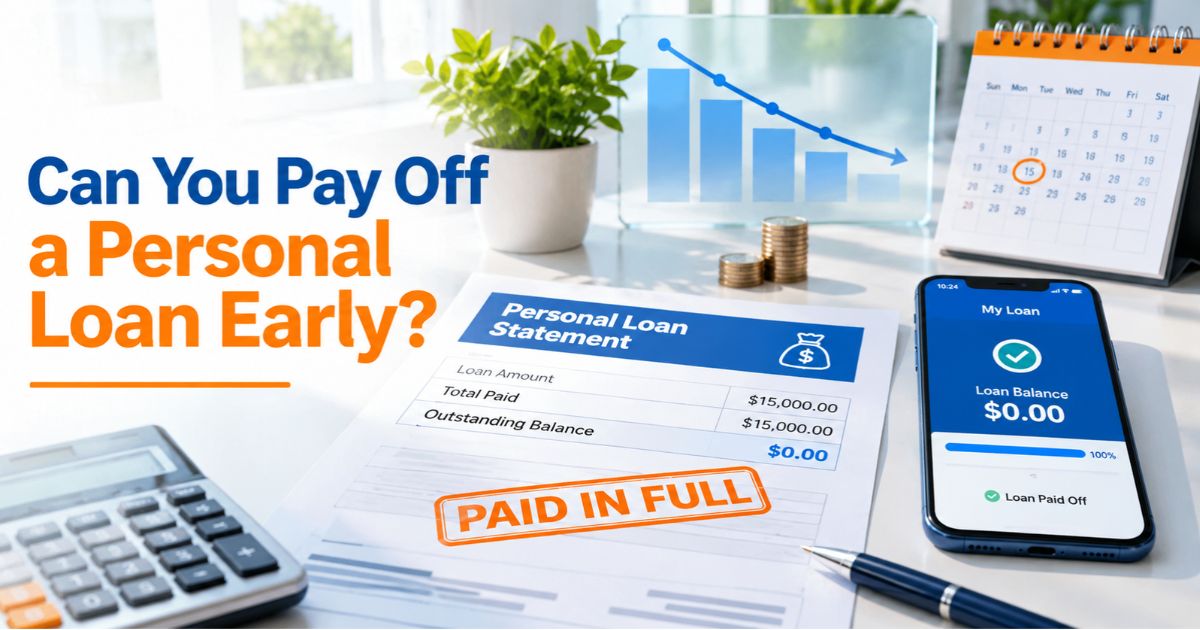
Early repayment can eliminate a monthly financial obligation and free money for savings or other priorities. But using a large amount of cash to close a loan may leave you without enough money for emergencies or higher-priority expenses.
Before deciding can you pay off a personal loan early, review your lender’s prepayment terms, request an official payoff quote, and compare the amount required today with your remaining scheduled payments.
This guide explains seven important steps for reviewing prepayment penalties, calculating potential interest savings, understanding amortization, protecting your emergency fund, and monitoring credit reports after a loan has been paid.
For related information, read our personal loan application guide and personal loan interest rates comparison.
Key Takeaways
- Most personal installment loans can be paid before their scheduled maturity date.
- Some agreements contain prepayment charges or other early-settlement conditions.
- Interest savings depend on the loan’s interest calculation and remaining term.
- A payoff quote can differ from the principal balance displayed on a monthly statement.
- Additional principal payments may reduce borrowing costs without requiring full repayment.
- Preserving an emergency fund can be more important than eliminating low-cost debt immediately.
- Paying off an installment loan does not guarantee an immediate credit score increase.
- Confirm the account is closed and keep the lender’s written settlement confirmation.
1. Can You Pay Off a Personal Loan Early?
When borrowers ask can you pay off a personal loan early, the general answer is yes. Most personal installment loan agreements permit borrowers to repay their outstanding debt before the original repayment period ends.
However, the financial benefit and exact procedure depend on the lender and contract.

What does paying off a loan early mean?
Early payoff occurs when you repay the amount required to satisfy the loan before the original final payment date.
For example, a borrower with a five-year personal loan may decide to repay the remaining balance after three years.
Once the lender receives and applies the correct payoff amount, the account can be closed according to the loan agreement.
Is early repayment always beneficial?
Not necessarily. Early repayment may save interest, but several financial factors deserve consideration.
These include:
- The remaining loan principal.
- The contractual interest rate.
- The number of payments remaining.
- Applicable prepayment charges.
- The amount of emergency savings available.
- Other debts with higher borrowing costs.
Do all lenders have the same rules?
No. Personal loan agreements differ among banks, credit unions, online lenders, and other financial institutions.
Some lenders permit full repayment without an additional charge. Others may apply fees where permitted by law and the contract.
Before asking can you pay off a personal loan early, examine your original loan documents rather than assuming that every financial institution follows identical rules.
Does paying extra automatically close the loan?
No. A large payment may reduce principal without fully satisfying accrued interest or other amounts due.
Ask your lender for the exact payoff amount and required payment instructions before attempting to close the account.
To understand how installment borrowing works, explore our secured personal loan guide and secured versus unsecured personal loans comparison.
2. Review Personal Loan Prepayment Penalties
A personal loan prepayment penalty is a charge that may apply when a borrower repays some or all of a loan before its scheduled maturity.
Not every lender charges this fee, and applicable legal limitations can vary.
Where should you check for penalties?
Review the original promissory note, loan agreement, and applicable financing disclosures.
Look for sections discussing:
- Prepayment.
- Early settlement.
- Early repayment fees.
- Finance charges.
- Interest calculation.
- Payment allocation.
- Loan termination.
How do prepayment penalties work?
The calculation depends on the contract.
Some agreements may specify a fixed charge, a percentage-based charge, or another permitted method.
Never assume that a charge applies merely because you are repaying early. Verify the exact terms.
Review applicable state laws
State laws may restrict certain prepayment charges, depending on the type of loan and lender.
Federal requirements can also affect particular lending products and borrowers.
Because rules differ, verify your individual situation before concluding that a charge is prohibited or permitted.
Understand other financing fees
Early payoff calculations may also involve previously assessed fees or unpaid charges.
The Consumer Financial Protection Bureau’s personal installment loan fee guidance explains the importance of reviewing lender disclosures and associated borrowing costs.
Example of a penalty affecting savings
Suppose paying a loan early would avoid $700 in future interest, but the applicable early repayment charge is $150.
Ignoring other financial considerations, the estimated net savings would be $550.
| Calculation | Illustrative Amount |
|---|---|
| Future Interest Avoided | $700 |
| Applicable Prepayment Fee | $150 |
| Estimated Net Savings | $550 |
This example is hypothetical. Actual savings depend on the lender’s payoff calculation.
Understand sunk financing costs
An origination fee already paid when the loan was issued is generally a past cost.
Unless the contract provides for a refund or rebate, repaying early may not recover that charge.
For borrowing cost comparisons, read our personal loans without origination fees guide and personal loan rate comparison.
Evaluating can you pay off a personal loan early should include potential fees instead of focusing solely on the interest rate.
3. Request an Accurate Personal Loan Payoff Quote
A payoff quote is a lender-provided statement showing the amount needed to satisfy an outstanding loan by a specified date.
It can include remaining principal, accrued interest, and applicable fees or adjustments.

Why your current balance may not equal the payoff amount
Your account dashboard may display the outstanding principal or a statement balance that does not include all interest accruing through the proposed settlement date.
The payoff amount may therefore be different from the figure shown on the latest monthly statement.
Ask for a specific payoff date
Contact the lender through its official customer service channel and request a payoff quote valid through the date you expect your payment to arrive.
The lender may provide a written statement or an amount through a secure account portal.
Understand accrued interest
For loans that accrue simple interest daily, the amount due can increase each day that principal remains outstanding.
Consider an illustrative $8,000 principal balance with an annual interest rate of 12%.
Assuming a 365-day calculation:
Daily Interest = $8,000 × 12% ÷ 365
The estimated daily interest would be approximately $2.63 while the principal remains unchanged.
Over ten days, approximately $26.30 could accrue.
Actual interest calculations depend on your agreement, payment dates, and balance changes.
Confirm the accepted payment method
Ask whether the lender accepts an electronic transfer, automated clearing house payment, wire transfer, check, or another authorized method.
Confirm when the payment must be received and how long processing normally takes.
Understand the good-through date
A payoff quote may only be valid through a specified date.
Sending the payment after that date can create a remaining balance if additional interest accrues.
Compare a statement balance with a payoff quote
| Feature | Statement Balance | Payoff Quote |
|---|---|---|
| Purpose | Regular account reporting | Complete debt settlement |
| Interest | May exclude later accrual | Generally calculated through a specified date |
| Fees | Shows applicable posted charges | Includes applicable settlement charges |
| Validity | Associated with a reporting date | Valid through stated payoff date |
What to request after payment
Once the funds clear, ask your lender to confirm that the obligation has been satisfied.
Keep the final statement, transaction confirmation, and any account-closure correspondence.
For related credit considerations, see our credit inquiry and prequalification guide and personal loan credit requirements guide.
When considering can you pay off a personal loan early, requesting a valid payoff quote is one of the most important administrative steps.
4. Calculate Potential Interest Savings Before Paying
The potential financial benefit of early repayment comes primarily from interest that would otherwise accrue or become payable under the remaining schedule.

What is an amortization schedule?
An amortization schedule shows scheduled installment payments and how each payment is allocated between principal and interest under the stated loan assumptions.
For a conventional fixed-rate installment loan, the interest portion generally declines as the principal balance decreases.
Compare remaining scheduled payments
Start by calculating the total amount you would pay if you continued making payments according to the existing schedule.
Then request the amount needed to settle the obligation immediately.
The difference can provide an initial estimate of the financial benefit of paying early.
Illustrative payoff savings calculation
Assume the following hypothetical situation:
| Loan Detail | Illustrative Amount |
|---|---|
| Remaining Scheduled Payments | $9,600 |
| Official Payoff Amount | $8,700 |
| Separate Applicable Payoff Fee | $100 |
| Estimated Savings | $800 |
This example assumes the $100 fee is not already included in the $8,700 payoff quote, and that no other adjustments apply.
Estimated Savings = $9,600 – $8,700 – $100 = $800
Check whether fees are already included
Do not subtract a fee twice.
If the official payoff quote already includes the applicable charge, use that total directly when comparing repayment options.
Understand simple interest
On a simple-interest installment loan, reducing outstanding principal generally reduces future interest accrual.
However, the actual effect depends on how payments are applied and how interest is calculated.
Understand precomputed interest
Some loans use a precomputed finance charge or another contractual method.
Early repayment under these arrangements may not generate the same savings as a standard daily simple-interest loan.
Review any required rebates, adjustments, or payoff provisions in the agreement.
Consider the timing of repayment
Paying earlier in the loan’s life may avoid more future interest than waiting until only a few installments remain.
However, a lower remaining balance, prepayment fee, or unusual interest structure can change that result.
Do not rely only on advertised savings
Borrowers should calculate net benefits using actual lender statements rather than relying on promises of a particular savings percentage.
For more information, compare our personal loan APR guide, loan fee comparison, and personal loan repayment planning guide.
Before deciding can you pay off a personal loan early, compare the verified financial savings with the amount of cash you would need to surrender.
5. Compare Full Payoff With Extra Principal Payments
Paying the entire remaining loan balance at once is not the only way to reduce financing costs.
Additional principal payments can sometimes shorten the loan term and reduce future interest while allowing the borrower to retain more savings.
Full loan payoff
Full repayment eliminates the remaining obligation after the lender properly applies all required funds.
It can free the monthly payment for other financial priorities.
However, it may require a substantial withdrawal from savings.
Additional monthly payments
Some borrowers make a payment larger than the scheduled installment.
When the additional amount reduces principal, future interest may decline under a simple-interest calculation.
Confirm payment allocation
Ask your lender whether additional money will be applied to principal, outstanding interest, permitted charges, or future scheduled installments.
Do not assume that every financial institution automatically applies an extra payment in the same way.
Example of an additional payment strategy
Suppose the required installment is $300 and your household can afford an additional $100 per month.
You might choose to pay $400 each month, subject to the loan terms and payment allocation rules.
The effect on total interest and the payoff date depends on the remaining balance, rate, payment timing, and lender procedures.
Compare repayment approaches
| Strategy | Potential Benefit | Main Consideration |
|---|---|---|
| Full Payoff | Eliminates outstanding loan obligation | Requires available cash |
| Extra Principal Payments | May reduce future interest | Account remains open |
| Regular Scheduled Payments | Preserves immediate liquidity | More scheduled interest may remain |
| Partial Lump-Sum Payment | Reduces principal without using all savings | Check payment application |
Protect your emergency fund
An emergency fund helps cover necessary expenses during unemployment, illness, unexpected repairs, or other financial disruptions.
A common planning goal is several months of essential expenses, although the suitable amount depends on income stability, household responsibilities, and risk.
Using every available dollar to repay a relatively low-interest loan can leave the household vulnerable to more expensive borrowing later.
Pay higher-interest debt first when appropriate
If you have a credit card with a considerably higher interest rate than your personal loan, prioritizing the more expensive debt may reduce total interest costs.
Account for fees, tax considerations where applicable, and essential liquidity needs.
Explore our personal loans for credit card debt guide and debt consolidation options.
When evaluating can you pay off a personal loan early, compare full settlement with gradual repayment strategies instead of assuming one approach fits every borrower.
6. Understand the Credit Score and Debt-to-Income Impact
Early loan repayment can change a borrower’s financial profile, but the effect on credit scores is not always straightforward.
Does paying off a loan improve credit scores?
Not necessarily.
Credit scoring models consider several factors, including payment history, amounts owed, credit mix, and information associated with open or closed accounts.
Some borrowers may see little change, while others may experience a temporary decrease or increase depending on their complete credit file.
Does closing a loan erase its payment history?
No. A paid installment loan may remain on consumer credit reports for a period after the account closes.
Accurate historical payment information can continue to affect credit assessments according to the relevant scoring model and reporting rules.
Understand credit mix
Credit mix refers to the different types of credit accounts in a consumer’s history.
Closing the only active installment loan could affect some scoring models differently from closing one of several installment accounts.
However, maintaining unnecessary debt solely to influence credit mix may create avoidable interest expenses.
Understand debt-to-income ratio
Debt-to-income ratio compares qualifying monthly debt payments with gross monthly income.
DTI = Monthly Debt Payments ÷ Gross Monthly Income × 100
Example DTI calculation
Suppose your gross monthly income is $5,000, and your qualifying monthly debt payments total $1,500.
Your DTI would be 30%.
If you completely repay a personal loan requiring $300 per month, and no other amounts change, the qualifying debt payments could fall to $1,200.
Your resulting DTI would be 24%.
| Financial Factor | Before Payoff | After Payoff |
|---|---|---|
| Gross Monthly Income | $5,000 | $5,000 |
| Qualifying Debt Payments | $1,500 | $1,200 |
| DTI | 30% | 24% |
This is an illustrative calculation. Lenders may use different obligations and income definitions when assessing new applications.
DTI is not the same as a credit score
Debt-to-income ratio is generally an underwriting measure rather than a direct component of mainstream consumer credit scores.
Reducing a required monthly payment may improve your borrowing profile without automatically increasing your score.
When will the credit report update?
Credit reporting timelines vary by lender and credit reporting agency.
After the account is settled, monitor your records and verify that the reported status reflects the actual repayment.
What if the credit report is inaccurate?
Contact the lender and the applicable credit reporting company if a genuine reporting error remains.
Keep payoff statements and account closure confirmation as supporting documents.
For related credit education, read our personal loan credit score guide, 650 credit score personal loan guide, and prequalification and credit inquiries guide.
The decision can you pay off a personal loan early should be based on actual borrowing costs and financial priorities rather than expectations of guaranteed credit score improvement.
7. Follow a Safe Early Loan Payoff Process
A careful payoff process helps reduce the risk of processing errors, unexpected balances, and incorrect account information.
Step 1: Review the original loan agreement
Check the remaining balance, interest method, repayment rules, possible penalties, and payment instructions.
Step 2: Request a written payoff quote
Ask for the exact amount required to satisfy the loan through your intended settlement date.
Step 3: Compare the financial benefit
Calculate the difference between the remaining scheduled payments and the settlement cost, including any separate applicable fees.
Step 4: Protect essential cash reserves
Confirm that the payoff will not prevent your household from covering necessary living expenses or likely emergencies.
Step 5: Submit payment through a verified method
Use the lender’s authorized payment instructions rather than sending money based on unsolicited communications.
Step 6: Confirm the payment was applied
Check the account after the transaction clears and ask whether any balance remains.
Step 7: Obtain closure confirmation
Request documentation showing the loan has been satisfied.
Do not immediately assume that automatic payment instructions have been canceled. Verify the status directly with the lender.
What happens if an extra payment is misapplied?
If an amount is incorrectly allocated, contact the lender promptly.
Provide transaction details and request a written correction or explanation.
What happens if a small balance remains?
A payment received after the payoff quote expires may not cover all accrued interest or other amounts due.
Ask for a revised amount and settle it according to the lender’s instructions.
Keep financial records
Save the payoff quote, payment receipt, final statement, and any correspondence confirming account closure.
The Consumer Financial Protection Bureau’s personal installment loan guidance provides additional background on installment loan obligations and repayment.
For broader borrowing guidance, see our personal loan requirements guide and personal loan types comparison.
Benefits of Paying Off a Personal Loan Early
Early repayment can provide several financial advantages when the savings justify the cash required.
Potentially reduce future interest
On a suitable interest-accruing loan, repaying principal earlier can reduce the amount of interest owed over the remaining period.
Eliminate a monthly payment
Once the obligation is fully satisfied, the scheduled installment is no longer required.
This can free room in your household budget for savings, insurance, retirement contributions, or other priorities.
Reduce outstanding debt
Repaying a loan lowers total liabilities.
Borrowers may benefit from having fewer financial obligations to manage.
Potentially improve repayment capacity
Eliminating a required monthly installment may improve your debt-to-income ratio, depending on how a future lender calculates your qualifying obligations.
Reduce exposure to future missed payments
Closing the obligation removes the need to make future installments on that account.
However, responsible budgeting remains necessary to avoid replacing the debt with other borrowing.
Increase future budget flexibility
Money previously used for the loan may become available for planned financial goals.
Consider building or replenishing emergency savings before increasing discretionary spending.
For related debt management strategies, compare our credit card debt repayment options and debt consolidation alternatives.
Risks and Disadvantages of Paying a Loan Early
Reduced liquidity
Using a large portion of available savings can make it harder to handle unexpected expenses.
Potential prepayment charges
Some agreements include permitted early-settlement charges that reduce the financial benefit of repayment.
Opportunity cost
Money used to close the loan cannot simultaneously cover another financial need.
Compare the interest savings with higher-cost debts, essential savings, and near-term obligations.
Possible credit score changes
Closing an installment account can affect credit scoring factors differently depending on the consumer’s existing credit file.
Loss of financial flexibility
Unlike an accessible savings account, money used to repay a closed installment loan cannot ordinarily be withdrawn again without applying for new financing.
Refinancing may have different costs
Some borrowers consider refinancing instead of full repayment.
A lower rate can be beneficial, but a longer repayment period or additional fees can reduce or eliminate expected savings.
Comparison of major financial trade-offs
| Factor | Early Payoff | Continuing Payments |
|---|---|---|
| Future Interest | May be reduced | Continues under contract |
| Available Savings | Decreases immediately | More cash remains available |
| Monthly Loan Payment | Eliminated after full settlement | Continues |
| Credit Score | Outcome varies | Depends on ongoing credit activity |
| Emergency Liquidity | Potentially reduced | Potentially preserved |
Borrowers researching can you pay off a personal loan early should evaluate these trade-offs rather than treating early repayment as automatically superior.
Early Payoff vs Refinancing vs Debt Consolidation
Several debt strategies may be appropriate depending on interest rates, available savings, and monthly repayment capacity.
Early payoff
This strategy uses available funds to eliminate an existing balance.
It can reduce future interest but requires cash that might be needed elsewhere.
Loan refinancing
Refinancing replaces an existing loan with a new agreement.
Potential benefits depend on whether the new rate and terms improve the borrower’s overall financial position.
Origination charges, repayment length, and total interest should be considered.
Debt consolidation
A debt consolidation loan may combine several qualifying obligations into a single repayment plan.
It can simplify monthly budgeting but may not reduce costs if the new interest rate or fees are unfavorable.
Extra principal payments
Additional principal payments may offer a compromise between maintaining liquidity and reducing financing costs.
Confirm the lender’s allocation rules first.
Compare available strategies
| Strategy | Main Benefit | Potential Drawback |
|---|---|---|
| Full Payoff | Eliminates debt | Uses available savings |
| Refinancing | May offer improved terms | New fees or extended repayment |
| Consolidation | Simplifies multiple payments | May increase overall costs |
| Extra Principal | Potential interest savings | Requires ongoing discipline |
Explore our personal loans for credit card debt comparison, bad-credit consolidation guide, and no-origination-fee loan comparison.
When Should You Avoid Paying Off a Personal Loan Early?
Early repayment may not be the most suitable option when the financial disadvantages outweigh the expected interest savings.
Your emergency savings are insufficient
Consider preserving essential cash when your household has limited reserves for unexpected bills.
You have more expensive debt
High-interest credit cards or other costly obligations may deserve priority when reducing total interest is the main objective.
The payoff fee is substantial
Compare any applicable penalty with the amount of interest you could avoid.
Your interest rate is relatively low
When the loan is inexpensive and cash reserves are important, continuing scheduled repayment may be reasonable.
You expect major near-term expenses
Necessary medical costs, housing expenses, education payments, or essential repairs may require maintaining additional liquidity.
There are only a few payments remaining
The amount of interest remaining may be relatively small near the end of a conventional amortizing loan.
Request a payoff quote and calculate the actual benefit before using a large lump sum.
You may need the cash for another important obligation
Evaluate the consequences of reducing savings against the certainty of interest savings from repayment.
For broader borrowing decisions, review our secured loan risks guide and personal loans for bad credit guide.
Personal Loan Early Repayment Checklist
Use this checklist before making a final repayment decision.
- Review the original loan agreement.
- Confirm whether prepayment is permitted.
- Check for applicable penalties.
- Verify the interest calculation method.
- Find the current outstanding principal.
- Request an official payoff quote.
- Confirm the good-through date.
- Calculate remaining scheduled payments.
- Estimate future interest savings.
- Account for applicable charges.
- Review your emergency savings.
- Identify other higher-interest debts.
- Compare full payoff with extra payments.
- Confirm payment allocation rules.
- Use an authorized payment method.
- Check the final account balance.
- Verify automatic payment settings.
- Request account closure confirmation.
- Keep payment records.
- Review credit reports after settlement.
Related Best Finance Live Guides
- Get a Personal Loan: Requirements and Costs
- Personal Loan Rates and APR Comparison
- Personal Loans for Credit Card Debt
Conclusion
Can you pay off a personal loan early and save money? For many borrowers, the answer is yes, particularly when the loan charges interest on outstanding principal and early repayment does not involve substantial fees.
However, the amount of potential savings depends on the remaining balance, interest method, repayment schedule, and contractual conditions.
Before sending a lump sum, request an official payoff quote and compare it with the remaining scheduled payments.
Consider whether the repayment would leave you with adequate emergency savings and whether more expensive debts deserve priority.
Additional principal payments may be worth evaluating when full settlement would place too much pressure on available cash.
After repayment, confirm that the lender has closed the account properly and retain documentation for your records.
Ultimately, the best repayment strategy is the one that reduces unnecessary borrowing costs while maintaining a financially sustainable household budget.