
Some car buyers qualify for financing with little or no money down. Others may need a larger upfront contribution to satisfy lender requirements or obtain manageable financing terms. A larger down payment usually reduces the amount borrowed and can lower monthly payments and total interest.
Understanding how much down payment for a car fits your circumstances is about more than choosing an arbitrary percentage. You should consider the full out-the-door price, ownership expenses, interest rates, vehicle depreciation, and emergency savings.
This guide compares 0%, 10%, and 20% down payments using realistic educational calculations. It also explains trade-in equity, negative equity, loan-to-value ratios, financing costs, and seven practical tips for choosing an affordable upfront payment.
For more information, explore our auto finance calculator, car loan APR guide, and average car payment 2026 comparison.
Key Takeaways
- No single car down payment percentage is required by every lender.
- Higher down payments generally reduce principal, monthly payments, and total interest when other terms stay the same.
- Zero-down financing may be available, but it can increase negative-equity risk.
- The out-the-door price includes more than the advertised vehicle price.
- Positive trade-in equity may help reduce the amount financed.
- Rolling negative equity into a replacement loan increases borrowing costs.
- Protecting emergency savings can be more important than meeting an arbitrary down payment target.
- Compare APR, repayment term, and total cost before signing.
1. How Much Down Payment for a Car Is Recommended?
When researching how much down payment for a car is appropriate, many buyers encounter recommendations such as 20% for new vehicles and 10% for used vehicles.
These percentages can serve as planning benchmarks, but they are not universal lender requirements or guarantees of affordability.

Why there is no universal percentage
Auto lenders use different underwriting rules. A borrower with strong credit and stable income may qualify for a small down payment, while another applicant may need more money upfront.
Lenders may consider:
- Credit score and credit history.
- Debt-to-income ratio.
- Vehicle purchase price.
- Vehicle age and mileage.
- Loan-to-value ratio.
- Requested loan term.
- Income stability.
- Existing financial obligations.
Is 20% down necessary?
No. A 20% down payment is a commonly discussed financial planning guideline, not a requirement that automatically applies to every auto loan.
A larger deposit can reduce the principal and help protect against negative equity, particularly on a vehicle that may depreciate rapidly.
Is 10% down enough?
It may be enough for some transactions, but approval depends on the lender and applicant.
For a $30,000 vehicle, a 10% down payment equals $3,000 before considering taxes, fees, and trade-in adjustments.
Can you buy a car with zero down?
Some lenders offer financing with no cash down to eligible borrowers. However, the buyer may still owe taxes, registration costs, or other charges depending on how the transaction is structured.
Financing the full purchase price can create a larger loan and increase your exposure to depreciation.
Choose a personal target
Determining how much down payment for a car you can afford should begin with your available savings, realistic transportation budget, and financing quotes.
The Consumer Financial Protection Bureau explains that down payments can consist of cash, net trade-in proceeds, or both, and that larger contributions reduce the amount you need to borrow.
Read our first-time auto loan guide for additional financing preparation.
2. Calculate the Out-the-Door Vehicle Price
The advertised vehicle price is not necessarily the final amount you will pay.
Before deciding how much down payment for a car to make, request the total out-the-door price in writing.

What is the out-the-door price?
The out-the-door price generally represents the agreed vehicle purchase price plus applicable taxes, government charges, dealer fees, and other included costs before financing.
Common purchase expenses
- Negotiated vehicle price.
- Sales tax.
- Title charges.
- Registration fees.
- Dealer documentation fees.
- Applicable destination or delivery charges.
- Dealer-installed products.
- Optional protection packages.
Example of a total purchase price
| Expense | Amount |
|---|---|
| Vehicle Price | $30,000 |
| Sales Tax (Hypothetical) | $1,800 |
| Title and Registration | $400 |
| Dealer Documentation Fee | $300 |
| Total Out-the-Door Price | $32,500 |
This example is hypothetical. Actual taxes, fees, and legal requirements vary by location and transaction.
Subtract your available contribution
If the total purchase cost is $32,500 and you make a $5,000 down payment, the initial amount financed would be $27,500, assuming no additional financed products or other adjustments.
Review optional products separately
Dealers may offer service contracts, GAP products, appearance protection, and other add-ons.
Ask whether each product is optional and what it costs. Financing these products can increase the total loan balance.
Get the final price in writing
The Federal Trade Commission’s vehicle financing guidance recommends obtaining the written out-the-door price before visiting the dealership and comparing financing offers.
For further help, read our best auto finance deals guide and car financing options.
3. Determine How Much Cash You Can Afford Upfront
Choosing a down payment requires balancing the immediate purchase cost with your need for available cash after buying the vehicle.
Even when a lender permits a large contribution, using nearly all your savings may create unnecessary financial stress.

Start with your liquid savings
Identify the money available in checking, savings, and other accessible accounts.
Do not automatically treat all available cash as a vehicle down payment.
Protect your emergency fund
Emergency savings can help cover unexpected expenses such as:
- Medical bills.
- Urgent vehicle repairs.
- Unplanned travel.
- Job interruptions.
- Home maintenance.
- Insurance deductibles.
Some households use three to six months of essential expenses as an emergency savings planning target, although the appropriate amount depends on income stability and personal circumstances.
Allow for initial ownership costs
Buying a car creates additional costs beyond the deposit.
Budget for insurance, fuel, registration, parking, maintenance, and possible repairs.
Example of a savings allocation
| Budget Item | Amount |
|---|---|
| Available Savings | $15,000 |
| Protected Emergency Reserve | $8,000 |
| Initial Vehicle Expense Reserve | $2,000 |
| Potential Cash Down Payment | $5,000 |
This example shows how someone with $15,000 in savings might choose to contribute only $5,000 upfront.
The correct amount depends on the household’s actual expenses and financial priorities.
Do not sacrifice financial flexibility
When deciding how much down payment for a car is realistic, consider whether a smaller deposit and manageable loan are preferable to exhausting your savings.
See our money management guide, financial planning tips, and personal finance guide.
4. Compare Zero, 10%, and 20% Down Payments
One practical way to understand how much down payment for a car changes financing is to compare different deposit percentages using the same vehicle price.

Example: $30,000 vehicle
Assume a vehicle has an agreed price of $30,000.
The following table excludes taxes, fees, trade-in adjustments, and optional products to isolate the effect of the down payment.
| Down Payment | Cash Upfront | Amount Financed |
|---|---|---|
| 0% | $0 | $30,000 |
| 10% | $3,000 | $27,000 |
| 20% | $6,000 | $24,000 |
What happens with zero down?
The entire $30,000 vehicle price is financed in this simplified example.
This preserves cash initially but increases the balance and associated interest compared with making a down payment.
What happens with 10% down?
A $3,000 contribution reduces the principal to $27,000.
This can lower both the monthly payment and total interest when the APR and term remain the same.
What happens with 20% down?
A $6,000 contribution reduces principal to $24,000.
That improves the borrower’s initial equity position, although it requires more available cash at purchase.
These are planning examples, not lender requirements
Actual down payment requirements depend on lender underwriting and the specific vehicle.
A buyer should not assume that any one of these percentages guarantees approval or a particular interest rate.
5. How Down Payments Affect Monthly Loan Payments
The amount financed is an important factor in calculating the required monthly payment.
To compare the effect fairly, use the same interest rate and repayment term for every example.
Illustrative monthly payment comparison
Assume the following:
- Vehicle price: $30,000.
- Fixed annual interest rate: 8%.
- Loan term: 60 months.
- Equal monthly amortizing payments.
- No additional taxes, fees, or financed products.
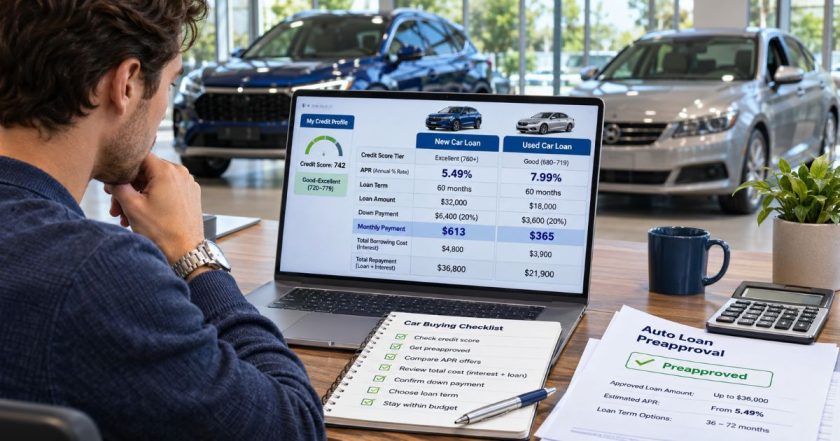
| Down Payment | Amount Financed | Monthly Payment | Total Interest |
|---|---|---|---|
| $0 | $30,000 | $608.29 | $6,497.51 |
| $3,000 | $27,000 | $547.46 | $5,847.76 |
| $6,000 | $24,000 | $486.63 | $5,198.01 |
Amounts are calculated using standard monthly amortization and rounded for presentation. The figures are educational examples, not lender quotations.
Why higher deposits reduce payments
When all other loan terms are equal, borrowing less reduces the principal on which interest is calculated.
In this example, the 20% down payment reduces the monthly payment by approximately $121.66 compared with zero down.
Compare total interest
Borrowing $24,000 rather than $30,000 also reduces the total interest burden.
However, the borrower needs an additional $6,000 in cash upfront.
APR may also change
In actual financing, a lender may offer different rates depending on credit history, vehicle details, loan amount, and loan-to-value ratio.
The examples intentionally hold the interest rate constant to isolate the effect of the down payment.
Avoid focusing only on monthly payments
A lender may offer a lower monthly payment through a longer repayment term, but that can increase total interest.
For more details, read our 96-month auto loan guide, finance charge explanation, and affordable auto loans guide.
6. Use Trade-In Equity to Reduce Your Down Payment
Buyers do not always need to contribute the full amount in cash.
Positive trade-in equity may reduce the amount financed and can sometimes satisfy part of the lender’s down payment requirement.
What is positive trade-in equity?
Positive equity exists when a vehicle’s trade-in value exceeds the loan payoff.
For example:
| Trade-In Detail | Amount |
|---|---|
| Trade-In Allowance | $15,000 |
| Existing Loan Payoff | $10,000 |
| Positive Equity | $5,000 |
That $5,000 in positive equity may be applied toward the replacement vehicle purchase.
Combining cash and trade-in equity
Suppose you contribute $2,000 cash and receive $5,000 of positive trade-in equity.
Your combined contribution toward the new purchase would be $7,000, subject to how the transaction and applicable taxes are calculated.
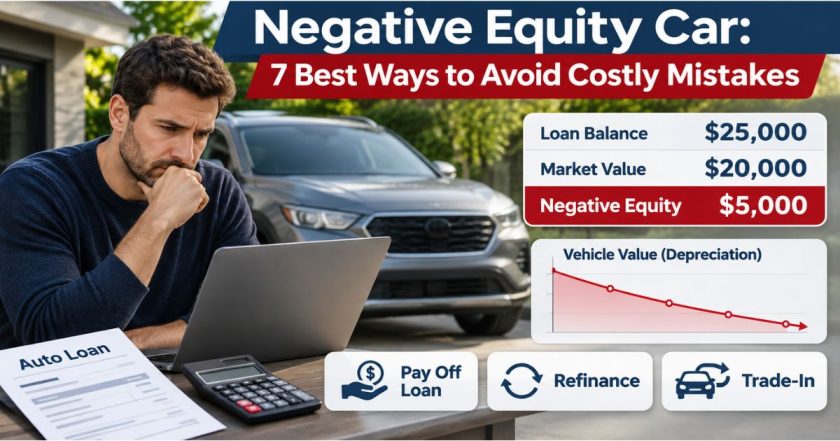
Understand negative equity
Negative equity occurs when the payoff exceeds the current vehicle value.
For example, if you owe $18,000 but the dealer offers $14,000, the shortfall is $4,000.
If that shortfall is rolled into new financing, the new loan balance increases.
How negative equity changes your loan
Rolling $4,000 into a replacement loan may increase the amount financed by $4,000 before other adjustments.
This can increase the required monthly payment, interest cost, and risk of owing more than the replacement vehicle is worth.
Compare private sale and dealer offers
A private-party sale may generate a higher amount than a dealer trade-in, although this is not guaranteed.
Compare actual offers and account for any applicable transaction costs or tax treatment.
See our negative equity car guide, selling a financed car, and auto refinancing guide.
7. Match the Down Payment to Your Transportation Budget
Your monthly car loan payment is only one part of the cost of owning a vehicle.
Before deciding how much down payment for a car to provide, calculate the ongoing expenses you will face after purchase.
Monthly transportation expenses
Common vehicle ownership costs include:
- Loan payments.
- Auto insurance.
- Fuel or electricity.
- Routine maintenance.
- Unexpected repairs.
- Parking and tolls.
- Registration renewals.
- Tire replacement.
Illustrative transportation budget
| Expense | Monthly Amount |
|---|---|
| Car Loan Payment | $450 |
| Insurance | $150 |
| Fuel | $140 |
| Maintenance Reserve | $60 |
| Parking and Miscellaneous | $50 |
| Total Monthly Transportation Cost | $850 |
These are hypothetical costs. Actual expenses depend on location, vehicle, coverage, mileage, and household circumstances.
Consider your household obligations
Compare the transportation budget with take-home income and other recurring expenses.
Include housing, food, healthcare, childcare, existing loan payments, and savings.
When a cheaper car is the better choice
Instead of increasing your down payment to make an expensive vehicle affordable, consider whether purchasing a less expensive car would be more financially sustainable.
Lowering the vehicle price can reduce both the upfront cash requirement and the amount financed.
Compare financing offers
Seek written financing estimates from banks, credit unions, and dealerships.
Compare the same loan amount and term where practical, then review APR, total interest, and other fees.
For more guidance, visit our top auto finance options, car financing deals, and new versus used car interest rates.
How Credit Scores Affect the Required Down Payment
When calculating how much down payment for a car you may need, remember that credit scores can influence lender requirements and the rates you receive.
Borrowers with strong credit
Applicants with stronger credit histories may have access to a wider range of financing offers, but low-down-payment approval is not guaranteed.
Borrowers with fair or weak credit
Some lenders may require larger upfront contributions to reduce credit risk.
Others may approve financing with smaller deposits but charge higher interest rates.
Down payment and loan-to-value ratio
The loan-to-value ratio compares the loan amount with the value of the vehicle.
For example, borrowing $24,000 against a vehicle valued at $30,000 produces an 80% loan-to-value ratio.
A higher down payment generally reduces this ratio.
Loan-to-value ratio and vehicle depreciation
If the outstanding loan balance exceeds the vehicle’s market value, the borrower has negative equity.
Depreciation may cause this even after a down payment, so no initial contribution guarantees protection.
Read our credit score calculation guide, credit improvement timeline, and subprime auto loan guide.
New Cars vs Used Cars: Down Payment Considerations
Whether you purchase a new or used vehicle can influence the amount financed, interest rate, depreciation risk, and loan terms.
New cars
New cars generally have higher purchase prices, although eligible buyers may sometimes access promotional financing offers.
A larger down payment can reduce the financing burden and help offset early depreciation.
Used cars
Used cars may cost less initially, but loan rates can differ because of lender policies and vehicle age.
Some lenders also restrict financing for older or high-mileage vehicles.
Consider total ownership costs
A used car with lower monthly payments may still require a larger maintenance reserve.
Compare realistic repair expenses, insurance, fuel, depreciation, and financing costs.
Do not rely on one percentage
Deciding how much down payment for a car is appropriate should depend on your actual vehicle choice and the written financing terms.
See our average car payment guide and car financing comparison.
Seven Proven Tips Before Making a Down Payment
Tip 1: Know the out-the-door price
Request a detailed price including taxes, government fees, dealer charges, and any included products.
Tip 2: Protect emergency savings
Do not empty your savings account merely to achieve a particular down payment percentage.
Tip 3: Compare multiple loan offers
Request quotes and compare APR, term, amount financed, and total repayment.
Tip 4: Calculate monthly ownership costs
Include insurance, fuel, maintenance, parking, and other recurring expenses.
Tip 5: Understand trade-in equity
Ask your current lender for a valid payoff quote before relying on a trade-in estimate.
Tip 6: Avoid unnecessary financed add-ons
Review extended warranties, protection packages, and other optional products separately.
Tip 7: Read the complete financing contract
Confirm the APR, loan term, cash contribution, trade-in value, finance charge, and amount financed.
Following these steps can help you decide how much down payment for a car is realistic without making an unnecessary financial commitment.
Common Car Down Payment Mistakes
Draining your savings
Using all available cash can leave you without money for repairs or emergencies.
Ignoring taxes and fees
Taxes, title, registration, and dealer charges can increase the final loan amount.
Assuming 20% guarantees approval
A large down payment may improve certain financing factors, but it does not override all underwriting requirements.
Rolling negative equity into a new loan
Including unpaid debt from a previous car can increase the new loan’s balance and overall cost.
Choosing a long loan solely for a lower payment
Extending repayment may increase total interest and the time you remain in debt.
Confusing rebates and cash contributions
Dealer incentives, manufacturer rebates, and trade-in credits may be applied differently. Verify the details in writing.
Failing to review the contract
Ensure the agreed down payment and other transaction credits are accurately reflected before signing.
Final Car Loan Checklist
- Confirm the total out-the-door price.
- Calculate your available down payment.
- Protect emergency savings.
- Review vehicle insurance costs.
- Obtain the current trade-in payoff.
- Identify positive or negative equity.
- Compare APR and loan terms.
- Calculate the amount financed.
- Review optional products.
- Confirm the monthly payment.
- Calculate total interest.
- Read all disclosures carefully.
- Keep copies of signed documents.
Related Best Finance Live Guides
- Auto Finance Calculator
- Good APR for a Car Loan
- New vs Used Car Interest Rates
- Average Car Payment 2026
- Negative Equity Car Loans
- First-Time Auto Loan Guide
- Subprime Auto Loans
- Affordable Auto Loans
- Best Auto Finance Deals
- Auto Loan Refinancing
- How to Sell a Financed Car
- Paying Off a Car Loan Early
- Long-Term Auto Loans
- Car Financing Options
- Top Auto Finance Options
Conclusion
Deciding how much down payment for a car to make requires balancing your available savings with your monthly transportation budget and long-term financial goals.
There is no universal percentage that every lender requires. Some borrowers qualify with little or no money down, while others may benefit from a larger contribution that reduces the financed balance.
Compare 0%, 10%, and 20% deposit scenarios using the same APR and loan term. Consider how each option changes monthly payments, total interest, and your remaining cash reserves.
Also review trade-in equity, taxes, dealership fees, vehicle depreciation, and ownership expenses before committing to a loan.
Ultimately, determining how much down payment for a car is appropriate means finding a balance between affordable financing and enough savings to handle life’s unexpected costs.