
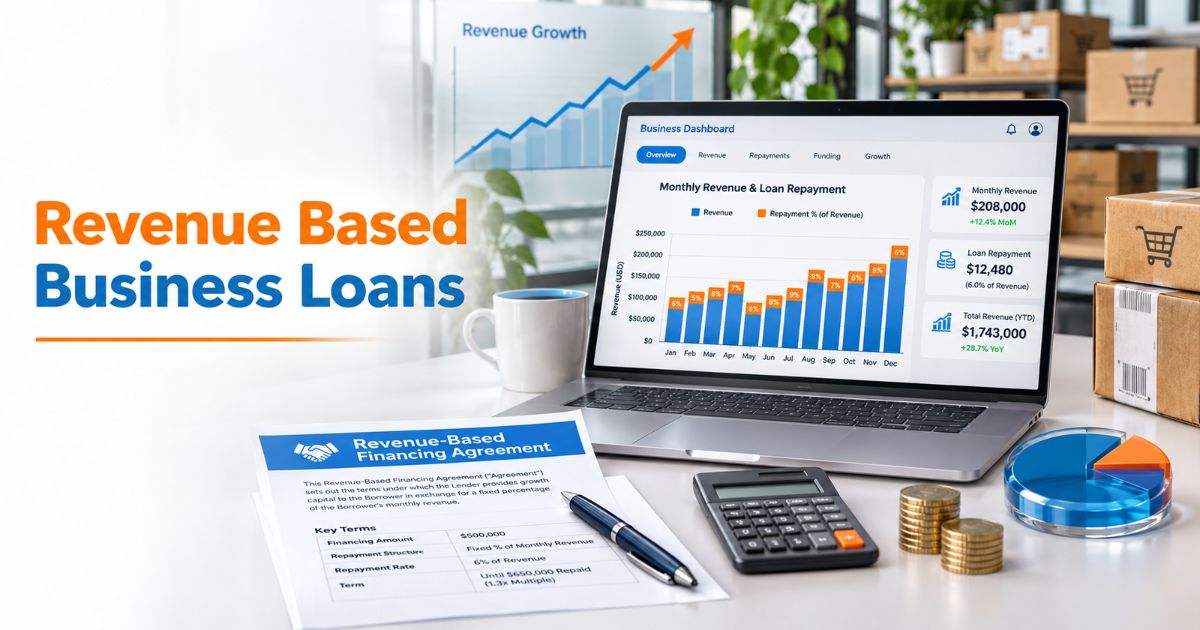
Before considering revenue based business loans, understand the percentage collected, total amount owed, fee structure, revenue definition, reconciliation rights, and consequences of a sales decline. A flexible payment formula is not a guarantee of low costs or easy repayment.
This U.S.-focused guide covers eligibility, factor rates, examples, contract risks, cash-flow forecasting, and alternatives. Compare the fundamentals with our business loans guide, working capital line of credit overview, and business loan versus credit line comparison.
Key Takeaways
- Payments linked to a share of actual revenue may vary as sales change; fixed ACH withdrawals may not adjust automatically.
- Read whether your agreement is a loan, a receivables purchase, or another commercial financing product.
- A factor rate is a multiplier, not an annual percentage rate (APR).
- Daily or weekly withdrawals can reduce cash available for wages, inventory, and taxes.
- Reconciliation, early payoff, default, guarantee, and lien provisions must be checked in writing.
- Commercial financing disclosures and remedies depend partly on state law and the actual agreement.
- Compare complete repayment costs and cash-flow pressure against alternatives.
1. Revenue Based Business Loans: How the Payment Model Works
Revenue based business loans differ from conventional fixed-installment term loans when the amount collected is calculated as an agreed percentage of defined business receipts. That percentage is sometimes called a holdback or remittance rate. Providers may use card-processing data, business bank deposits, or other records to calculate collections.

Percentage of sales versus fixed withdrawals
If a company agrees to remit 10% of eligible collected receipts and records $40,000 in those receipts during a month, the illustrative payment is $4,000. At $20,000 of eligible receipts, the same percentage would produce $2,000. This assumes the agreement truly calculates payments from actual receipts and imposes no minimum payment.
Some products instead debit an estimated fixed daily amount based on prior sales. Those withdrawals may continue during a slowdown unless the business invokes a contractual reconciliation procedure. When examining revenue based business loans, never assume the deduction will automatically fall with sales.
Define revenue precisely
One recurring source of confusion with revenue based business loans is whether recorded sales and money actually deposited into the account mean the same thing.
Ask whether the payment base is gross sales, card receipts, settled bank deposits, net revenue, or another contractual measure. Refunds, chargebacks, unpaid invoices, taxes collected on behalf of governments, and seasonal adjustments can affect the calculation differently.
Do slower sales cancel the balance?
Not necessarily. A lower sales share may delay the time needed to deliver the total agreed amount. Some agreements impose minimums, maturity dates, default triggers, or covenants. Others allocate genuine business-performance risk differently. Read the provisions rather than relying on a salesperson’s general description. Related budgeting considerations appear in our working capital planning article.
Use our emergency business loans guide and commercial financing cost comparison when assessing short-term capital.
2. Check Eligibility and Business Cash Flow
Providers offering revenue based business loans often examine recent receipts, recurring deposits, time in business, industry, chargebacks, existing financing, and banking activity. Some also review owners’ credit or require identity verification and personal guarantees. There is no universal minimum revenue level that establishes approval.

Documents commonly requested
- Recent business bank statements and deposit details.
- Merchant-processing or sales-platform reports if relevant.
- Profit and loss statements and a current balance sheet.
- Business identification, ownership, and tax records.
- Schedule of existing debts, advances, liens, and guarantees.
- Explanations for irregular deposits, refunds, or seasonality.
Prepare a conservative cash-flow forecast
Underwriting for revenue based business loans may emphasize deposits, yet revenue alone cannot establish that the operation has enough profit to absorb withdrawals.
Compare deposits with the cash required for payroll, rent, inventory, utilities, tax obligations, supplier payments, and existing loans. A financing offer sized from gross sales can be too large relative to your profit margin. Underwriting approval does not prove that a new repayment will fit your operating budget. See small business application preparations.
When evaluating revenue based business loans, model at least three sales cases: expected performance, a moderate decline, and a severe decline. Use actual historical weak months rather than assuming that next quarter will always improve.
Check other lenders’ rights
Prior financing may contain liens or restrictions on taking additional advances. A new provider may ask for a UCC filing, bank-account access, or an owner guarantee. Obtain an explanation of which assets or individuals would be exposed if the business misses payments. See our secured business loan guide and high-risk business financing overview.
3. Understand Payment Frequency and Reconciliation
Payment timing is as important as the total amount owed. For some revenue based business loans, a processor withholds a percentage of eligible card settlements. Other arrangements debit a business account daily, weekly, or monthly. Ask what happens on weekends, holidays, bank-error days, and periods with no sales.

Why reconciliation matters
In reviewing revenue based business loans, distinguish a genuine proportional sales remittance from scheduled debits calculated using estimates.
Reconciliation can mean recalculating estimated fixed withdrawals using actual receipts. But a right to reconciliation is not universal: the agreement may set eligibility, documentation, deadlines, and adjustment procedures. A provider might issue a credit, change future debits, or deny a request if conditions are unmet.
Before accepting revenue based business loans, request a written worked example showing a 40% sales decline, exactly how you apply for an adjustment, and how quickly it would affect scheduled withdrawals.
Illustrative payment comparison
| Monthly Eligible Sales | 10% Actual-Sales Remittance | Fixed Estimated Remittance |
|---|---|---|
| $60,000 | $6,000 | $4,000 |
| $40,000 | $4,000 | $4,000 |
| $20,000 | $2,000 | $4,000 unless adjusted |
See also urgent business cash flow funding. The figures are hypothetical, not lender quotes. A fixed debit schedule could be reconciled under some agreements but not others. The $4,000 fixed amount illustrates cash-flow risk rather than a generally applicable product feature.
Check what happens if the business closes
A sales-based agreement may still include breach provisions for diverting receipts, blocking authorized debits, or making inaccurate representations. The contract’s allocation of ordinary business failure risk matters. Ask counsel about ambiguous provisions, especially when a provider describes the agreement as a purchase of receivables.
Learn the differences between flexible and fixed financing in our term loan versus line of credit article and revolving working capital guide.
4. Calculate Factor Rates, Fees and Total Repayment
A factor rate is commonly written as a multiplier, such as 1.20. If the agreement multiplies $50,000 by 1.20, the stated purchased or repayable amount would be $60,000 before considering how other charges are handled. That $10,000 difference is not a 20% APR: APR depends on the timing of cash flows and applicable disclosure methodology.

Calculate what actually reaches your account
Suppose the nominal funding is $50,000, the factor is 1.20, and the provider deducts a $2,000 fee. Depending on the contract, the business may receive $48,000 while owing or delivering $60,000. That produces a $12,000 difference between net proceeds and total repayment. The actual classification of fees and the amount owed must be confirmed in writing.
| Component | Illustrative Value |
|---|---|
| Nominal funding | $50,000 |
| Factor rate | 1.20 |
| Stated total repayment | $60,000 |
| Fee deducted at funding | $2,000 |
| Net proceeds | $48,000 |
| Difference between repayment and net proceeds | $12,000 |
Pricing is a crucial issue with revenue based business loans. A seemingly modest multiplier can represent a substantial annualized cost when funds are collected rapidly. Do not convert a factor rate to APR simply by subtracting 1 and multiplying by 100.
Check every additional fee
Ask about origination fees, underwriting charges, processing costs, ACH failures, maintenance fees, broker commissions, renewal charges, and collection expenses. Compare net proceeds and total repayment, not just the headline advance amount.
Early payoff and renewals
Borrowers examining revenue based business loans should ask how a payoff on day 30 compares with paying over the expected full period.
Some contracts require substantially the full agreed purchase amount even when paid early; others include an early settlement discount. Never assume interest savings similar to a conventional amortizing loan. Repeated renewals may impose new costs and create overlapping remittance obligations.
Use business loan interest rate comparisons, business credit alternatives, and invoice factoring costs to evaluate your options.
5. Read the Contract and Understand Personal Risk
In revenue based business loans, the contract controls the funding amount, remittance formula, authorized debits, reconciliation, events of default, collections, and possible liens. Have a qualified commercial-finance attorney examine unusual language before agreeing to it.
Personal guarantees
A personal guarantee can expose an owner to liability under the terms signed. Some guarantees are limited to specified misconduct; others may be broader. Do not accept a claim that the transaction is entirely nonrecourse unless the written terms actually support it.
UCC filings and security interests
A UCC filing may publicly announce a creditor’s claimed security interest, but its scope and enforceability depend on the security agreement and applicable law. Review whether the claim covers specified receivables, a bank account, or a broad set of business assets.
Default and collection clauses
The default language in revenue based business loans can be just as consequential as the funding price.
Check whether default can be triggered by inaccurate representations, unauthorized bank changes, receipt diversion, other financing, blocked debits, bankruptcy events, or the provider’s assessment of business distress. Sales declines alone do not have the same legal effect under every agreement.
Confession of judgment and arbitration
Certain agreements may contain confession-of-judgment provisions or mandatory arbitration language, subject to important jurisdiction-specific limits. Understand notice rights, dispute procedures, and whether court review is restricted. The FTC has pursued providers over deceptive commercial-funding practices and abusive collections.
For context, see the FTC enforcement announcement concerning merchant cash advances.
A thorough review of revenue based business loans should cover legal rights as carefully as monthly affordability. For related risks, consult our collateral and guarantees guide and high-risk business lending article.
6. Compare Merchant Cash Advances With Other Revenue Financing
The words revenue based business loans are used in marketing for products that can be economically similar but legally different. A genuine loan creates a debt repayment obligation. A merchant cash advance may be structured as a purchase of future receivables. Some revenue-sharing funding arrangements use yet another structure.
Do not classify a product by its name alone
Actual risk allocation, reconciliation rights, collections, default clauses, and applicable state law influence legal characterization. A document titled “purchase agreement” does not conclusively establish that it is not a loan, and a sales-based remittance arrangement does not guarantee the business is protected from all collection remedies.
| Feature | Conventional Term Loan | Sales-Based Financing or MCA |
|---|---|---|
| Funding | Usually a lump sum | Advance or purchase payment |
| Repayment | Scheduled installments | Receipts share or estimated withdrawals |
| Cost quote | Interest rate and charges | Often factor or purchased amount |
| Sales decline | Payment usually unchanged | Depends on true payment formula |
| Legal classification | Credit | Depends on substance and state law |
State commercial financing disclosures
State disclosure rules can affect the written information borrowers receive about revenue based business loans and related products.
Some states require commercial financing disclosures or regulate providers and brokers. Requirements differ by product, location, transaction size, and date. For example, California’s financial regulator has warned businesses about misleading merchant cash advance practices and provides a complaint channel.
Review the California DFPI advisory on merchant cash advances, and verify applicable rules in your own state.
Because revenue based business loans can overlap with merchant cash advance terminology, request plain-language explanations of the transaction’s legal structure and all mandatory disclosures.
7. Consider Safer or Lower-Cost Alternatives
Before selecting revenue based business loans, compare traditional business term loans, revolving credit, SBA-backed financing, invoice-based funding, and equipment loans. The lowest headline fee is not necessarily the lowest total cost; timing and collateral matter too.
Business term loans
Fixed-installment funding can make budgeting easier when cash flow is consistent. However, payment dates remain fixed even in weak sales months, and lender approval may be harder for some firms. Read our business loan options and small-business loan application guide.
Lines of credit
A revolving facility permits qualifying draws up to an approved limit, subject to borrowing conditions and renewal requirements. Interest may be charged on outstanding advances, and fees may apply. See our working capital credit line overview and loan-versus-line comparison.
SBA-backed loans
The SBA 7(a) program guarantees qualifying loans made by participating lenders; it does not guarantee approval for every applicant or establish a universally cheapest rate. Eligibility, uses, terms, and fees depend on the program and lender. Check the official SBA 7(a) program.
Invoice and asset-backed options
Invoice factoring may provide liquidity from eligible business-to-business receivables, while equipment financing may match repayments to the useful life of machinery. Both can involve fees, collateral, and different contractual risks. Compare small business invoice factoring and asset-backed business financing.
Alternatives comparison
Even businesses eligible for revenue based business loans should compare at least one nonsales-linked offer on the same financing amount.
| Option | Potential Advantage | Main Check |
|---|---|---|
| Term loan | Predictable installments | Total interest and eligibility |
| Credit line | Draw as needed | Variable rates and renewal |
| SBA-backed loan | Government guarantee for eligible loans | Program and lender terms |
| Invoice factoring | Liquidity tied to invoices | Discount fees and recourse |
| Equipment financing | Asset-specific funding | Collateral and asset value |
A fair comparison of revenue based business loans should use the same cash actually received, expected payment dates, potential decline scenarios, and any total repayment or early-payoff obligation.
8. A Step-by-Step Application and Decision Checklist
Step 1: Define the use of funds
Separate one-time inventory, equipment, seasonal payroll, and recurring operating losses. Short-term funding should not cover an unresolved structural cash deficit without a credible improvement plan.
Step 2: Reconcile sales records
Compare bank deposits, merchant processing records, refunds, and accounts receivable. Explain any transfers that could be mistaken for actual customer revenue.
Step 3: Calculate true affordability
Estimate required payments at normal and reduced sales levels while reserving money for employees, vendors, taxes, and essential operations.
Step 4: Request comparable written offers
For revenue based business loans, request the nominal advance, net proceeds, purchase or repayment total, factor rate where used, each fee, payment calculation, expected duration, and reconciliation procedure.
Step 5: Verify the provider
Confirm its legal name, website, contact details, licensing or registration where required, and broker compensation disclosures. Do not provide bank credentials through an unverifiable message or link.
Step 6: Read legal obligations
Review UCC security, guarantees, automatic withdrawals, default triggers, renewals, arbitration, dispute rights, and settlement terms with qualified advisers.
Step 7: Compare other products
Before selecting revenue based business loans, identify the funding alternatives that are realistically available rather than comparing only advertised products.
Check whether a conventional loan, line of credit, invoice factoring, or equipment facility offers better economics for the intended use. Useful references include our emergency business funding guide, business loan rates, factoring comparison, and high-risk lending risks.
Step 8: Monitor after funding
Track daily deductions against actual receipts and the outstanding purchased or repayable amount. Keep statements, sales reports, emails, amendments, and evidence of any reconciliation request. Our business funding comparison can help during periodic reviews.
Before signing revenue based business loans, insist that all material promises appear in the final contract; verbal assurances about flexible payments do not replace written provisions.
Warning Signs That Deserve Extra Review
- A provider refuses to state total repayment and net funds received.
- The agreement says sales-based, but fixed withdrawals do not adjust or provide a clear process for adjustment.
- Promises of “no personal liability” conflict with a broadly written guarantee.
- Broker commissions or fees appear only after the application.
- The provider pressures immediate signing without time to review terms.
- Overlapping advances leave too little money for necessary business expenses.
- Dispute or enforcement rights are difficult to understand.
Marketing for revenue based business loans should be tested against cash-flow forecasts and actual legal obligations, not accepted as proof of suitability.
Frequently Asked Questions
What are revenue based business loans?
They are commercially marketed financing products in which payments may be tied to business revenue. Some are debt agreements, while others can be structured as purchases of receivables. Read the legal terms to identify the actual product.
Do payments always decrease when sales fall?
No. A true percentage remittance may fall automatically, but an estimated fixed debit may require a formal reconciliation request, and some contracts impose additional conditions.
How does a factor rate work?
A 1.20 factor applied to $50,000 produces $60,000 of stated repayment before considering separately charged fees. It does not mean a 20% APR.
Are revenue based business loans cheaper than bank loans?
Not necessarily. Cost depends on net proceeds, total payment, withdrawal schedule, fees, and the time needed to repay. Compare complete written terms.
What is repayment reconciliation?
It is a contractual process, when available, for reviewing estimated withdrawals against actual eligible revenue and adjusting payments or providing credits according to the agreement.
Are personal guarantees required?
Some providers require them and others do not. Scope can range from specific misconduct to broader repayment liability, depending on wording and law.
What is a UCC lien?
A UCC filing can give public notice of a claimed security interest in business assets. The agreement and applicable law determine its actual scope and effect.
Can I repay early for a discount?
Only if the contract provides an applicable reduction or settlement option. Never assume an advance using a factor rate works like an amortizing loan.
What documents will a provider request?
Common items include bank statements, sales reports, financial statements, identification, and existing debt information. Each provider sets its own requirements.
Are merchant cash advances the same as loans?
Not always. Some arrangements purchase future receivables rather than creating a conventional debt. Legal classification depends on actual terms and applicable law, not marketing alone.
What happens when business revenue collapses?
Consequences depend on the true remittance formula, reconciliation rights, default clauses, and legal structure. Seek advice before blocking payments or changing collection accounts.
What alternatives should I compare?
Business term loans, revolving credit, eligible SBA-backed loans, invoice factoring, and asset-backed financing may meet similar needs with different trade-offs.
Conclusion
Revenue based business loans may provide working capital that responds to business sales, but neither flexibility nor approval guarantees affordability. Some arrangements use genuine percentages of receipts; others rely on fixed withdrawals that may require contractual reconciliation. Factor rates, fees, guarantee terms, collateral rights, and legal classification all matter.
Before choosing revenue based business loans, calculate net proceeds and total repayment, model weak sales months, compare alternatives, and obtain independent legal or accounting advice when clauses are unclear. A financing agreement should support business operations without consuming the cash needed to keep them running.