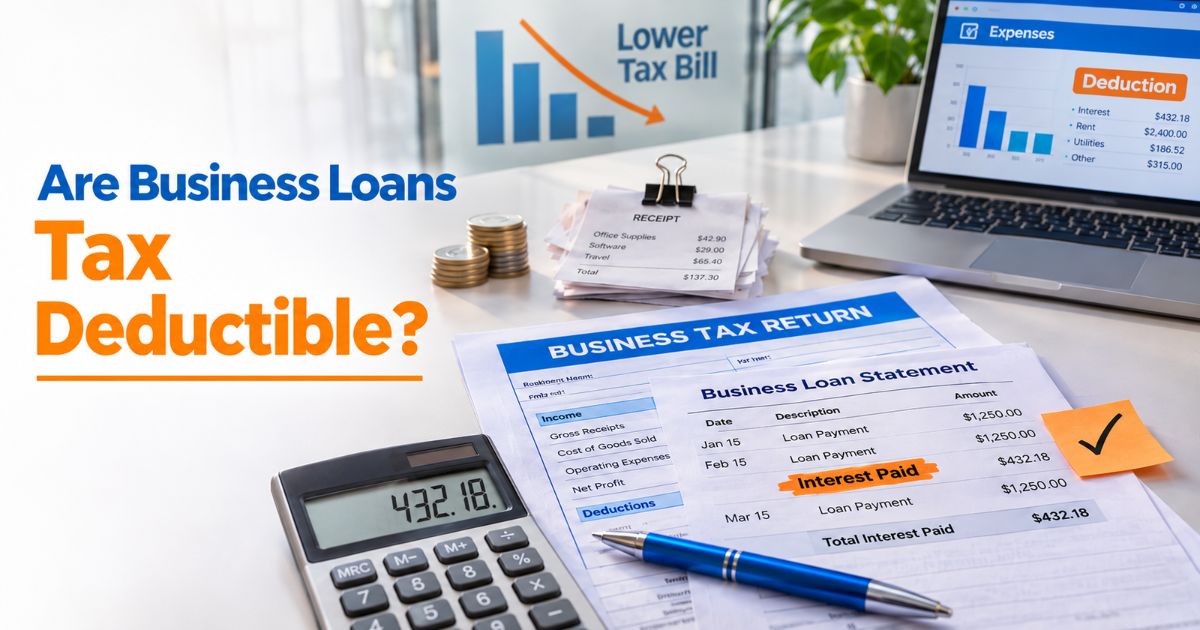
The answer to are business loans tax deductible depends on how the borrowed money was spent, the borrower’s tax structure, the accounting method, and the nature of the expense. A loan used for inventory is not treated exactly like a loan used to construct a building or pay for personal travel.
This practical U.S. guide covers seven rules, examples, mixed-use borrowing, origination fees, principal repayments, refinancing, canceled debt, and recordkeeping. It is educational information, not individualized tax advice. Compare financing basics in our business loans overview and business borrowing rate guide.
Key Takeaways
- Receiving bona fide borrowed funds usually creates a liability, not taxable revenue.
- Principal repayment normally reduces that liability and is not an operating deduction.
- Interest may qualify when the proceeds are properly allocated to a trade or business.
- Mixed personal and business uses require an appropriate allocation and clear evidence.
- Loan fees may have to be capitalized or deducted over time rather than immediately.
- Section 163(j) may restrict business-interest deductions for some taxpayers.
- Debt forgiveness can create cancellation-of-debt income, subject to exceptions and exclusions.
- Tax treatment of an asset bought with borrowed funds is separate from repayment of the debt.
1. Are Business Loans Tax Deductible? Separate Principal and Interest
Start with the basic accounting distinction. Money borrowed under a genuine obligation to repay is generally not included in gross income. When the business makes principal payments, it is reducing a debt rather than paying a new deductible business expense.

Principal is different from interest
When reviewing are business loans tax deductible, never use the total bank withdrawal as the interest deduction. The allocation on a current payment schedule is the starting point.
If a business receives a $50,000 term loan, it usually records $50,000 in cash and a corresponding liability. Repaying $5,000 of principal reduces the liability. Interest is a separate borrowing cost and may be deductible if the relevant rules are met.
Simple repayment example
A correct answer to are business loans tax deductible distinguishes cash received, financing expenses, and the separate cost of any assets acquired with proceeds.
| Transaction | Illustrative Amount | General Treatment |
|---|---|---|
| Loan proceeds received | $50,000 | Liability, usually not taxable income |
| Principal repaid | $5,000 | Liability reduction, not a deduction |
| Eligible business interest | $2,000 | Potential deduction, subject to rules |
| Purchased equipment | $20,000 | Asset basis and applicable cost-recovery rules |
Why the use of funds matters
For site owners wondering are business loans tax deductible, separate the legal borrower, the ultimate business use, and the timing of each relevant expense.
Compare the distinction further in our business financing essentials.
Because are business loans tax deductible is a use-of-proceeds question, both the financial records and the underlying business purpose need to support the classification.
The category of the loan is not conclusive. The use of the proceeds typically controls whether interest is allocated to business, investment, or personal purposes. Proper tracing is essential when one account finances several activities.
When someone asks are business loans tax deductible, the most accurate response is to analyze the loan’s components individually. See our business loan payment calculator guide for principal-and-interest comparisons and secured financing explanation for collateral distinctions.
2. Trace Loan Proceeds to Their Actual Business Use
Borrowers should follow the proceeds from disbursement to expenditure. Paying interest on money used for legitimate operations may create a business-interest expense, while using the same money for personal purchases generally does not.

Working capital and ordinary expenses
The phrase are business loans tax deductible does not mean borrowed payroll or inventory costs automatically receive an immediate deduction; each expense follows its own rules.
Borrowed funds may be used to cover qualifying payroll, rent, utilities, supplies, or other costs. Whether the underlying expense is deductible depends on the normal business-expense rules. Inventory often has cost-of-goods-sold timing rather than an immediate ordinary-expense deduction.
Equipment and real property
A machine bought with loan proceeds normally becomes a capital asset. Its cost may be recovered under depreciation, expensing elections, or other applicable provisions. The treatment of interest may be affected by capitalization requirements, especially for qualifying construction or production activities.
Mixed-use borrowing
For are business loans tax deductible, a mixed-use account can demand a more careful tracing analysis than merely applying a rough percentage once at origination.
Suppose $30,000 of a $50,000 loan supports genuine business purchases while $20,000 goes to personal expenses. Interest must be allocated according to the applicable debt-tracing rules and repayment history; it is not safe to automatically deduct 100% of the interest.
Personal loans used for business
Even if an individual takes out a loan in their personal name, interest may be allocable to a business when the actual use and relevant taxpayer liability requirements support that treatment. Entity boundaries and arrangements between owners and companies can complicate the analysis.
For are business loans tax deductible, retain transfer records, receipts, invoices, and bank statements rather than relying on a lender’s product label. Read our personal loan interest tax guide and working capital line of credit guide.
How to document tracing
An audit-ready answer to are business loans tax deductible should identify dates, bank transactions, assets, and how lender payments were divided.
- Save the original loan agreement and date of receipt.
- Record disbursement into the bank account.
- Match subsequent transfers with specific purchases.
- Mark each use as business, personal, investment, or other.
- Reconcile interest expense with the lender’s statements.
- Document refinancing and how replacement proceeds were used.
These records help resolve are business loans tax deductible questions when business and personal money pass through multiple accounts. For financing categories, compare business loans versus credit lines and unsecured business borrowing.
3. Calculate Interest Deductions and Check Section 163(j)
A business-interest deduction may be allowed for eligible interest paid or accrued on bona fide debt. The deduction is not universal: the income tax rules, timing principles, entity-specific provisions, and other limitations must be considered.

Start with the lender’s payment details
Determining are business loans tax deductible starts with interest actually attributable to business activity, before checking the separate limitation rules.
An installment of $1,000 might include $750 of principal and $250 of interest. Only the potentially qualifying interest belongs in the interest-expense calculation; principal is not a deduction. Obtain a payment ledger or amortization statement that separates the components.
Cash and accrual methods
Tax year matters when assessing are business loans tax deductible. The date on a lender statement does not necessarily settle when a deduction is permitted.
The accounting method affects the year in which an interest deduction may be taken. Cash-method taxpayers generally focus on eligible payments, while accrual-method taxpayers consider when qualifying liabilities accrue. Special rules can override the simple timing approach, including related-party and prepaid-interest restrictions.
What is Section 163(j)?
An advisor checking are business loans tax deductible should determine whether the taxpayer qualifies for an exception before completing any limitation calculation.
For repayment context, see the commercial payment example.
Section 163(j) limits business-interest deductions for certain taxpayers. Broadly, the limit can depend on business interest income, 30% of adjusted taxable income, and qualifying floor plan financing interest, with exceptions and special rules. Some eligible small businesses are exempt from the limitation based on the applicable gross-receipts test.
Important 2026 considerations
For 2026 discussions of are business loans tax deductible, check the updated statutory framework rather than assuming last year’s business-interest formulas remain unchanged.
The IRS updated its Section 163(j) FAQs in August 2026. The adjusted-taxable-income calculation and capitalization interaction reflect legislative changes; do not rely on old thresholds or an outdated assumption that depreciation is always excluded from the calculation. Partnerships and S corporations have additional reporting considerations.
Read the IRS Section 163(j) questions and answers and consult a tax preparer if the rules may apply.
Illustrative interest calculation
| Item | Amount | Meaning |
|---|---|---|
| Annual interest charged | $8,000 | Starting accounting amount |
| Potential personal allocation | $2,000 | Not treated as business interest |
| Potential business allocation | $6,000 | Subject to other tax rules |
This example assumes an otherwise supportable allocation; it is not a statement that $6,000 will necessarily be deductible for every taxpayer.
Questions about are business loans tax deductible should be answered using the applicable tax year and tax form. Further background is available in our business interest rates guide and higher-risk financing costs article.
4. Understand Principal, Assets, and Refinancing
Debt repayment and asset cost recovery are separate tax concepts. When a borrower uses a loan to buy property, the tax result generally follows what was acquired and how it was used, not merely the number of monthly principal payments.

Equipment and depreciation
When considering are business loans tax deductible, remember that depreciation can be a separate tax benefit connected to the acquired asset, not to principal payment.
Business equipment may qualify for depreciation or special cost-recovery rules. Exact deductions depend on the purchase, placed-in-service date, business-use percentage, eligibility requirements, and current law. Land itself is generally not depreciable, although qualifying improvements may be.
Interest connected with construction
Interest on borrowing for certain construction or production projects may have to be capitalized. Recent statutory changes to Section 163(j) affect how certain capitalized interest is handled, making professional review especially important for larger projects.
Refinancing existing business debt
If the question is are business loans tax deductible after a debt replacement, keep both loan agreements so their financing costs can be analyzed separately.
Review borrowing structures in our loan and revolving-credit comparison.
The answer to are business loans tax deductible after refinancing depends on what the replacement funds actually accomplish and on how old and new debt costs are classified.
When a new loan pays off an old one, the new principal is not automatically a deductible expense. The treatment of interest and any unamortized costs depends on the new loan’s use, the old transaction, and applicable debt-issuance rules.
Early repayment and prepayment charges
An early repayment charge may have a specific tax treatment depending on its legal character. Do not automatically record it as ordinary interest or a same-year deduction without examining the agreement.
For are business loans tax deductible, track purchased assets and loan balances on different schedules. Review our collateralized loan guide and loan amortization explanations.
5. Determine How Origination and Closing Fees Are Treated
Fees charged to obtain financing are not always immediately deductible. Some costs are treated as debt issuance costs and recovered over the financing period; others may be part of an asset’s basis or have a different classification.
Origination charges and points
In the context of are business loans tax deductible, a fee that reduces the cash you receive may still be a cost recovered over time rather than immediately.
A loan origination charge can reduce the cash disbursed without reducing the face amount of the debt. Tax treatment depends on its substance and applicable accounting rules, not just its name on the closing statement.
Underwriting, legal, and appraisal charges
Explore borrowing costs in our first-time borrower overview.
For are business loans tax deductible, read every closing line separately because the label “loan fee” does not guarantee a uniform tax result.
Fees related to issuing debt can differ from amounts paid to purchase land, buildings, or machinery. An appraisal cost associated with acquiring property may affect basis, while a debt-specific cost may follow debt-issuance treatment. Item-by-item classification matters.
Original issue discount
Some arrangements issue debt for proceeds below its stated repayment amount. Original issue discount has specialized interest accrual rules and should not be assumed to be a straightforward upfront deduction.
Fees on a refinanced loan
Refinancing can require examining unamortized costs from the old obligation and new fees for the replacement debt. The outcome depends on whether the transaction is a retirement, modification, or another arrangement for tax purposes.
| Cost | Potential Treatment | Check |
|---|---|---|
| Ordinary eligible interest | Potential interest deduction | Allocation and limits |
| Debt issuance costs | May be recovered over loan term | Type and timing |
| Asset acquisition costs | May increase asset basis | Purchased property |
| Original issue discount | Special interest rules | Debt instrument terms |
| Personal-purpose charge | Generally not business deductible | Actual use |
If you are checking are business loans tax deductible because of a large closing fee, keep the signed closing disclosure and ask a tax professional how each charge should be reported. For cost comparisons, read first-time business loan costs and emergency financing costs and risks.
6. Report Borrowing and Debt Cancellation Correctly
Regular loan proceeds generally are not gross income because they must be repaid. However, when debt is canceled or forgiven, the borrower may have cancellation-of-debt income unless an exception or exclusion applies.
Ordinary loan proceeds
A legitimate $40,000 loan typically appears as cash and a liability, rather than taxable sales income. This distinction matters when reconciling financial statements and tax returns.
What if the creditor forgives a balance?
An important qualification to are business loans tax deductible is that receiving a loan and later having the loan canceled are different taxable events.
Suppose a lender cancels $10,000 of an outstanding obligation. Some or all of that amount may be includible in income, subject to exceptions, exclusions, and potential tax-attribute adjustments. Bankruptcy and insolvency exclusions can apply in qualifying circumstances but are not automatic deductions.
Forms 1099-C and 982
A borrower may receive Form 1099-C when a reportable cancellation occurs. Form 982 may be required for specified exclusions and related adjustments. Reporting is fact-specific: receipt of a form is not, by itself, conclusive that the full amount is taxable.
Entity-specific reporting
See financing preparations in our application documentation guide.
A consistent response to are business loans tax deductible requires using the tax rules and forms that apply to the actual borrower and its tax classification.
A sole proprietor generally reports relevant business activity on Schedule C. Partnerships and S corporations generally file entity returns and may pass through certain items to owners. C corporations generally report at the corporate level. Interest-limitation rules can require separate calculations and schedules.
For are business loans tax deductible, do not confuse exempt loan proceeds with later cancellation of debt. See our small-business borrowing challenges and loan versus line-of-credit differences.
7. Keep Records and Prepare the Tax Return
Careful records help prove that a debt exists, identify the use of proceeds, separate principal from interest, and connect expenses with the correct tax year. Lender statements are helpful, but they do not decide deductibility by themselves.
Core documents to retain
- Promissory note, loan agreement, and amendments.
- Closing statement and itemized financing fees.
- Bank statements tracing the loan proceeds.
- Receipts and invoices for business purchases.
- Monthly principal and interest allocation schedules.
- Records of mixed-use transfers and repayments.
- Asset purchase and depreciation records.
- Debt cancellation, restructuring, or refinance documents.
- Prior returns and any relevant supporting schedules.
Year-end reconciliation process
A year-end checklist for are business loans tax deductible is strongest when someone can reproduce each deduction from reliable source documents.
Asking are business loans tax deductible should lead to a documented reconciliation, not a deduction based solely on the total amount paid to a lender.
- Confirm opening and closing loan balances.
- Reconcile all payments to principal, interest, and charges.
- Match borrowed funds with their ultimate expenditures.
- Identify expenses requiring capitalization or depreciation.
- Check special rules for related-party borrowing and prepaid interest.
- Evaluate whether Section 163(j) or other limits apply.
- Compare statements with books and tax returns.
- Resolve discrepancies before filing.
Where to find primary IRS guidance
The IRS Publication 334, Tax Guide for Small Business explains business interest concepts and expense classification. Check the tax year of the publication and any newer IRS updates before applying a rule.
Answering are business loans tax deductible is easier when bank transfers, accounting entries, and tax workpapers tell a consistent story. Learn about business preparation in our small-business loan application checklist and business loan guide.
Common Mistakes to Avoid
Deducting the entire loan payment
Separately classify principal, interest, and other charges. A monthly payment is not automatically a deductible expense in full.
Treating all inventory purchases as immediate expenses
Inventory and cost of goods sold have their own timing rules. Track acquisition, production, and sales correctly.
Claiming personal interest as a business expense
A business label on a loan does not change personal spending into a deductible business expense.
Automatically deducting every closing fee
Debt issuance charges and asset acquisition costs may have capitalization or amortization requirements.
Using obsolete tax thresholds
Business-interest limitation details can change. Verify the tax year and current IRS rules.
These errors show why are business loans tax deductible deserves more analysis than simply checking a lender’s year-end total. See our business interest rate guide and personal versus business interest guide.
Business Loan Tax Checklist
- Verify the debt is genuine and enforceable.
- Keep evidence of the proceeds received.
- Separate loan principal from interest.
- Trace spending to business and personal uses.
- Apply appropriate inventory and asset-cost rules.
- Classify closing charges individually.
- Review cash-versus-accrual timing.
- Consider Section 163(j), related-party, and capitalization rules.
- Review refinanced or modified debt separately.
- Check possible cancellation-of-debt income.
- Confirm applicable return forms and schedules.
- Retain documents for the applicable limitations period.
Frequently Asked Questions
Are business loans tax deductible in full?
No. The principal generally is not deductible. Qualifying interest and particular fees may receive tax treatment that reduces taxable income, subject to restrictions.
Is a business loan taxable income?
Genuine borrowed proceeds ordinarily are not gross income because the borrower has an obligation to repay the lender. Forgiven debt can have a different result.
Can I deduct interest on a business loan?
Potentially, when the interest is properly connected to eligible business use and other deduction requirements are satisfied. Interest limitations and capitalization may apply.
Are origination fees immediately deductible?
Not necessarily. Certain borrowing costs may have to be recovered over the debt term or treated under another applicable rule.
Can I deduct principal used to buy equipment?
Loan principal repayment is not itself deductible. Eligible equipment costs may be recovered under applicable depreciation, expensing, or other basis rules.
What happens if a loan pays for personal and business expenses?
Interest may need to be allocated under applicable tracing and repayment rules. Keep documentary evidence identifying each use.
Does a personal guarantee change the interest deduction?
A guarantee alone does not establish business use or automatic deductibility. The identity of the actual debtor, use of proceeds, and applicable tax requirements matter.
Can canceled business debt become taxable?
Yes. Cancellation may produce taxable income unless an exception or exclusion applies; reporting and tax-attribute adjustments may be necessary.
Does Section 163(j) affect every business?
No. The limitation has exceptions, including an eligible small-business gross-receipts exemption, and various special rules. Qualification depends on the tax year and facts.
Where are deductions reported?
The correct location depends on entity type, tax classification, and the expense. Sole proprietorships, partnerships, S corporations, and C corporations use different return structures.
Conclusion
Are business loans tax deductible? Usually not as a single deduction. Genuine loan proceeds are generally not taxable income, and principal repayment generally is not deductible. Eligible business interest may be deductible, but borrowing costs, tracing, accounting methods, asset rules, and Section 163(j) can change the outcome.
Keep reliable records of where every borrowed dollar went, separate financing charges from principal, and review complicated transactions with a qualified tax professional. Comparing loan payment estimates alongside borrowing cost guidance can help organize the financial side before tax filing.