Farming presents financial challenges that differ from many other industries. Revenue often arrives after harvest or livestock sales, while expenses for seed, fertilizer, labor, feed, fuel, and machinery must be paid earlier.
Understanding agribusiness loans helps farmers compare funding sources, evaluate borrowing costs, and create repayment schedules that reflect actual production cycles.
This guide explains seven important financing options, USDA loan programs, lender eligibility requirements, collateral, seasonal cash flow management, and practical steps for evaluating agricultural borrowing.
For broader financing information, explore our business loans guide and working capital line of credit comparison.
Key Takeaways
- Match financing to operating expenses, equipment, livestock, or land purchases.
- Use realistic production forecasts when estimating repayment capacity.
- Compare USDA direct and guaranteed farm loan programs.
- Review interest rates, fees, collateral, and personal guarantees.
- Account for weather, crop yields, commodity prices, and seasonal revenue.
- Compare agricultural lenders before accepting a financing agreement.
- Verify current government program requirements through official sources.
- Understand how crop insurance and other risk-management tools may affect lending decisions.
1. Agribusiness Loans: Understanding Agricultural Financing
Agribusiness loans are financing arrangements designed to support eligible agricultural activities. Depending on the lender and program, financing may cover operating expenses, productive assets, agricultural real estate, or business expansion.
Why agricultural financing is different
Many farms generate revenue seasonally rather than receiving uniform payments throughout the year. Operating expenses may accumulate months before crops are harvested and sold.
A financing arrangement should account for these timing differences.
Operating financing
Farm operating credit commonly covers production expenses such as seed, fertilizer, chemicals, livestock feed, fuel, and labor.
These loans often have repayment schedules connected to the production and marketing cycle.
Capital investment financing
Longer-term borrowing may support tractors, harvesting machinery, irrigation systems, agricultural buildings, and land purchases.
The financing period should reflect the useful life of the asset and realistic cash flow.
Why repayment planning matters
Borrowing can support business development, but the farm must generate sufficient cash to meet repayment obligations.
Unpredictable weather, market prices, and production costs can create financial pressure.
Types of financing compared
| Financing Type | Common Purpose | Main Consideration |
|---|---|---|
| Operating Loan | Seed, feed and labor | Seasonal repayment |
| Equipment Loan | Machinery and technology | Asset useful life |
| Land Loan | Farmland acquisition | Long-term affordability |
| Credit Line | Recurring cash needs | Renewal and draw rules |
| Livestock Financing | Animals and production | Market and health risks |
| Real Estate Loan | Farm structures | Appraisal and collateral |
| Emergency Financing | Eligible disaster-related needs | Program requirements |
Before applying for agribusiness loans, determine whether the borrowing requirement is temporary or represents a long-term investment.
See our business loan versus line of credit guide and secured financing requirements.
2. Farm Operating Credit and Seasonal Cash Flow
Seasonal operating expenses create financing needs that may arise before farm revenue becomes available.
Understanding farm operating credit
Operating financing can provide access to funds for eligible recurring production expenses.
Examples include seed, fertilizer, equipment fuel, livestock feed, irrigation costs, and employee wages.
Seasonal cash flow management
Farmers often spend money during planting and growing periods before receiving income from commodity sales.
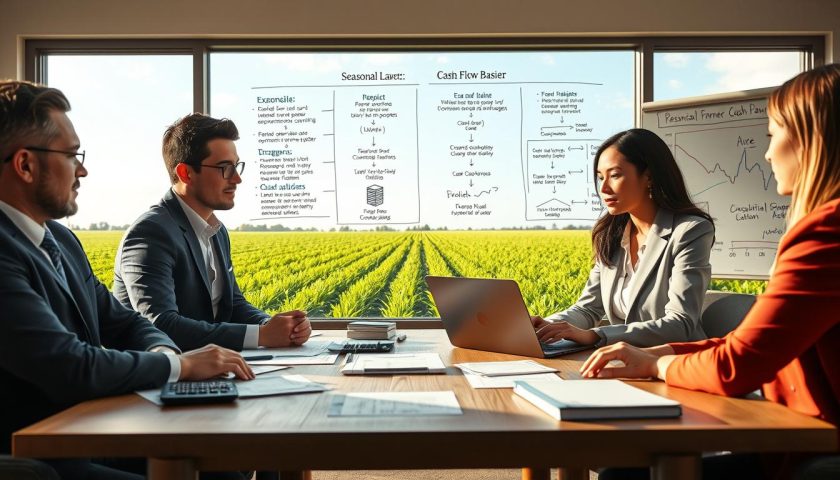
A cash flow projection helps identify when additional funds may be necessary.
Create a monthly financial forecast
Estimate expected income, production expenses, debt payments, and remaining cash for each month.
Consider both normal operating conditions and less favorable production scenarios.
Example of seasonal financing
Assume a farm requires $40,000 for planting-related expenses and expects qualifying crop sales later in the year.
A short-term financing arrangement could help bridge that period if expected revenues support the repayment obligation.
Actual borrowing costs depend on the lender’s interest calculation, fees, and repayment schedule.
Account for delayed customer payments
Agricultural businesses may wait for payments from commodity buyers, processors, cooperatives, or wholesale customers.
Include realistic collection dates rather than assuming immediate payment.
Manage changes in input costs
Fuel, fertilizer, feed, labor, and transportation expenses can fluctuate.
Financial projections should account for potential increases during the production cycle.
Use borrowing only when necessary
Drawing funds earlier than required may increase financing expenses.
Some revolving facilities charge interest on outstanding balances, while others include unused commitment or maintenance fees.
Operating expense planning table
| Expense | Typical Timing | Repayment Consideration |
|---|---|---|
| Seeds | Before planting | Expected crop revenue |
| Fertilizer | Planting and growing | Production costs |
| Fuel | Throughout operations | Operating cash flow |
| Labor | Seasonal or ongoing | Payroll affordability |
| Livestock Feed | Recurring | Animal production revenue |
Using agribusiness loans for seasonal expenses requires a realistic repayment source, not simply an expectation that future commodity prices will increase.
For related information, read our working capital financing guide and emergency business loans comparison.
3. Agricultural Equipment Financing
Modern agricultural production often requires expensive machinery and technology. Equipment financing may help eligible businesses spread purchase costs over an agreed period.

Equipment purchases
Eligible equipment may include tractors, combines, planting machinery, irrigation systems, commercial trailers, and precision agricultural technology.
New equipment financing
New machinery may provide updated technology and manufacturer support but can require substantial capital.
Compare purchase costs with the expected improvements in farm productivity.
Used agricultural machinery
Used equipment may reduce upfront costs, but condition, maintenance history, and expected remaining useful life require careful examination.
Equipment loan versus lease
An equipment loan generally finances a purchase and may involve a security interest in the asset.
A lease provides rights to use equipment under the agreement, with ownership and end-of-term options depending on the contract.
Cash purchases
Buying equipment with cash avoids borrowing interest but uses funds that may otherwise support operating expenses.
Compare equipment financing options
| Feature | Cash Purchase | Loan | Lease |
|---|---|---|---|
| Initial Cash Need | Usually high | Down payment may apply | Contract-specific |
| Ownership | Immediate | Buyer generally owns, subject to lien | Agreement-specific |
| Interest or Financing Cost | No loan interest | Interest and possible fees | Lease charges |
| Maintenance | Owner | Usually owner | Agreement-specific |
| End of Term | Asset retained | Loan repaid | Return, renew or purchase where offered |
Understand depreciation
Farm equipment can lose value over time because of age, use, wear, and technological changes.
Compare the expected remaining value with the loan balance throughout repayment.
Review maintenance costs
Machinery repairs can create significant expenses during planting or harvest.
Include preventive maintenance and potential downtime in the budget.
Check equipment insurance
Lenders may require insurance protecting financed equipment.
Confirm the coverage amount, deductibles, and other contract obligations.
Understand collateral
The financed equipment may secure the loan.
Default can expose pledged machinery to lender remedies under the agreement and applicable law.
Match payments to production revenue
Some agricultural lenders offer seasonal repayment arrangements, but availability varies.
The schedule should reflect realistic income rather than optimistic harvest assumptions.
When evaluating agribusiness loans for machinery, compare the complete financing cost with expected operating benefits.
Related articles include our secured business loan guide and business financing interest rates.
4. Land Acquisition and Agricultural Real Estate Financing
Buying farmland or improving agricultural property may require financing structured over a longer period than ordinary operating credit.
Farmland acquisition
Land loans may support eligible farmland purchases, subject to lender or government program requirements.
Borrowers should review acreage, soil quality, water access, existing improvements, and market value.
Long-term repayment planning
Farmland is generally a long-lived asset.
Financing periods and amortization schedules should match realistic production income and the applicable contract.
Property appraisal
A lender may require an appraisal to assess collateral value.
The appraised value can influence the maximum financing amount.
Title and ownership verification
Property records should establish ownership rights and disclose relevant liens, easements, and other restrictions.
Water rights and irrigation access
Water availability can materially influence the productive value of agricultural land.
Review the applicable water rights, permits, and irrigation infrastructure before purchase.
Zoning requirements
Local land-use restrictions may limit construction, agricultural activities, or future development.
Existing leases
Property may be subject to leases or other occupancy arrangements that affect operations and financing.
Environmental considerations
Environmental risks, land contamination, drainage conditions, and other property issues may affect valuation and lender requirements.
Fixed versus variable rates
Fixed-rate financing generally provides greater payment predictability.
Variable-rate agreements may adjust based on a specified benchmark and contractual margin.
Land loan considerations
| Factor | What to Evaluate |
|---|---|
| Purchase Price | Total property cost |
| Appraisal | Accepted collateral value |
| Soil Quality | Expected productivity |
| Water Access | Availability and legal rights |
| Property Taxes | Recurring ownership expense |
| Insurance | Required protection |
| Interest Structure | Fixed or adjustable |
| Repayment | Expected farm cash flow |
Before accepting agribusiness loans secured by farmland, understand the consequences of default and the potential effect on essential farm assets.
Read our collateral requirements guide and business borrowing comparison.
5. USDA Farm Loan Programs
The United States Department of Agriculture supports several farm financing programs through the Farm Service Agency.
Eligibility, funding availability, interest rates, and program limits depend on applicable rules.
USDA Farm Service Agency
The Farm Service Agency offers direct and guaranteed farm loan programs for eligible applicants.
These programs may help qualified producers who have difficulty obtaining sufficient commercial financing.
Direct farm ownership loans
Eligible direct ownership financing may support farmland purchases and other permitted ownership-related expenses.
Applicants must satisfy relevant program requirements.
Direct operating loans
Operating loans may support eligible farm expenses, including certain production costs and other permitted uses.
Guaranteed loans
Under qualifying guaranteed programs, participating commercial lenders provide financing while the government guarantees an eligible portion of the lender’s potential loss.
A government guarantee does not eliminate the borrower’s repayment obligation.
Beginning farmer programs
Some USDA programs contain provisions intended to support eligible beginning farmers.
Requirements can include agricultural experience, farm size, ownership considerations, and repayment ability.
Farm ownership eligibility
Eligibility depends on the specific program and may require verification of legal status, credit history, management ability, permitted loan uses, and other conditions.
USDA emergency farm loans
Qualifying agricultural producers affected by eligible natural disasters may be able to apply for emergency assistance under applicable program conditions.
Disaster designation, documented losses, and other requirements may apply.
USDA loan interest rates
Government program rates may change, so borrowers should verify the rate applicable to their specific program and application period.
Official USDA resources
For current details, visit the USDA Farm Service Agency farm loan programs.
Applicants should confirm application requirements with their local USDA service center or the appropriate participating lender.
Direct versus guaranteed farm financing
| Feature | Direct FSA Loan | Guaranteed Loan |
|---|---|---|
| Lender | USDA Farm Service Agency | Participating commercial lender |
| Government Role | Direct financing and servicing | Eligible lender guarantee |
| Eligibility | Program-specific | Program and lender requirements |
| Rates | Applicable published program rates | Subject to program and lender terms |
| Repayment | Contract-specific | Contract-specific |
When comparing government-supported agribusiness loans, verify current program guidelines rather than relying on outdated financing advertisements.
For broader commercial options, review our business financing overview and small business loan application guide.
6. Agricultural Loan Eligibility and Collateral Requirements
Lenders evaluate agricultural loan applications using financial, operational, and collateral information.
Business credit history
Credit records help lenders evaluate prior repayment performance and existing financial obligations.
Personal credit history
Some agricultural financing arrangements involve reviews of individual owners or guarantors.
Operating experience
Farm management history may help demonstrate agricultural knowledge and operational ability.
Farm revenue
Lenders may examine revenue from crops, livestock, agricultural services, or related operations.
Production records
Historical crop yields, livestock production, and sales records may provide evidence supporting financial projections.
Existing debt
Current loans, lease obligations, and other financial commitments affect repayment capacity.
Debt service coverage
Debt service coverage compares cash flow available for repayment with required debt payments under a defined calculation.
DSCR = Cash Flow Available for Debt Service ÷ Required Debt Service
Illustrative DSCR calculation
Suppose a farming operation generates $150,000 of annual cash flow available for debt service and has $120,000 of annual qualifying debt payments.
The calculated ratio would be 1.25.
The acceptable threshold and calculation method depend on lender requirements.
Collateral requirements
Depending on the financing arrangement, lenders may accept or require:
- Farmland.
- Farm buildings.
- Tractors and equipment.
- Livestock.
- Inventory.
- Eligible crops.
- Accounts receivable.
- Other permitted assets.
Personal guarantees
Some lenders require owners to guarantee business repayment obligations.
The scope of liability depends on the agreement and applicable law.
Required documents
| Document | Purpose |
|---|---|
| Tax Returns | Historical financial information |
| Income Statements | Operating profitability |
| Balance Sheets | Assets and liabilities |
| Cash Flow Reports | Repayment capacity |
| Production Records | Operating performance |
| Property Records | Ownership and collateral |
| Debt Schedule | Existing obligations |
| Insurance Policies | Risk-management coverage |
Why accurate documentation matters
Complete and consistent records can help lenders understand the business and reduce avoidable application delays.
However, better documentation does not guarantee approval.
Applicants for agribusiness loans should provide realistic financial projections supported by operating history and documented assumptions.
For related information, see our business financing application checklist and secured business loan requirements.
7. Compare Loan Costs, Commodity Risks and Repayment Terms
Agricultural financing costs can be influenced by market conditions, creditworthiness, collateral, program requirements, and the chosen loan structure.
Interest rates
Rates may be fixed or variable, depending on the agreement.
Annual percentage rate
Where applicable, APR can help compare the annualized cost of financing, including qualifying charges.
Commercial agricultural financing does not always provide standardized consumer-style APR disclosures, so compare itemized fees and total costs as well.
Origination fees
Some lenders charge a fee to establish financing.
Appraisal costs
Land or equipment financing may require asset valuations.
Insurance expenses
Financing arrangements may require specified insurance coverage.
Collateral filing fees
Secured loans may involve documentation and registration costs.
Variable-rate exposure
Variable interest rates can increase when the relevant benchmark rises.
Farmers should estimate whether higher financing costs remain affordable during lower-revenue periods.
Commodity price risk
Agricultural commodity prices can change significantly because of supply, demand, weather, international trade, and other market conditions.
Production risk
Drought, flooding, pests, diseases, and unexpected weather can reduce production volumes.
Crop insurance
Eligible insurance products may provide protection against certain covered production or revenue losses.
Coverage, exclusions, premiums, and claim requirements differ by product.
Official risk-management information
Review the USDA Risk Management Agency for official information about federal crop insurance programs.
Stress-test repayment
Calculate whether the business can meet loan payments after a reduction in yield, a decline in commodity prices, or an increase in fertilizer and fuel costs.
Illustrative financial stress test
| Scenario | Annual Cash Available | Annual Debt Service | DSCR |
|---|---|---|---|
| Expected Conditions | $150,000 | $100,000 | 1.50 |
| Moderate Decline | $120,000 | $100,000 | 1.20 |
| Severe Decline | $80,000 | $100,000 | 0.80 |
These figures are hypothetical and illustrate how declining cash flow can affect repayment capacity.
A ratio below 1.00 under this simplified calculation indicates cash flow available for debt service is insufficient to cover the stated debt service.
Review maturity dates
Understand when principal must be repaid and whether the financing agreement requires renewal.
Understand prepayment terms
Some loans allow early repayment without additional penalties, while others have contractual restrictions or charges.
Review default remedies
Missed payments or other contractual defaults may expose pledged collateral to lender enforcement rights.
For agribusiness loans, compare the complete financing obligation with conservative cash flow projections.
Related reading includes our business loan interest rate guide and loan versus credit line comparison.
8. How to Apply for Agricultural Business Financing
Step 1: Define your financing purpose
Identify whether the funds will support operating expenses, land, livestock, equipment, or another permitted business need.
Step 2: Calculate the amount required
Prepare a realistic budget rather than applying for an arbitrary maximum amount.
Step 3: Prepare cash flow forecasts
Project revenue and expenses across relevant production and marketing periods.
Step 4: Review credit records
Check available business and personal credit information for accuracy.
Step 5: Organize financial statements
Prepare current financial records, tax returns, bank statements, and existing debt schedules.
Step 6: Identify collateral
Determine which assets may be available to support secured borrowing.
Step 7: Compare lenders
Consider Farm Credit institutions, agricultural banks, eligible credit unions, USDA programs, and other appropriate providers.
Step 8: Request written financing offers
Compare interest rates, loan amounts, origination fees, repayment timing, and collateral obligations.
Step 9: Review government eligibility
Check whether the farm qualifies for relevant USDA direct or guaranteed financing programs.
Step 10: Understand repayment schedules
Choose financing that reflects realistic harvest, livestock, or other agricultural income.
Step 11: Review legal documents
Read guarantees, security agreements, covenant requirements, and default provisions carefully.
Step 12: Confirm final terms
Verify that the signed documents match the approved offer.
Step 13: Track financing use
Maintain accurate records documenting how borrowed funds are used.
Step 14: Monitor business performance
Compare actual revenue and costs with original projections.
Step 15: Communicate early about difficulties
If future repayment problems become likely, contact the lender before overdue balances accumulate.
When applying for agribusiness loans, clear documentation and realistic repayment planning are essential.
See our small business loan application steps and business financing eligibility guide.
9. Common Agricultural Financing Mistakes
Borrowing without a defined purpose
Unnecessary debt can create additional expenses without improving productivity.
Using short-term debt for long-term assets
Financing major long-lived assets with very short repayment periods may strain operating cash flow.
Ignoring seasonal revenue
Repayment schedules should reflect the timing of agricultural income.
Overestimating crop yields
Optimistic production projections can produce unrealistic borrowing budgets.
Ignoring commodity price changes
Lower commodity prices may reduce revenue even when physical production remains strong.
Overlooking insurance requirements
Insurance may be required by the agreement and can add to total ownership costs.
Underestimating equipment maintenance
Repairs and downtime may affect the economic benefits of equipment purchases.
Ignoring collateral risks
Default on secured borrowing can expose essential farm property to creditor remedies.
Accepting unclear rates and fees
Request itemized written information about all significant financing charges.
Assuming automatic renewal
Credit lines and other facilities may require periodic lender review.
Failing to compare government programs
Eligible producers should review available USDA options alongside commercial financing.
Not reviewing legal obligations
Personal guarantees and security agreements can create significant financial consequences.
A carefully selected agribusiness loans financing arrangement should support productive operations without creating unsustainable repayment obligations.
10. Final Agricultural Financing Checklist
- Define the purpose of borrowing.
- Calculate the actual financing need.
- Prepare monthly cash flow forecasts.
- Review historical production records.
- Estimate operating expenses.
- Account for seasonal income patterns.
- Consider commodity price volatility.
- Review available crop insurance.
- Check existing debt obligations.
- Review credit history.
- Prepare current financial statements.
- Gather tax returns.
- Document land and equipment ownership.
- Identify available collateral.
- Understand personal guarantees.
- Compare USDA financing programs.
- Consider agricultural lenders.
- Request written term sheets.
- Compare interest rates and fees.
- Review fixed and variable rate risks.
- Understand repayment schedules.
- Check maturity dates.
- Review prepayment restrictions.
- Understand default consequences.
- Stress-test production revenue.
- Review lender reporting requirements.
- Confirm final loan documents.
- Maintain accurate borrowing records.
Related Best Finance Live Articles
- Business Loans: Types, Requirements and Costs
- Working Capital Line of Credit
- Secured Business Loan: Collateral and Risks
Conclusion
Agribusiness loans can help eligible agricultural businesses cover operating expenses, acquire productive assets, purchase farmland, and manage seasonal financing requirements.
However, selecting suitable financing requires more than comparing advertised interest rates.
Farm owners should evaluate repayment timing, total borrowing costs, collateral, insurance requirements, and the potential effects of unpredictable production conditions.
Government-supported programs may provide useful financing options for eligible farmers, but program availability and approval requirements must be verified through official sources.
Before accepting an offer, prepare realistic cash flow projections and compare multiple lenders.
Long-term investments should generally be supported by financing terms appropriate for their expected useful life and repayment capacity.
Responsible use of agribusiness loans can support agricultural productivity while helping protect the farm’s financial stability.
Frequently Asked Questions
What are agribusiness loans?
Agribusiness loans are financing arrangements intended to support eligible agricultural activities such as operating expenses, livestock production, equipment purchases, and farmland acquisition.
What are farm operating loans?
Farm operating loans may provide financing for qualifying production costs such as seed, fertilizer, labor, feed, and fuel.
Can farmers finance agricultural equipment?
Yes. Eligible borrowers may obtain equipment loans or leases for qualifying tractors, harvesting machinery, irrigation equipment, and other agricultural assets.
Are USDA farm loans available?
The USDA Farm Service Agency provides direct and guaranteed loan programs for eligible farmers. Requirements and availability depend on the specific program.
What is the difference between direct and guaranteed USDA loans?
Direct loans are provided by the Farm Service Agency, while guaranteed loans are issued by participating commercial lenders with applicable government guarantees.
Can beginning farmers qualify for financing?
Some USDA and commercial programs consider eligible beginning farmers. Requirements may include management experience, repayment capacity, and other program-specific conditions.
Can agricultural land be financed?
Eligible farm ownership or commercial real estate loans may support agricultural land purchases, subject to lender requirements.
What collateral is commonly required?
Depending on the financing structure, eligible collateral may include farmland, equipment, livestock, crops, inventory, or receivables.
Are personal guarantees required?
Some agreements include personal guarantees, but requirements vary according to the lender, borrower, and financing structure.
How do lenders evaluate repayment capacity?
Lenders may examine financial statements, production records, existing obligations, collateral, and projected operating cash flow.
Why is seasonal cash flow important?
Farm operating expenses often occur before harvest or livestock-sale proceeds become available. Financing schedules should reflect those timing differences.
Does crop insurance affect agricultural financing?
Some lenders require or consider insurance coverage as part of risk management. Specific requirements depend on the loan and applicable program.
What happens if commodity prices fall?
Lower selling prices may reduce farm revenue and available cash for debt service, even when production volumes remain unchanged.
Can farming businesses obtain revolving credit?
Some agricultural lenders offer revolving facilities for eligible working capital requirements. Availability and repayment conditions depend on the agreement.
Are agricultural loan interest rates fixed?
Some products use fixed interest rates, while others use variable rates. The applicable structure depends on the lender and program.
What documents are needed to apply?
Common requirements may include financial statements, tax returns, production records, debt schedules, identification, and collateral documents.
Can farmers repay loans seasonally?
Some agricultural financing products offer repayment schedules that reflect production and sales cycles, but arrangements vary.
How should farmers compare financing offers?
Compare total borrowing costs, net proceeds, interest rate structures, repayment timing, collateral provisions, lender fees, and contractual obligations.