

If you are asking how soon can you refinance a car loan after purchase, there is no single waiting period that applies to every borrower or lender. In practice, your original loan generally needs to be established, an accurate payoff amount must be available, and title or lien processing may need to be completed far enough for a new lender to refinance the debt.
Refinancing shortly after buying a vehicle can sometimes be possible, but the earliest opportunity is not necessarily the best financial time to apply. Your current APR, credit profile, vehicle value, payoff balance, lender requirements, fees, and proposed new loan terms all matter.
This guide explains how soon can you refinance a car loan after purchase, what can delay the process, how to compare refinance offers, and how to determine whether replacing your current vehicle loan could actually save money.
Key Takeaways
- There is no single refinance waiting period that applies to every lender.
- Your original loan and payoff information generally need to be established before refinancing can be completed.
- Title and lien processing can affect the practical refinance timeline.
- A lower monthly payment does not automatically mean a cheaper loan.
- Compare APR, fees, repayment term, and total remaining cost before refinancing.
- Negative equity can make approval more difficult.
- Continue following your existing payment schedule until the old loan payoff is confirmed.
How Soon Can You Refinance a Car Loan After Purchase?
When determining how soon can you refinance a car loan after purchase, start by checking whether your existing account is fully established and whether your lender can provide an accurate payoff quote.

There is not one universal number of days that applies to every refinance. Prospective lenders can establish their own eligibility requirements, and administrative processes involving the original loan, title, and lien can affect timing.
Before applying, confirm that:
- Your original vehicle loan account is active.
- Your current lender can provide a payoff amount.
- Required vehicle and lien information is available.
- The prospective lender accepts your vehicle and loan characteristics.
- The proposed refinance provides a meaningful financial benefit.
If you need a broader overview of vehicle financing first, read our Auto Finance Center guide.
1. Understand Your Car Loan Refinance Time Frame
Your car loan refinance time frame depends on both administrative readiness and the requirements of the prospective lender.

Original Loan Funding
The original financing transaction needs to be sufficiently established for a new lender to determine the debt that must be paid off. If the account is still being processed, refinancing may have to wait.
Title and Lien Processing
Because an auto loan is generally secured by the vehicle, title and lien information can affect the auto loan refinancing timeline. Procedures vary by jurisdiction and lender.
Payoff Information
The new lender generally needs an accurate payoff figure for the existing loan. A payoff quote can differ from the balance shown on an older monthly statement because interest and other applicable amounts can change over time.
Prospective Lender Rules
Individual lenders may consider the age of the current loan, vehicle value, mileage, outstanding balance, credit history, income, and other underwriting factors.
| Factor | Why It Matters | What to Check |
|---|---|---|
| Original Loan | Account must be established | Confirm lender and account details |
| Title/Lien | Supports the lender’s security interest | Verify processing if required |
| Payoff Quote | Shows debt that must be satisfied | Request a current quote |
| Lender Policy | Eligibility requirements vary | Check before applying |
Another part of understanding how soon can you refinance a car loan after purchase is checking whether the new lender can obtain everything needed to complete the payoff. Even when you are financially ready, incomplete account, title, or lien information can affect the practical timing.
2. Determine the Best Time to Refinance a Car Loan
Knowing how soon can you refinance a car loan after purchase is different from knowing when refinancing makes financial sense.

The best time to refinance a car loan may be when the proposed new financing meaningfully improves your situation after accounting for all relevant costs.
Potential reasons to investigate refinancing include:
- A meaningfully lower APR becomes available.
- Your credit profile has improved.
- Your original financing was comparatively expensive.
- You want a different repayment structure.
- You now have access to financing sources you did not compare when purchasing the vehicle.
However, refinancing may offer little benefit if the rate reduction is small, fees are significant, or the new loan substantially extends your repayment period.
The Consumer Financial Protection Bureau’s auto loan guidance provides consumer information for evaluating vehicle financing.
For this reason, the answer to how soon can you refinance a car loan after purchase should not be based on speed alone. Compare the financial benefit of refinancing now with the potential benefit of waiting until your credit, equity, or available loan terms improve.
3. Review Your Existing Loan and Purchase Documents
Before refinancing a car loan, understand exactly what you currently owe and what terms you already have.

Collect the following information:
- Current lender
- Loan account information
- Current APR or interest rate
- Monthly payment
- Remaining loan term
- Current balance
- Vehicle information
- Original loan agreement
- Current payoff quote
Request an Accurate Payoff Quote
Ask your current lender for a payoff quote and note how long the quote remains valid. This figure is important because it tells you how much must be paid to satisfy the existing loan.
Review Your Existing Contract
Check your agreement for terms that could affect an early payoff. Also review any optional products that were financed with the vehicle.
Our guide explaining what a finance charge on a loan means can help you understand borrowing costs in greater detail.
If you are still deciding how soon can you refinance a car loan after purchase, your payoff quote is especially useful. It gives you a current figure to compare with the amount a prospective lender is willing to refinance.
4. Estimate Your Vehicle Equity and Refinance Eligibility
If you are researching how soon can you refinance a car loan after purchase, vehicle equity is another important part of the decision.
Compare Vehicle Value With the Payoff Amount
You generally have positive equity when the vehicle’s estimated value exceeds the amount required to pay off the loan.
You have negative equity when you owe more than the vehicle is currently worth. This situation can make refinancing more difficult because a prospective lender may limit the amount it is willing to finance relative to the collateral value.
Understand Loan-to-Value
Lenders can use loan-to-value considerations when evaluating a refinance. The exact limits and calculation methods vary between lenders.
Check Vehicle Requirements
A lender may also establish requirements involving:
- Vehicle age
- Mileage
- Current value
- Outstanding loan balance
- Vehicle type
- Condition or eligibility
If you have a pre-owned vehicle, our used car loan guide covers related financing considerations.
5. Compare Car Loan Refinancing Options
Once the existing account is ready, compare refinancing options after car purchase rather than automatically accepting the first offer.
Potential financing sources can include:
- Banks
- Credit unions
- Online lenders
- Auto-focused lenders
- Other financial institutions offering eligible vehicle refinancing
Compare APR, Not Just the Monthly Payment
When deciding when to refinance a car loan, compare:
- APR
- Interest rate
- Amount financed
- Loan term
- Monthly payment
- Applicable fees
- Total expected repayment
The Federal Trade Commission’s vehicle financing guidance explains important factors consumers should consider when comparing auto financing.
You can also review our car finance options guide for an overview of common financing routes.
Compare Similar Terms
Compare offers using similar balances and repayment periods when possible. Otherwise, a longer loan may appear cheaper simply because the debt is spread across additional months.
Our auto finance calculator guide can help when testing different rate and term scenarios.
Borrowers researching how soon can you refinance a car loan after purchase should compare more than one eligible offer whenever practical. Differences in APR, fees, repayment term, and lender requirements can change whether refinancing produces meaningful savings.
6. Calculate Whether Refinancing Will Actually Save Money
The answer to how soon can you refinance a car loan after purchase should not be separated from the question of whether refinancing will actually improve your finances.
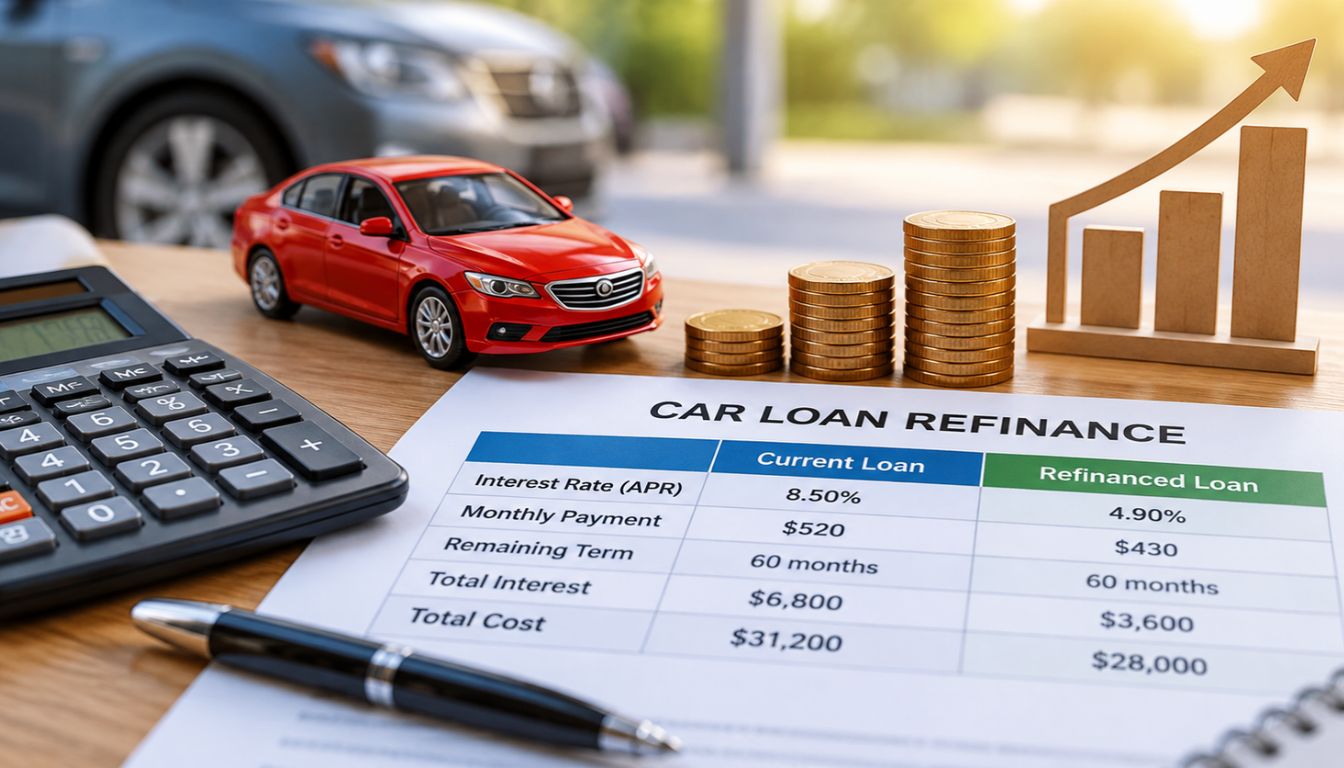
Compare your current loan’s remaining cost with the proposed refinance.
| Feature | Current Loan | Proposed Refinance |
|---|---|---|
| APR | Enter current APR | Enter proposed APR |
| Balance | Current payoff | New loan amount |
| Term | Remaining months | New term |
| Monthly Payment | Current payment | Proposed payment |
| Fees | Relevant remaining costs | New refinance costs |
| Estimated Remaining Cost | Calculate | Calculate |
A Lower Monthly Payment Is Not Always a Saving
A new lender may reduce your payment by extending the repayment period. That can improve monthly cash flow but may increase the amount of time you remain in debt.
Distinguish between:
- Monthly savings: the difference between required payments.
- Total savings: the difference in overall remaining borrowing costs.
If your main objective is lower-cost financing, also read our affordable auto loans guide.
Calculate the Break-Even Point
If refinancing involves upfront costs, calculate how long your monthly savings would take to recover those expenses.
If you plan to sell or trade the vehicle before reaching that point, the refinance may provide less value than expected.
7. Apply and Complete the Auto Loan Refinance Carefully
Once you decide the numbers work, proceed carefully through the application and payoff process.
Once you understand how soon can you refinance a car loan after purchase, the next priority is completing the transaction correctly. Approval for a new loan does not by itself confirm that your existing vehicle loan has already been paid off.
Understand Credit Inquiries
Some lenders may provide preliminary information through a soft credit inquiry, while a formal application can require a hard inquiry.
Check the lender’s disclosures rather than assuming all prequalification and application processes affect credit in the same way.
Provide Accurate Information
Make sure your income, existing loan balance, vehicle details, insurance information, and other requested information are accurate.
Review the Final Disclosures
Before accepting the new loan, confirm:
- APR
- Interest rate
- Loan amount
- Term
- Payment
- Fees
- Payment due date
- Any other material terms
Continue Paying the Existing Loan
Do not stop making required payments merely because a refinance application has been approved.
Continue following the existing payment schedule until the payoff has been processed and you have confirmation that the old balance has been satisfied.
Verify the Old Loan Was Paid
After completion, check your previous lender account and confirm the expected payoff or zero balance.
Keep the payoff confirmation and refinance documents for your records.
Can You Refinance a Car Loan Quickly?
People researching how soon can you refinance a car loan after purchase often want to complete the process as quickly as possible. Speed, however, should be secondary to getting financially suitable terms.
You may be able to refinance a car loan quickly once the original loan and required vehicle records are ready, but confirm that:
- The current lender can provide a payoff quote.
- The new lender accepts your vehicle.
- You understand the new APR.
- The new term is appropriate.
- Fees do not eliminate expected savings.
- The refinance fits your financial goals.
For a broader look at available financing, see our top auto finance guide.
When Refinancing Soon After Purchase May Make Sense
The question of how soon can you refinance a car loan after purchase becomes particularly relevant when your original financing is expensive or your financial circumstances have changed. In those situations, comparing new terms sooner may reveal whether a refinance is worth considering.
Your New APR Is Meaningfully Lower
If another lender offers substantially better terms than your existing financing, calculating the potential savings can be worthwhile.
Your Credit Profile Has Improved
A stronger financial profile can potentially affect the financing terms available to you, although lender underwriting requirements still apply.
Your Original Loan Was Expensive
If you accepted relatively costly financing when buying the vehicle and later find a more competitive offer, refinancing may deserve consideration.
Our best auto finance deals guide provides additional context for comparing offers.
When You May Want to Wait Before Refinancing
Although you may understand how soon can you refinance a car loan after purchase, waiting can sometimes be the better choice.
Your Loan or Title Is Still Processing
If the initial transaction is not fully established, additional time may make the refinance process easier.
Your Credit Has Declined
If your credit profile has worsened, the available refinance terms may not improve on your current agreement.
You Have Significant Negative Equity
A high payoff amount relative to vehicle value can limit your refinancing options.
The Rate Reduction Is Too Small
A slightly lower APR may not produce meaningful savings after fees and other costs are considered.
You Plan to Sell the Car Soon
If you expect to sell the vehicle shortly, there may not be enough time to recover refinancing costs.
Read our guide on how to sell a financed car if selling is your likely next step.
Can You Refinance a Car With Negative Equity?
It may be possible in some circumstances, but negative equity can make approval more difficult.
If your payoff amount exceeds the vehicle’s current value, the lender may be asked to finance more than the collateral is worth.
Depending on lender requirements, possible approaches could include:
- Reducing the principal balance
- Waiting while the balance declines
- Comparing lender loan-to-value requirements
- Reassessing after your equity position improves
Do not assume that refinancing makes negative equity disappear. The outstanding debt still has to be addressed.
What About 0% APR or Promotional Financing?
Think carefully before replacing unusually low promotional financing.
If your existing vehicle loan has a very low promotional APR, refinancing into a conventional loan could increase borrowing costs even if another part of the offer looks attractive.
Our 0 APR car finance guide explains promotional financing in more detail.
For manufacturer-related research, you can also review our guides to Nissan Auto Finance, Kia Optima finance, and Ford Fusion finance.
Alternatives to Refinancing a Newly Purchased Car
If refinancing is not attractive right now, you still have other options to consider.
Make Additional Principal Payments
If your loan terms allow it and your budget permits, paying additional principal can reduce your balance faster. Confirm with the lender how additional payments are applied.
Improve Your Credit Profile
If available refinance offers are unattractive, waiting while improving your financial profile may provide better options later.
Keep Your Current Loan
If your existing APR, payment, and remaining term are already competitive, replacing the loan may not provide enough benefit.
Consider Selling the Vehicle
If the vehicle itself is no longer affordable, compare its current value with your payoff amount before deciding whether a sale is practical.
Our guide explaining whether you can return a financed car also covers important considerations when a vehicle loan becomes difficult to manage.
A practical way to decide how soon can you refinance a car loan after purchase is to use a checklist rather than relying on a fixed number of days. Your loan status, payoff amount, equity, credit profile, vehicle eligibility, and potential savings provide a more useful basis for the decision.
Auto Loan Refinancing Checklist
- Confirm that your existing loan account is established.
- Request an up-to-date payoff quote.
- Check title and lien status when necessary.
- Review your current APR.
- Check the remaining loan term.
- Estimate the vehicle’s current value.
- Determine whether you have positive or negative equity.
- Review your credit profile.
- Compare multiple refinance offers.
- Compare APR, fees, term, and total cost.
- Check vehicle age and mileage requirements.
- Calculate the break-even point for fees.
- Read the final loan disclosures.
- Continue existing payments until payoff is confirmed.
- Verify that the old loan is closed as expected.
For additional vehicle-loan research, see our PAC Auto Finance guide and California Auto Finance guide.
Ultimately, determining how soon can you refinance a car loan after purchase requires both administrative readiness and a financial comparison. Being eligible to refinance is only the first step; the proposed replacement loan should also make sense after considering its APR, term, fees, payment, and total cost.
Frequently Asked Questions
How soon can you refinance a car loan after purchase?
There is no single waiting period that applies to every lender. The original loan generally needs to be established, accurate payoff information must be available, and title or lien processing may need to be sufficiently complete. Prospective lenders can also impose their own eligibility requirements.
Do you have to wait six months to refinance a car?
Not necessarily. A six-month waiting period is not a universal rule for every auto refinance. Check the prospective lender’s requirements because policies can differ.
Is it bad to refinance immediately after buying a car?
Not automatically. Compare the new APR, fees, term, monthly payment, and total remaining borrowing cost with your existing loan. Refinancing only makes sense when the overall result supports your financial goals.
What is the best time to refinance a car loan?
The best time can be when your existing account is ready for payoff and a new offer provides a worthwhile financial benefit. A lower APR, improved credit profile, or expensive original financing can be reasons to investigate refinancing.
Does refinancing a car affect your credit?
A formal application may involve a hard credit inquiry, and opening a new account can affect your credit profile. The exact impact depends on your circumstances and the credit-scoring model. Check the lender’s inquiry process before applying.
Can you refinance a car loan with negative equity?
Negative equity can make refinancing more difficult because the loan balance exceeds the vehicle’s value. Prospective lenders may impose loan-to-value limits or other requirements.
Does refinancing automatically lower your monthly payment?
No. The new payment depends on the amount financed, APR, repayment term, and other applicable costs. A longer term may lower the monthly payment while increasing the time you remain in debt.
Can you refinance the same car more than once?
Potentially, if you meet a lender’s eligibility requirements. However, each refinance should be evaluated based on APR, fees, remaining term, vehicle value, and total financial benefit rather than refinancing simply because another application is possible.
What documents might you need for an auto loan refinance?
Requirements vary, but a lender may request identity, income, current loan, payoff, vehicle, registration, insurance, and other financial information.
Should you refinance for a small rate reduction?
Calculate the actual expected savings first. A small rate reduction may provide limited benefit if the remaining balance is small, the loan is close to being repaid, or refinancing introduces additional fees.
Final Thoughts
The question how soon can you refinance a car loan after purchase does not have one universal answer. Your original loan must generally be sufficiently established for payoff, while title or lien processing and prospective lender requirements can affect the practical timeline.
Before applying, review your existing APR and term, obtain a current payoff quote, estimate vehicle equity, check your credit profile, and compare multiple offers.
Most importantly, do not judge refinancing only by how quickly it can be completed or how much it lowers the monthly payment. Compare the APR, fees, repayment period, and total expected cost before replacing your existing loan.
Continue your research with our affordable auto loans guide, car finance options guide, or auto finance calculator guide.
Best Finance Live provides general educational information and does not provide individualized financial, legal, tax, or investment advice. Refinancing availability, rates, fees, title procedures, vehicle requirements, and qualification standards vary by lender, borrower, vehicle, and jurisdiction.