
Getting a used car loan is about more than finding a monthly payment you can afford. The interest rate, APR, loan term, amount financed, vehicle price, fees, down payment, and optional add-ons can all affect what you ultimately pay.
A smart financing process starts before you visit a dealership. Review your credit, build a realistic vehicle budget, compare multiple lenders, get preapproved when possible, and make sure the used vehicle meets the lender’s requirements.
This guide walks through eight practical steps for comparing used car financing, improving your application, choosing a vehicle, reviewing the contract, and managing the loan after purchase.
Key Takeaways
- Compare total borrowing costs rather than focusing only on the monthly payment.
- Review your credit reports before applying for financing.
- Compare banks, credit unions, online lenders, and dealer-arranged financing.
- Get the vehicle’s out-the-door price in writing before discussing financing.
- Confirm that the vehicle meets the lender’s age, mileage, value, title, and seller requirements.
- Review APR, amount financed, finance charge, loan term, and total payments before signing.
- Treat optional add-ons separately from the vehicle purchase and financing decision.
- Consider an independent mechanical inspection before buying a used vehicle.
If you want to compare the broader market first, review our best auto finance deals guide.
Step 1: Understand How a Used Car Loan Works
A used car loan lets you borrow money to purchase a pre-owned vehicle and repay that money over an agreed period, usually with interest and other applicable credit costs.
Depending on how financing is arranged, you may borrow directly from a bank, credit union, or finance company, or obtain dealer-arranged financing.

How the Lender, Dealer, Vehicle, and Loan Fit Together
With direct financing, you typically obtain a loan offer from a lender and use the approved financing to purchase the vehicle. With dealer-arranged financing, the dealership may submit your application to one or more lenders and arrange the credit transaction.
The lender or finance company generally holds a security interest or lien in the vehicle until the loan is satisfied.
If you are new to vehicle financing, our Auto Finance Center explains the fundamentals in more detail.
Why Used Car Financing Can Differ From New Car Financing
Lenders can consider whether a vehicle is new or used when determining loan terms. For a used vehicle, its age, mileage, value, title status, and condition can also affect eligibility.
There is no universal age or mileage cutoff that applies to every lender. Check the specific lender’s current vehicle requirements before relying on a financing offer.
Compare the Full Cost, Not Only the Monthly Payment
A low monthly payment does not necessarily mean a low-cost loan. A longer term can reduce the required monthly payment while increasing the amount of interest you pay over time.
Important figures can include:
- Vehicle price: The negotiated price of the car.
- Down payment: Cash you contribute upfront.
- Amount financed: The amount of credit provided under the transaction.
- Interest rate: The rate used to calculate interest.
- APR: A standardized annual measure of the cost of credit.
- Finance charge: The dollar cost of credit under applicable disclosure rules.
- Loan term: How long you have to repay the loan.
- Total of payments: The total scheduled payments under the credit agreement.
See our guide to finance charges on a loan for a deeper explanation of finance charge, interest, and APR.
Step 2: Set a Realistic Used Car Budget
Before applying for a used car loan, decide what you can comfortably spend based on your own income, expenses, debts, savings goals, and transportation needs.

Do Not Use the Lender’s Maximum Approval as Your Budget
A lender’s willingness to approve a particular amount does not necessarily mean that amount is comfortable for your household.
Start with your monthly take-home income and account for:
- housing;
- utilities;
- food;
- existing debt payments;
- insurance;
- savings;
- medical and family expenses;
- other recurring obligations.
Instead of relying on a universal percentage rule, choose a transportation budget that leaves enough room for your other obligations and emergency savings.
Include the Cost of Owning the Vehicle
The loan payment is only part of the cost of owning a used car. Also estimate:
- auto insurance;
- fuel or charging;
- registration;
- routine maintenance;
- tires;
- repairs;
- parking or tolls where applicable.
Get the Out-the-Door Price in Writing
The vehicle’s advertised price may not represent what you will actually pay.
Ask the dealer for the out-the-door price in writing. It should show the total price before financing, including applicable taxes and fees.
This makes it easier to compare dealers and identify unwanted or unexpected add-ons before you spend time negotiating financing.
Understand How a Down Payment Changes the Loan
| Vehicle Price | Down Payment | Illustrative Amount Before Other Costs |
|---|---|---|
| $20,000 | $2,000 | $18,000 |
| $20,000 | $5,000 | $15,000 |
| $20,000 | $8,000 | $12,000 |
This table is simplified. Taxes, fees, trade-in equity, optional products, and other amounts can change the actual amount financed.
Use our auto finance calculator guide to see how different loan amounts, rates, and terms affect estimated payments.
Be Careful With Negative Equity
If you trade a vehicle worth less than its current loan payoff, you have negative equity. Rolling that difference into another loan increases the amount you need to finance.
If you’re considering disposing of a vehicle with an existing loan, see how to sell a financed car.
Step 3: Review Your Credit and Improve Approval Odds
Your credit profile can affect your used car loan rates and available terms. Lenders may also consider income, existing debts, down payment, loan amount, term, and characteristics of the vehicle.

Check Your Credit Reports Before Applying
Review your credit reports for accounts you do not recognize, incorrect balances, or other inaccurate information.
If you identify an error, follow the appropriate dispute process rather than assuming it will correct itself before your application.
Understand What Lenders May Evaluate
Factors can include:
- credit scores and credit history;
- income;
- existing debts;
- loan amount;
- loan term;
- down payment;
- vehicle type and value.
Different lenders use different underwriting standards, which is one reason two lenders can make different offers to the same borrower.
Strengthen Your Application Where Practical
Before applying, consider paying bills on time, reviewing credit-report errors, reducing high revolving balances where practical, and avoiding unnecessary new debt.
Have requested documentation ready, but remember that exact used car loan requirements vary by lender.
Consider a Co-Signer Carefully
A co-signer can become legally responsible for repayment if the primary borrower does not pay as agreed.
Late or missed payments can affect both parties when reported. Before using a co-signer, both people should understand the contract and be comfortable with the financial responsibility.
First-time borrowers can also review our first time auto loan guide for additional approval and budgeting guidance.
Step 4: Compare Used Car Loan Rates, Terms, and Lenders
Shopping around is one of the most important parts of getting a used car loan. Compare multiple offers rather than accepting the first financing option presented to you.

Compare Different Types of Lenders
Potential financing sources include:
- banks;
- credit unions;
- online lenders;
- finance companies;
- dealer-arranged financing.
Dealer financing can be convenient, but convenience alone does not establish that it is your lowest-cost option. An outside preapproval can give you a benchmark for evaluating the dealer’s offer.
Our top auto finance guide covers additional financing options to compare.
Compare APR, Rate, Term, and Amount Financed
When comparing used car loan rates, do not look at the advertised interest rate in isolation.
| Factor | Why It Matters |
|---|---|
| Interest Rate | Affects interest charged on the balance |
| APR | Standardized measure of credit cost |
| Loan Term | Affects payment and total interest |
| Amount Financed | Shows how much credit is being provided |
| Monthly Payment | Shows recurring cash-flow requirement |
| Total of Payments | Shows scheduled total repayment |
Keep Rate Shopping Focused
Credit-scoring treatment can vary, but CFPB consumer guidance notes that keeping auto-loan rate shopping within a focused period can help multiple lender checks be treated as a single inquiry for scoring purposes under applicable models.
Do not assume every credit check or scoring model works identically. Ask lenders whether they use a soft or hard inquiry at each stage.
Check Vehicle Restrictions Before Applying
Ask each lender about:
- minimum and maximum loan amounts;
- vehicle age limits;
- mileage limits;
- title restrictions;
- loan-to-value requirements;
- private-party financing;
- dealer eligibility;
- other lender-specific conditions.
For another example of used-vehicle financing considerations, see our Ford Fusion finance guide.
Step 5: Get Preapproved Before Visiting the Dealer
A used car loan preapproval can help you understand the terms a lender may offer before you enter the dealership’s finance office.
Why Preapproval Can Help
Depending on the lender, preapproval may give you information about:
- potential loan amount;
- rate or rate range;
- loan term;
- estimated payment;
- vehicle restrictions;
- offer expiration.
It can also provide a financing offer against which you can compare dealer-arranged financing.
Preapproval Is Not the Same as Final Funding
A preapproval can remain subject to lender conditions, final underwriting, verification of your information, and approval of the selected vehicle.
Read the lender’s actual terms rather than assuming every preapproval works the same way.
Prepare the Information the Lender Requests
Depending on the lender and application, you may be asked for information or documents concerning:
- identity;
- address;
- income;
- employment;
- housing;
- existing debts;
- vehicle price;
- VIN;
- mileage;
- seller.
Do not treat this as a universal checklist. Follow the requirements of the lender handling your application.
Check the Offer Before Relying on It
Review the expiration date, maximum approved amount, rate information, term, conditions, and vehicle eligibility.
Also verify whether the lender finances the type of transaction you plan to make, such as a dealership purchase or private-party sale.
Step 6: Choose a Used Vehicle That Qualifies for Financing
A good financing offer is useful only if the vehicle you want meets the lender’s requirements.
Confirm Age, Mileage, Value, and Title Requirements
Before committing to a vehicle, ask the lender whether its age, mileage, title status, value, and seller type are eligible.
Do not rely on a universal rule such as “all lenders reject vehicles over a certain age or mileage.” Policies differ.
Review the Vehicle’s History
A vehicle history report can provide useful information about a used vehicle, but it should not automatically be treated as a substitute for a mechanical inspection.
Consider an Independent Mechanical Inspection
An independent inspection can identify mechanical issues that may not appear in a vehicle history report.
If the seller will not allow an independent inspection, consider whether you are comfortable proceeding without one.
Check for Open Safety Recalls
Use the vehicle identification number to check for open safety recalls before purchase.
NHTSA allows consumers to search recalls using a VIN and provides information about unrepaired safety recalls.
Compare the Asking Price With the Market
Compare similar vehicles using factors such as:
- model year;
- trim;
- mileage;
- condition;
- equipment;
- location.
If an inspection identifies needed repairs, you can factor those costs into your purchasing decision and negotiation.
Negotiate Vehicle Price Separately From Monthly Payment
Focus first on the vehicle’s total out-the-door price. Negotiating primarily around a target monthly payment can make it harder to see changes to the term, amount financed, or total cost.
If promotional financing is offered, our 0 APR car finance guide explains why the complete transaction still needs to be compared.
Step 7: Review the Final Used Car Loan Contract Carefully
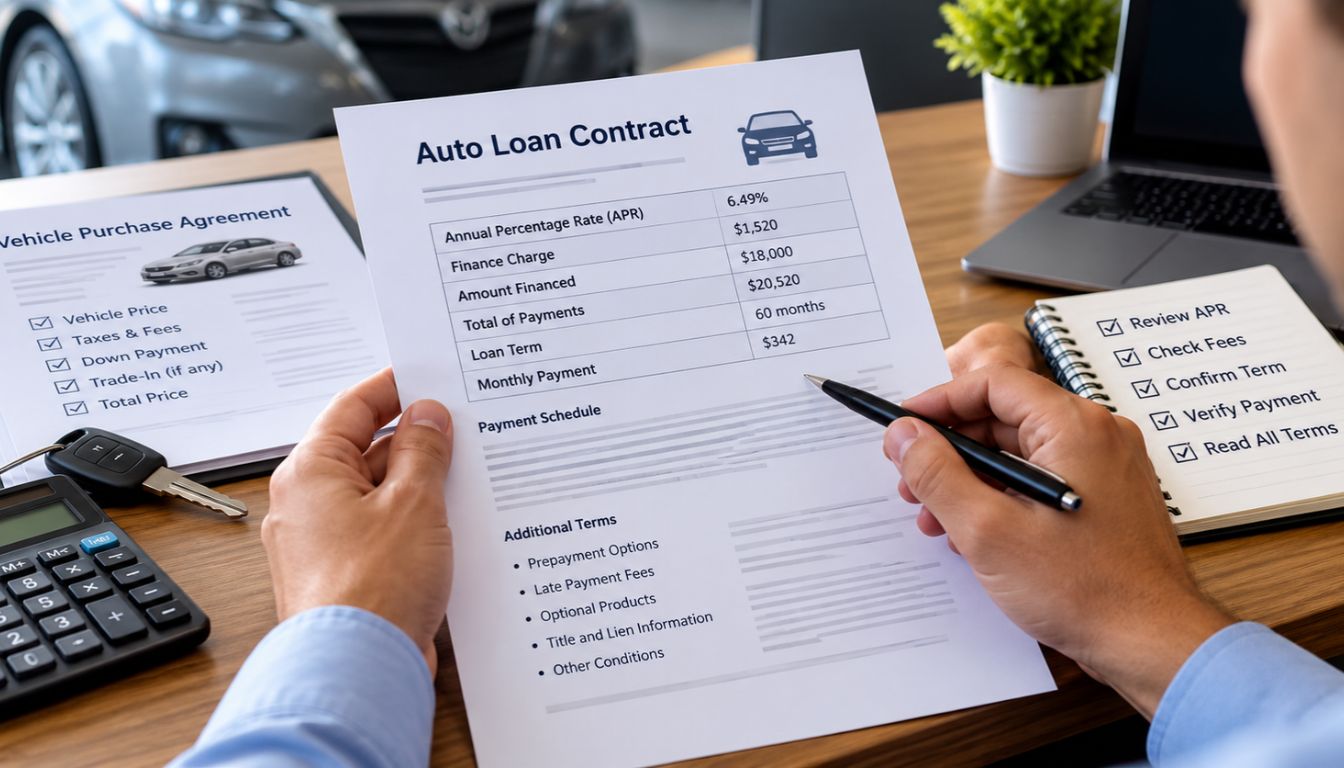
Before signing your used car loan, compare the final documents with the vehicle price and financing terms you previously agreed to.
Review the Credit Disclosures
For covered closed-end auto credit, important Truth in Lending disclosures can include:
- APR;
- finance charge;
- amount financed;
- total of payments;
- payment schedule.
Confirm the numbers match your understanding of the transaction.
Review the Vehicle Transaction Separately
Check the:
- vehicle price;
- taxes;
- government charges;
- dealer fees;
- down payment;
- trade-in credit;
- negative equity, if any;
- optional products.
Review Add-Ons Before Accepting Them
Products such as service contracts, GAP products, credit insurance, or other dealer add-ons can increase the amount you pay.
Ask for the price of each product, what it covers, exclusions, cancellation terms, and whether it is optional before agreeing to it.
Do not assume an add-on is required merely because it appears in paperwork. Ask questions and make sure the final contract includes only products you agreed to purchase.
Understand Whether Financing Is Final
Before leaving the dealership, understand whether your financing has been finalized or is subject to additional conditions.
If you are later asked to return and sign different financing terms, carefully compare the new offer with the original agreement rather than signing automatically.
Keep copies of signed contracts, disclosures, receipts, and relevant communications.
Step 8: Manage Your Used Car Loan After Purchase
Managing the account properly after purchase can help you avoid unnecessary fees and credit problems.
Confirm Your First Payment and Account Details
Know:
- the payment amount;
- first due date;
- payment method;
- automatic-payment terms if used;
- lender or servicer contact details.
Contact the Lender Early if You Expect Payment Problems
If you believe you will have difficulty making a payment, contact your lender or servicer before simply ignoring the account.
Available hardship options, if any, depend on the lender and your circumstances.
Track Your Loan Balance and Vehicle Value
Vehicle depreciation can affect your options if you later want to trade, sell, or refinance the car.
Knowing both your current payoff amount and approximate vehicle value can help you determine whether you have positive or negative equity.
Consider Extra Payments Carefully
Before paying extra toward the loan, review the contract and confirm:
- whether a prepayment penalty applies;
- how additional payments are applied;
- whether extra funds reduce principal;
- how the payment affects your broader financial priorities.
Maintaining emergency savings or paying higher-cost debt may sometimes be more important than accelerating a relatively lower-cost auto loan.
Evaluate Refinancing Based on Total Cost
If you later consider refinancing, compare the new APR, fees, remaining term, payment, and expected total cost.
Extending the repayment period solely to lower the monthly payment can keep you in debt longer and may increase total interest.
Common Used Car Loan Mistakes to Avoid
Shopping Only by Monthly Payment
A lower payment can result from a longer term rather than a better financing deal.
Accepting the First Financing Offer
Comparing multiple lenders can reveal meaningful differences in rates and terms.
Skipping the Out-the-Door Price
Get the complete vehicle price in writing so you can identify fees and add-ons before financing.
Ignoring Vehicle Eligibility
A lender may approve you as a borrower but reject the particular vehicle because of its age, mileage, value, title, or other criteria.
Skipping an Independent Inspection
A history report can be useful, but it may not reveal current mechanical problems.
Automatically Accepting Add-Ons
Evaluate optional products independently and understand their prices and terms.
Rolling Negative Equity Into Another Loan Without Calculating the Cost
Adding old vehicle debt to a replacement loan increases the amount financed.
Signing Before Reviewing the Final Numbers
Compare the final contract with your negotiated price, preapproval, and expected financing terms.
Used Car Loan Comparison Checklist
| Item | Offer A | Offer B |
|---|---|---|
| Vehicle Out-the-Door Price | _____ | _____ |
| Down Payment | _____ | _____ |
| Amount Financed | _____ | _____ |
| Interest Rate | _____ | _____ |
| APR | _____ | _____ |
| Loan Term | _____ | _____ |
| Monthly Payment | _____ | _____ |
| Finance Charge | _____ | _____ |
| Total of Payments | _____ | _____ |
| Optional Products | _____ | _____ |
| Prepayment Terms | _____ | _____ |
| Vehicle Restrictions | _____ | _____ |
This checklist makes it easier to compare used car financing on similar terms instead of choosing an offer based on one attractive number.
Official Used Car and Auto Loan Resources
- Consumer Financial Protection Bureau: Compare Auto Loan Offers
- Consumer Financial Protection Bureau: How Auto Loan Rates Are Determined
- Federal Trade Commission: Buying a Used Car From a Dealer
- Federal Trade Commission: Financing or Leasing a Car
- NHTSA: Vehicle Safety Recall Lookup
Frequently Asked Questions
How do I find a good used car loan?
Compare offers from several lenders using the same approximate loan amount and term. Review the interest rate, APR, amount financed, monthly payment, loan term, finance charge, and total of payments rather than choosing solely by monthly payment.
What affects used car loan approval?
Lenders can consider factors such as your credit scores and history, income, debts, loan amount, term, down payment, and the vehicle itself. Underwriting standards vary by lender.
Are used car loan rates always higher than new car loan rates?
Not necessarily in every transaction. Rates depend on the lender, borrower, loan structure, vehicle, and market conditions. Compare actual offers available to you rather than assuming a fixed difference.
Should I get preapproved before visiting a dealership?
Preapproval can be useful because it gives you an outside financing offer to compare with dealer-arranged financing and can help establish your budget before negotiating at the dealership.
Does auto loan preapproval guarantee final approval?
No. A lender may still need to verify your information and approve the specific vehicle and transaction. Review the conditions and expiration date of the actual preapproval.
What vehicle restrictions can apply to a used car loan?
Lenders may impose requirements concerning vehicle age, mileage, value, title status, loan-to-value ratio, seller type, and minimum or maximum loan amounts. There is no single age or mileage limit that applies to every lender.
Should I get a used car inspected before buying it?
An independent mechanical inspection can identify problems that may not appear in a vehicle history report. FTC consumer guidance recommends considering an independent inspection before purchasing a used vehicle.
What should I compare besides the used car loan interest rate?
Compare APR, amount financed, loan term, monthly payment, finance charge, total of payments, applicable fees, prepayment provisions, and vehicle eligibility requirements.
Are dealer add-ons required with a used car loan?
Many products offered by dealers, such as service contracts and other add-ons, are optional. Ask what each product costs, whether it is optional, what it covers, and make sure unwanted products are not included in the contract.
Can I finance a used car through a lender instead of the dealership?
Yes. Depending on availability and eligibility, you can seek financing directly from banks, credit unions, and other lenders and compare those offers with dealer-arranged financing.
Conclusion
A successful used car loan starts with preparation rather than the dealership finance desk. Establish your budget, review your credit, compare lenders, and get an out-the-door vehicle price before deciding how much to borrow.
Then compare the APR, interest rate, amount financed, loan term, monthly payment, finance charge, and total payments. Make sure the vehicle meets the lender’s requirements and consider an independent inspection before committing to the purchase.
Finally, read the financing documents carefully and evaluate optional products separately. The goal is not simply to get approved—it is to choose a vehicle and financing arrangement that fit your budget without hiding unnecessary costs in a low monthly payment.
For more guidance, continue with our first time auto loan guide, best auto finance deals, finance charge guide, auto finance calculator guide, and Auto Finance Center.