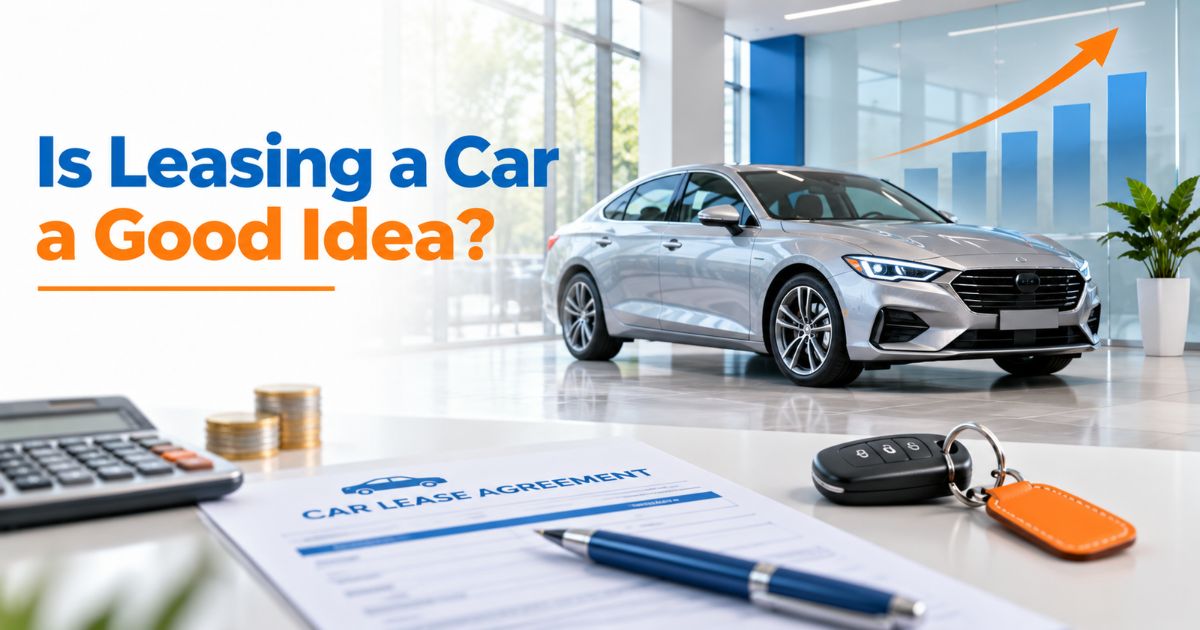
Leasing allows you to use a vehicle for an agreed period and mileage allowance without purchasing it outright. Monthly payments may be lower than payments on a loan used to buy the same new vehicle, but leasing does not automatically build ownership equity.
Before deciding is leasing a car a good idea for your household, compare upfront costs, vehicle depreciation, residual value, the money factor, insurance requirements, excess-mileage fees, and end-of-lease obligations.
Leasing may suit drivers who want a relatively new vehicle every few years and can predict their annual mileage. Buying may be more attractive for drivers who want long-term ownership, unrestricted mileage, and the possibility of driving a paid-off car for several additional years.
This guide examines seven important advantages and disadvantages, illustrates how vehicle leasing works, explains common charges, and compares leasing with financing and purchasing a used vehicle.
For additional information, explore our average car payment comparison and car down payment guide.
Key Takeaways
- Leasing may provide lower monthly payments than financing the same new vehicle, but the actual difference depends on the offers.
- Most vehicle leases include a mileage allowance and charges for exceeding it.
- Lease payments generally cover expected depreciation, a rent charge, taxes, and applicable fees.
- Returning a leased vehicle does not normally create ownership equity.
- Ending a lease early may create significant financial obligations.
- Maintenance, insurance, and excess-wear costs can affect the total expense.
- Buying can be more suitable for long-term ownership and unrestricted driving.
- A written lease-versus-buy comparison is more reliable than comparing advertised monthly payments alone.
1. Is Leasing a Car a Good Idea for Your Lifestyle?
To determine is leasing a car a good idea, start by evaluating how long you expect to keep your vehicle, how frequently you drive, and what you can comfortably afford.

When leasing may make financial sense
Leasing can be worth considering when you prefer a newer vehicle, expect relatively consistent mileage, and have sufficient income to meet ongoing contractual payments.
Some drivers appreciate the opportunity to change vehicles every few years without independently arranging a private sale.
However, the convenience of returning a vehicle should not be confused with eliminating all financial responsibilities.
When buying may be more suitable
Purchasing generally makes more sense when you intend to keep a vehicle for many years, travel extensively, or want to avoid mileage restrictions.
With financing, payments gradually reduce the loan principal. Once the loan is fully repaid, you own the vehicle without further loan installments.
You remain responsible for insurance, maintenance, registration, and repairs regardless of the financing method.
Consider your annual mileage
Many conventional leases include annual mileage allowances around 10,000 to 15,000 miles, although other limits are available.
If your commute, family travel, or work activities produce unusually high mileage, excess-mileage charges could make leasing less attractive.
Consider your household budget
A lower advertised lease payment does not necessarily mean lower overall transportation costs.
Calculate insurance, fuel, maintenance, taxes, registration, upfront fees, and expected charges when the agreement ends.
Consider your future plans
A lease can become inconvenient if you unexpectedly move, change jobs, start driving much farther, or need a different type of vehicle before the agreement expires.
Early termination may be costly, so drivers expecting major lifestyle changes should evaluate alternatives carefully.
Quick decision checklist
| Personal Situation | Option Worth Comparing |
|---|---|
| Predictable mileage | Leasing or buying |
| High annual mileage | Buying |
| Preference for newer vehicles | Leasing |
| Long-term ownership goal | Buying |
| Uncertain future transportation needs | Buying used or keeping current vehicle |
| Limited savings for fees | Lower-cost alternatives |
Our guide to lowering car payments and auto financing calculator guide can help with budgeting.
The question is leasing a car a good idea should ultimately be answered using your actual transportation needs, not a dealership’s advertised payment.
2. How Car Leasing Works From Start to Finish
A vehicle lease is a contract allowing a customer to use a car for a specified period under agreed financial and usage conditions.
Choose a vehicle and negotiate its price
Start by comparing vehicles that meet your needs and budget.
Although you are not buying the vehicle outright, the negotiated vehicle price can influence the lease’s financial terms.
The lessor or finance company generally retains ownership during the agreement.
Understand capitalized cost
The capitalized cost represents the amount used in the lease calculation, generally reflecting the agreed vehicle value and applicable financed items.
The adjusted capitalized cost can reflect reductions such as a down payment, eligible rebates, or trade-in credit.
Understand residual value
Residual value is the estimated value of the vehicle when the lease ends.
It is an important component because a conventional closed-end lease generally charges for expected depreciation during the contract term.

Understand the money factor
Some vehicle leases express their rent charge using a money factor rather than a conventional loan interest rate.
A commonly used approximation multiplies the money factor by 2,400 to express a percentage resembling an annual interest rate.
However, this is not necessarily an equivalent consumer loan APR calculation.
Ask for the actual rent charge and complete written lease disclosures.
Choose the contract duration
Many consumer vehicle leases last approximately 24 to 48 months.
Payment amounts depend on the agreed term, vehicle price, projected residual value, rent charges, and other applicable costs.
Make scheduled payments
During the lease, you must comply with payment requirements, mileage restrictions, insurance obligations, and maintenance standards.
Missed payments can create fees and other contractual consequences.
Choose an option at lease end
When the agreement expires, you may be able to return the vehicle, purchase it under an available buyout provision, or enter a different vehicle transaction.
Your actual options depend on the contract.
Important terms to understand
| Lease Term | Meaning |
|---|---|
| Capitalized Cost | Amount used as the starting basis for calculating lease payments |
| Residual Value | Estimated vehicle value at lease end |
| Money Factor | Rate-related factor used in certain rent-charge calculations |
| Acquisition Fee | Charge associated with establishing a lease |
| Disposition Fee | Potential charge when returning the vehicle |
| Mileage Allowance | Contractual driving-distance limit |
| Purchase Option | Right to buy under specified conditions when offered |
For loan-related comparisons, read our auto loan rates guide and car loan APR guide.
3. What Does Leasing a Car Really Cost?
Understanding the full cost of vehicle leasing requires reviewing upfront expenses, scheduled payments, and possible charges at the end of the contract.
Upfront costs
A lease may require an initial payment covering various expenses.
Depending on the agreement, these may include the first monthly installment, acquisition fee, applicable taxes, registration charges, a refundable security deposit, and a capitalized cost reduction.
Monthly payments
Monthly lease payments generally reflect the vehicle’s expected depreciation plus a rent charge and applicable taxes or fees.
Unlike purchasing, making lease payments does not normally reduce a consumer loan principal toward vehicle ownership.
Acquisition fees
An acquisition fee is an administrative charge associated with initiating a lease.
The amount varies by lessor and vehicle program. Do not assume that every leasing company charges the same amount.
Mileage charges
Contracts may impose additional charges for driving beyond the agreed allowance.
For example, an illustrative charge of $0.25 per additional mile would result in $500 for 2,000 excess miles.
This is a hypothetical calculation. Actual rates depend on the written agreement.
Wear-and-tear charges
Lease agreements usually distinguish acceptable wear from excessive damage.
Examples of potentially chargeable conditions may include substantial dents, broken equipment, unacceptable tire condition, or significant interior damage.
Insurance expenses
Many lessors require specified liability and physical damage insurance coverage.
Insurance costs can vary substantially according to driver history, location, vehicle model, coverage requirements, and deductibles.
Disposition and return charges
Some leases include a disposition fee when the car is returned.
Other charges may apply for missing equipment, late returns, excess mileage, or unacceptable condition.
Example lease cost calculation
Consider a hypothetical 36-month lease with these terms:
| Expense | Illustrative Amount |
|---|---|
| Monthly Lease Payment | $350 |
| Number of Payments | 36 |
| Total Monthly Payments | $12,600 |
| Additional Upfront Costs | $1,500 |
| Expected Return Charges | $400 |
| Estimated Total Lease Outlay | $14,500 |
This illustration assumes the additional upfront costs exclude amounts already counted in the 36 monthly payments. It also excludes insurance, fuel, maintenance, and unexpected charges.
When evaluating is leasing a car a good idea, calculate total spending over the complete contract rather than relying on the monthly installment.
For related cost planning, see our new versus used vehicle payments and upfront car payment considerations.
4. Leasing vs Buying: Which Costs Less?
A fair lease-versus-buy comparison should consider equivalent vehicles, the same time period, and all associated expenses.

Compare the same vehicle
A lower-priced leased vehicle should not be compared with a more expensive purchased vehicle without accounting for the difference.
Choose a similar model, trim, and equipment package for both estimates.
Compare equivalent periods
If you expect to drive the vehicle for three years, calculate the cost of leasing and the cost of buying over those three years.
For the ownership scenario, estimate the remaining loan payoff and realistic resale value at the comparison date.
Understand depreciation
Vehicle depreciation represents the loss in market value over time.
Lease payments commonly reflect projected depreciation, whereas a purchaser experiences changes in the vehicle’s market value directly.
Neither option eliminates the economic cost of depreciation.
Compare ownership equity
When buying with financing, loan principal payments reduce the outstanding debt.
Equity depends on the difference between the vehicle’s market value and the remaining loan balance.
During a conventional lease, scheduled payments normally do not create ownership equity.
Compare long-term transportation costs
Buying may be more economical when you keep the vehicle for several years after completing loan repayment.
However, older vehicles can require significant repairs and maintenance.
Repeatedly leasing new vehicles may mean continuing to make lease payments instead of eventually driving a paid-off vehicle.
Lease versus buy comparison
| Feature | Leasing | Buying |
|---|---|---|
| Ownership | Usually none during term | Ownership subject to any lender lien |
| Monthly Payment | Often lower for same new vehicle | Often higher for same new vehicle |
| Mileage Limits | Typically restricted | No contractual mileage allowance |
| Vehicle Modifications | Usually restricted | Generally more flexibility |
| Equity | Not normally accumulated | May accumulate |
| Early Exit | Potential termination charges | Possible sale, subject to loan payoff |
| End of Contract | Return or purchase if permitted | Keep, sell, or trade after payoff |
For purchase financing comparisons, review our vehicle financing rates, private-party car loans, and negative equity guide.
5. Seven Important Pros and Cons of Leasing a Car
Before asking is leasing a car a good idea for you, consider the following seven advantages and disadvantages.

Advantage 1: Potentially lower monthly payments
Leasing often produces a lower monthly payment than financing the entire purchase price of the same new car over a comparable period.
This happens because the lease generally reflects expected depreciation rather than repayment of the vehicle’s full purchase price.
However, down payments, incentives, credit qualifications, taxes, and contract terms affect the comparison.
Advantage 2: Access to newer vehicles
Drivers who prefer updated safety systems, technology, or vehicle designs may appreciate leasing for relatively short periods.
A new lease can provide access to another model without independently selling the previous vehicle, provided the earlier contract is completed properly.
Advantage 3: Potential warranty coverage
A leased vehicle may remain within some manufacturer warranty periods during the term.
However, warranty coverage does not guarantee that every repair or maintenance expense is free.
Consumable items, excluded damage, and required maintenance may remain the driver’s responsibility.
Disadvantage 1: No automatic ownership equity
At the end of a typical lease, the driver does not own the vehicle unless a contractual purchase option is exercised.
This can make repeated leasing less attractive for drivers whose primary goal is long-term ownership.
Disadvantage 2: Mileage restrictions
A lease contract usually includes a mileage allowance.
Drivers with long commutes, frequent road trips, or unpredictable travel needs may find those restrictions inconvenient or expensive.
Disadvantage 3: Early termination costs
Ending a lease before its scheduled expiration can produce substantial charges.
The amount depends on contractual terms, vehicle value, outstanding obligations, and applicable rules.
Do not assume that returning the car immediately eliminates future liability.
Disadvantage 4: Wear and maintenance requirements
Drivers must generally maintain the car according to contract requirements and return it within defined condition standards.
Unusual damage, missing components, or neglected maintenance may result in additional charges.
How these trade-offs affect different drivers
A driver with a reliable commute, predictable income, and a preference for newer vehicles may find leasing convenient.
A driver who frequently travels long distances, expects major lifestyle changes, or wants to keep a car for many years may prefer buying.
For alternative financing strategies, read our nine options to lower car payments, auto loan calculation guide, and affordable auto loan comparison.
6. Understand Mileage Limits and End-of-Lease Charges
Excess mileage and return-condition charges can materially affect the overall cost of a vehicle lease.
Estimate annual mileage accurately
Consider commuting distance, weekend travel, vacations, school transportation, and work-related driving.
Use your actual driving history whenever possible.
Check the excess-mileage rate
Review the precise rate stated in your contract.
For example, driving 3,000 miles beyond a contractual allowance at an illustrative $0.20 per mile would create $600 in charges.
Understand normal wear
Normal wear allowances differ among lessors.
Review the condition standards before returning the vehicle instead of assuming that all scratches or tire wear will be accepted.
Schedule the vehicle inspection
Some lessors offer or require a pre-return inspection.
Checking the vehicle before the final return date may provide time to address qualifying damage.
Keep maintenance records
Retain service invoices, repair documentation, tire records, and any other information required by the agreement.
These records may be helpful when disputing incorrect charges.
Understand return fees
Possible charges may include disposition fees, excess mileage, damage repairs, and missing equipment costs.
Some lessors waive particular charges under certain replacement-lease programs, but waivers should never be assumed.
Review the purchase option
A lease may include an agreed buyout price or method for calculating the purchase amount.
Compare the contractual buyout amount with the vehicle’s current market value and any applicable taxes or fees before purchasing.
When considering is leasing a car a good idea, estimate these end-of-contract expenses alongside normal monthly payments.
Our car payment costs comparison and vehicle equity explanation provide additional financial context.
7. Review Insurance, GAP Coverage, and Early Termination Risks
Insurance obligations and contract termination provisions are among the most important items to review before signing.
Lease insurance requirements
Vehicle lessors generally require specific liability and physical damage coverage.
The limits and deductible restrictions depend on the lease agreement and insurer.
Request insurance quotes before selecting a vehicle.
What is GAP coverage?
Guaranteed Asset Protection, often called GAP, may help address certain financial differences between an insurance settlement and the amount owed after a qualifying total loss.
Coverage, exclusions, eligibility, and maximum benefits depend on the product or waiver.
Is GAP automatically included?
No. Some leases include a GAP waiver, while others require separate arrangements or provide different protections.
Review the contract rather than assuming coverage is automatic.
What happens after a total loss?
If a leased vehicle is stolen or declared a total loss, the lessor and insurer apply the contract and insurance terms.
You may remain responsible for certain balances, deductibles, excluded charges, or other obligations.
Understanding early termination
A lease agreement normally describes how early termination liability is calculated.
Depending on the terms, leaving early may create a substantial amount due even when the vehicle is returned.
Can you transfer a lease?
Some leasing companies permit approved lease transfers, while others prohibit them.
Even when transfers are allowed, the original lessee may retain liability under some agreements.
Can you purchase the vehicle early?
Certain contracts permit early purchase under defined conditions.
Ask the lessor for an official payoff or purchase quotation and compare it with available alternatives.
For a related discussion of financial stress, see our vehicle payment hardship guide and auto loan refinancing guide.
8. How to Compare Car Lease Offers Before Signing
Comparing several offers can help identify differences in financing charges, upfront expenses, mileage allowances, and contract restrictions.
Choose comparable vehicle models
Start with vehicles offering similar equipment, capabilities, and expected reliability.
Request itemized offers
Ask each dealership or lessor to identify the agreed vehicle value, adjusted capitalized cost, residual value, rent charge, and all disclosed fees.
Compare the same mileage allowance
An offer with a lower annual mileage limit may appear cheaper because it assumes less vehicle depreciation.
Compare leases with equal mileage limits whenever possible.
Compare the same payment term
A 24-month offer and a 36-month offer should not be compared solely by monthly payment.
Calculate total spending over each contractual period.
Compare cash due at signing
One lease may advertise a lower payment while requiring a substantially larger upfront contribution.
Separate refundable deposits from nonrefundable charges and capitalized cost reductions.
Avoid concentrating only on monthly payments
Ask for the total of scheduled lease payments and other anticipated charges.
Consider the consequences of an unexpected need to terminate the agreement.
Evaluate the money factor
Ask whether the money factor or rent charge can be negotiated.
Compare the actual financial terms available for your credit profile.
Review official consumer guidance
The Consumer Financial Protection Bureau’s leasing versus buying guidance explains important financial differences, including depreciation, mileage limits, and end-of-lease obligations.
Read the final agreement carefully
Verify every amount before signing, including fees that may have been added after the initial quotation.
Keep a complete copy of the signed contract.
Lease offer comparison checklist
| Item | What to Compare |
|---|---|
| Vehicle Price | Agreed starting amount |
| Adjusted Capitalized Cost | Amount used in payment calculation |
| Residual Value | End-of-lease estimated value |
| Money Factor | Rent charge calculation |
| Lease Term | Number of scheduled months |
| Mileage | Contractual allowance |
| Upfront Costs | Initial cash requirement |
| Return Charges | Possible disposition and wear costs |
| Purchase Option | Buyout terms where offered |
Compare leasing with our current auto loan rate research, vehicle down payment planning, and vehicle financing calculations.
9. When Leasing May Be Better Than Buying
Leasing may be reasonable when several personal and financial circumstances align.
You drive predictable distances
Drivers with relatively stable commuting and travel habits can estimate mileage more confidently.
You prefer newer cars
Shorter-term leasing may suit people who value newer features and do not expect to retain a vehicle for many years.
You understand the full costs
A suitable lease should fit your budget after considering monthly payments, insurance, fees, and possible return expenses.
You do not prioritize long-term ownership
If building vehicle equity is not an important goal, leasing may be worth comparing with purchasing.
You can complete the entire contract
Leasing is generally easier to manage when your financial and transportation needs are unlikely to change significantly during the agreed term.
Even under these circumstances, is leasing a car a good idea remains a question of comparative costs rather than convenience alone.
10. When Buying or Keeping a Vehicle May Be Better
You drive many miles
Purchasing avoids contractual mileage penalties, although high mileage can reduce resale value and increase maintenance costs.
You want long-term ownership
Buying allows you to continue using a vehicle after the loan has been repaid.
You prefer to modify your vehicle
Ownership typically provides more freedom to make lawful modifications, subject to warranties, insurance, and other requirements.
Your future plans are uncertain
Drivers expecting a relocation, family changes, or substantial commuting changes may prefer avoiding rigid lease restrictions.
You already have a reliable vehicle
Keeping a dependable car may be less expensive than entering a new lease or loan.
Compare expected repairs with the total expense of replacement transportation.
You want to purchase a used car
A reasonably priced used vehicle can offer lower acquisition costs, although reliability and maintenance requirements vary.
Get a vehicle history report and an independent inspection when appropriate.
For used-car financing information, review our private-party vehicle financing guide and minimum credit score for car loans.
11. Common Car Leasing Mistakes to Avoid
Choosing only by the advertised payment
Lower monthly payments may be accompanied by higher cash requirements at signing or restrictive terms.
Underestimating annual mileage
Excess mileage can create additional charges when the lease ends.
Ignoring the residual value
Understanding the residual value is important when reviewing payments and potential purchase options.
Assuming all maintenance is free
Warranty coverage is not identical to free routine maintenance or unlimited repair protection.
Assuming GAP is included
Read the insurance and waiver provisions in the signed agreement.
Making an unnecessarily large down payment
A substantial upfront capitalized cost reduction can lower monthly payments, but it also exposes more cash at the beginning of the arrangement.
Consider how the contract treats upfront amounts after theft or total loss.
Ignoring early termination obligations
Do not assume you can return the vehicle without additional liability if circumstances change.
Rolling negative equity into a lease
Including unpaid debt from a previous vehicle can make a new arrangement more expensive.
Read our negative equity options guide before transferring old obligations into replacement transportation.
Failing to compare total ownership costs
Insurance, maintenance, taxes, fees, and anticipated replacement costs should be part of the decision.
12. Alternatives to Leasing a Car
Drivers uncertain about leasing have several alternatives worth evaluating.
Finance a new car
A conventional auto loan allows the buyer to acquire ownership while making agreed principal and interest payments.
Costs depend on vehicle price, credit qualifications, interest rate, fees, and repayment term.
Purchase a used vehicle
Buying used may reduce upfront expense and exposure to the earliest stages of depreciation.
However, repair history, maintenance, and vehicle condition require careful review.
Keep your current vehicle
If an existing car is safe, reliable, and reasonably economical to maintain, keeping it may avoid substantial replacement costs.
Consider short-term rentals
Rentals may suit temporary transportation needs without requiring a multi-year lease.
Compare insurance, mileage restrictions, and rental fees.
Use car sharing or public transportation
Drivers who travel only occasionally may find alternative transportation more affordable than maintaining a dedicated vehicle.
Compare credit union financing
Banks and credit unions may offer purchase financing terms worth comparing with dealership and manufacturer-affiliated arrangements.
Our affordable auto financing guide and auto loan preapproval guide explain related financing considerations.
13. Final Checklist Before Signing a Car Lease
- Compare leasing with buying the same vehicle.
- Calculate total transportation expenses.
- Review your credit profile.
- Confirm the negotiated vehicle price.
- Check adjusted capitalized cost.
- Verify residual value.
- Understand the rent charge or money factor.
- Review the length of the lease.
- Choose an appropriate mileage allowance.
- Confirm excess-mileage charges.
- Identify acquisition fees.
- Identify disposition fees.
- Review taxes and registration charges.
- Check all upfront payments.
- Understand insurance requirements.
- Verify whether GAP protection is included.
- Review maintenance obligations.
- Understand acceptable wear-and-tear standards.
- Review early termination provisions.
- Check whether lease transfer is permitted.
- Confirm any purchase option.
- Calculate expected end-of-lease costs.
- Compare at least two written offers where available.
- Verify that the signed agreement matches the quotation.
- Keep copies of all signed documents.
For additional consumer information, review the Federal Trade Commission’s car financing and leasing guide.
Related Best Finance Live Guides
- Average Car Payment 2026: New vs Used Costs
- How to Lower Car Payment: 9 Options
- Auto Loan Rates by Credit Score
Conclusion
Is leasing a car a good idea for drivers who want a newer vehicle and potentially lower monthly payments? It can be, but only when the total costs and contractual restrictions fit their financial circumstances.
Leasing may provide convenience and a predictable replacement cycle, while buying offers a path toward ownership and greater flexibility over mileage and vehicle use.
Before committing, compare the capitalized cost, residual value, rent charge, upfront fees, insurance requirements, mileage allowance, and end-of-contract expenses.
A lease can become expensive if you exceed mileage limits, return a damaged vehicle, or terminate the agreement early.
Buying a reliable used car or keeping an existing vehicle may be more economical for some households, especially when long-term ownership is the primary goal.
Ultimately, the right decision is the one that meets your transportation needs without placing unnecessary pressure on your household finances.