This funding method can help companies manage temporary cash flow shortages, supplier payments, payroll, and other necessary business expenses. However, factoring is not free money. Discount fees, reserve deductions, customer credit requirements, and contract obligations can reduce the amount ultimately received.
Before choosing small business invoice factoring, compare provider pricing, invoice eligibility, advance percentages, recourse obligations, collection procedures, and contract termination conditions. The best arrangement depends on your customer relationships, financial position, and actual funding requirements.
This 2026 guide explains how accounts receivable factoring works, how fees are calculated, which invoices may qualify, what risks businesses should understand, and seven practical ways to evaluate providers.
For additional background, review our business loans and funding options guide and business finance fundamentals.
Key Takeaways
- Factoring generally involves selling qualifying unpaid invoices to a third-party financing company.
- The factor commonly provides an advance before the customer pays.
- Advance rates, funding schedules, and reserve arrangements depend on the provider and contract.
- Customer creditworthiness can strongly influence eligibility and pricing.
- Recourse agreements may require the seller to repurchase or replace unpaid invoices.
- Non-recourse protection can contain significant exclusions.
- Discount charges and additional fees reduce net proceeds.
- Customer verification and collection procedures may affect commercial relationships.
- Existing security interests can complicate receivables transactions.
- Compare factoring with lines of credit, term loans, and invoice-backed borrowing before signing.
1. Small Business Invoice Factoring: How It Works
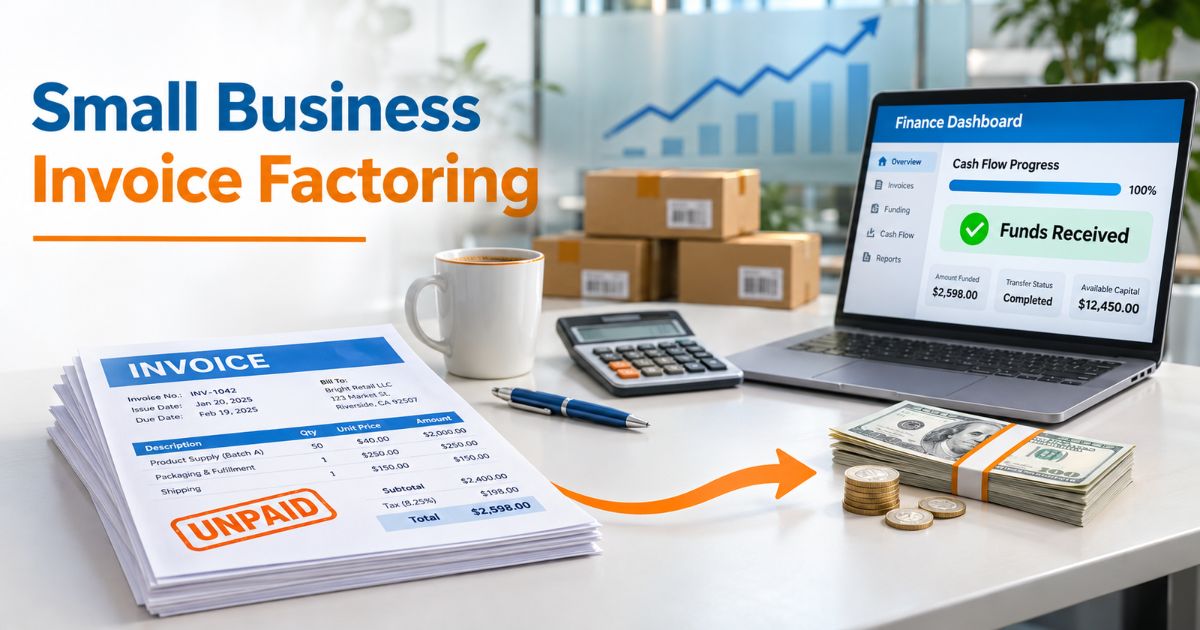
Small business invoice factoring is a commercial financing arrangement in which a company sells eligible accounts receivable to a factor, generally at a discount.
The factor pays an agreed advance and handles collection according to the contractual arrangement. When the customer pays, any remaining reserve is settled after fees, adjustments, and other contractual deductions.

What is an account receivable?
An account receivable represents an amount owed by a customer for goods or services that have been provided under applicable credit terms.
For example, a commercial supplier may deliver products and issue an invoice payable within 30 or 60 days.
The sale has been completed, but the supplier has not yet received the money.
How factoring converts invoices into cash
A financing company may purchase approved invoices and provide an initial payment based on their eligible value.
The customer later pays according to the applicable invoice and assignment terms.
The provider accounts for its fees and releases any remaining amount due to the seller.
Who receives customer payments?
Under many disclosed factoring arrangements, the customer receives a notice directing payment to the factor or a designated account.
Collection processes can differ, so businesses should verify the provider’s exact procedures.
What is an advance rate?
The advance rate is the percentage of the eligible invoice value provided upfront.
For illustration, an 80% advance against a $10,000 invoice produces an initial payment of $8,000 before any applicable upfront deductions.
The remaining $2,000 is typically held as a reserve until the customer’s payment is processed, subject to the agreement.
Does factoring guarantee immediate funding?
No. Approval may require invoice verification, customer credit checks, legal documentation, and resolution of competing security interests.
Some providers offer rapid funding after onboarding, but exact timing varies.
How factoring differs from a conventional loan
A traditional business loan generally provides funds that the borrower repays under an agreed schedule.
Factoring instead involves selling a receivable, although the accounting and legal treatment of specific arrangements requires separate evaluation.
| Feature | Invoice Factoring | Business Term Loan |
|---|---|---|
| Funding Basis | Eligible invoices | Underwritten loan amount |
| Payment Source | Customer receivables | Borrower’s repayment cash flow |
| Primary Cost | Discount and service fees | Interest and applicable fees |
| Availability | Depends on invoice eligibility | Depends on loan approval |
| Risk | Recourse, disputes, reserves | Default and contractual liability |
For more information, compare our business loans versus lines of credit and unsecured business financing options.
Understanding small business invoice factoring begins with recognizing that selling receivables involves a different transaction structure from ordinary installment borrowing.
2. Check Invoice Eligibility and Customer Creditworthiness
Not every unpaid invoice qualifies for financing. Providers evaluate the customer’s ability to pay, invoice validity, business relationships, and existing legal claims.

Business-to-business invoices
Many factors specialize in invoices issued to commercial customers or qualifying government entities.
Invoices from individual retail consumers may not fit the same underwriting model.
Completed goods and services
Providers often prefer invoices representing goods already delivered or services already performed.
Invoices for uncompleted work or conditional obligations may be excluded.
Invoice age
Recent invoices with clearly defined payment terms may be easier to evaluate.
However, there is no universal invoice-age limit accepted by every provider.
Customer payment history
A customer with a record of timely payment may be more attractive than one with repeated delinquencies.
The factor may request trade references, available financial information, or other evidence of payment capacity.
Customer concentration risk
When one customer accounts for most of a company’s receivables, the factor may face significant exposure to that single debtor.
Concentration limits can reduce the amount eligible for advances.
Invoice disputes
Invoices may be unsuitable when the customer disputes product quality, service completion, delivery, pricing, or contract performance.
Resolve discrepancies before attempting to sell the receivable.
Existing liens
A business line of credit or secured loan may already give another lender rights over accounts receivable.
Such claims can complicate the proposed sale or security arrangements.
Documents commonly requested
- Accounts receivable aging reports.
- Copies of qualifying invoices.
- Customer contracts or purchase orders.
- Delivery confirmations.
- Proof of completed services.
- Business registration information.
- Tax identification documentation.
- Bank statements when required.
- Information about existing security interests.
Invoice eligibility checklist
| Requirement | What to Verify |
|---|---|
| Valid Invoice | Actual amount owed |
| Completed Performance | Goods delivered or services completed |
| Customer Quality | Payment capacity and history |
| Payment Terms | Clear due date and contract |
| Dispute Status | No unresolved material dispute |
| Existing Liens | Legal ability to assign receivable |
Businesses with limited credit histories may also review our small business loans for bad credit guide and first-time business borrowing requirements.
For small business invoice factoring, the financial quality of the paying customer may be especially important, but it does not eliminate the need to evaluate the seller’s business.
3. Follow the Factoring Process From Application to Final Settlement
The transaction normally involves several stages, beginning with preliminary eligibility and ending with the distribution of collected proceeds.

Step 1: Submit the application
Provide accurate information about business ownership, commercial activities, customer accounts, and the invoices you intend to finance.
Step 2: Complete customer checks
The provider reviews customer credit quality and other eligibility information.
Additional documentation may be required for unusually large invoices or concentrated customer exposure.
Step 3: Verify the invoice
Invoice verification may include contacting the customer to confirm the amount owed and delivery of goods or services.
Incomplete documentation can delay approval.
Step 4: Review the factoring agreement
The contract identifies advance rates, fees, reserves, recourse obligations, payment instructions, and other responsibilities.
Review the full agreement before signing.
Step 5: Assign approved receivables
The parties complete the required documentation for the receivable transaction.
Depending on the arrangement, notices may be provided to affected customers.
Step 6: Receive the initial advance
After required conditions are satisfied, the provider releases the approved advance.
Do not assume funds will arrive before invoice verification is complete.
Step 7: Customer payment and final settlement
The customer pays according to the relevant instructions.
Once the payment clears, the factor calculates fees, deductions, and any reserve distribution required by the agreement.
What can delay the transaction?
- Incorrect invoice details.
- Incomplete delivery documentation.
- Customer disputes.
- Unsatisfactory debtor credit checks.
- Existing lender liens.
- Unclear payment instructions.
- Missing legal documentation.
Illustrative transaction timeline
| Stage | Key Activity |
|---|---|
| Application | Submit company and invoice records |
| Underwriting | Review eligibility and customer risks |
| Verification | Confirm invoice validity |
| Agreement | Complete financing documentation |
| Advance | Receive approved funds |
| Collection | Customer pays the assigned invoice |
| Settlement | Provider releases applicable reserves |
This table describes the sequence, not a guaranteed processing time.
For documentation guidance, see our small business financing application checklist and finance tips for entrepreneurs.
A properly documented small business invoice factoring arrangement should clearly identify who receives payment and how the seller’s remaining proceeds are calculated.
4. Calculate Factoring Fees, Advance Rates, and Net Proceeds
Pricing can vary according to the size of the receivables, customer quality, expected payment timing, transaction volume, industry, and contract conditions.

What is a factoring fee?
A factoring fee is the amount charged for purchasing and servicing the receivable under the agreed arrangement.
Providers may use discount rates, flat charges, time-based fees, or combinations of different charges.
Flat factoring fees
Under a flat-fee arrangement, a specified charge may apply to the qualifying transaction regardless of when payment arrives, subject to the contract.
Time-based fees
Some agreements increase charges when the customer takes longer to pay.
These fees can make delayed customer payments more expensive.
Advance rates
The advance rate determines how much of an eligible invoice is initially released.
The exact percentage depends on the provider and the invoice’s risk profile.
Reserve amounts
Any withheld portion may serve as a reserve to cover fees, adjustments, and other contractual amounts.
Ask whether reserves are calculated separately by invoice or across a broader account relationship.
Example: $10,000 invoice calculation
Assume a business sells an eligible $10,000 invoice under a contract with an 80% advance rate and a flat 3% factoring fee.
| Calculation | Amount |
|---|---|
| Invoice Face Value | $10,000 |
| Initial Advance (80%) | $8,000 |
| Initial Reserve | $2,000 |
| Factoring Fee (3%) | $300 |
| Reserve Released After Payment | $1,700 |
| Total Net Proceeds | $9,700 |
This example assumes full and timely customer payment, no additional fees, and no other contractual deductions.
Additional fees
Ask whether the contract includes:
- Account setup charges.
- Invoice processing fees.
- Wire transfer charges.
- Minimum-volume fees.
- Credit investigation charges.
- Late-payment adjustments.
- Contract termination penalties.
- Other administrative expenses.
Compare actual net proceeds
The advertised advance percentage does not describe the complete cost.
Compare what the business receives upfront, what may be released later, and the amount retained by the factor.
Understand annualized cost comparisons
Factoring fees are not automatically equivalent to an annual percentage rate.
Annualized comparisons can be informative when calculated using suitable assumptions, but they must account for actual funding duration, cash flows, fee timing, and transaction structure.
A 3% discount on a short-duration receivable should not be described as a 3% annual borrowing rate.
Compare the cost with expected profit
If the invoice represents a relatively low-margin sale, the factoring charge may consume a significant portion of the company’s profit.
Estimate the financing expense before accepting the transaction.
For broader financing cost planning, see our business loan interest rates and fees guide and business loan payment calculator.
Evaluating small business invoice factoring requires comparing the total dollar cost with the financial benefit of receiving funds earlier.
5. Understand Recourse and Non-Recourse Factoring
The contract determines how nonpayment risk is allocated between the factor and the company selling invoices.
What is recourse factoring?
Under a recourse arrangement, the seller may remain responsible for specified unpaid invoices.
Depending on the agreement, the factor may require the company to repurchase an invoice, provide a replacement receivable, or reimburse an applicable amount.
Why recourse matters
A business receiving an advance may later face a repayment obligation when its customer does not pay.
This can create unexpected pressure on working capital.
What is non-recourse factoring?
A non-recourse agreement transfers certain defined risks from the seller to the factor.
However, protection depends on the contract and may be limited to specified credit events.
Does non-recourse cover every unpaid invoice?
No. Non-recourse terms may exclude customer disputes, fraud, invalid invoices, performance failures, contractual breaches, or other defined circumstances.
Customer insolvency versus disputed invoices
A qualifying customer insolvency may be treated differently from a refusal to pay because goods were defective or services were incomplete.
Read the relevant definitions and exclusions carefully.
What happens after a chargeback?
A chargeback can create a contractual obligation to repay or replace amounts previously advanced.
Its treatment depends on the agreement.
Illustrative risk comparison
| Issue | Recourse | Non-Recourse |
|---|---|---|
| Ordinary Customer Nonpayment | Seller may retain liability | Depends on covered events |
| Qualifying Insolvency | Often seller exposure | May be covered |
| Invoice Fraud | Typically seller exposure | Often excluded |
| Service Dispute | Seller may retain liability | Often excluded |
| Pricing | Contract-specific | Contract-specific |
How to evaluate risk allocation
Ask the provider to identify the precise circumstances under which your business must repay an advance.
Request practical examples based on delayed payment, insolvency, customer disputes, and canceled invoices.
For related credit-risk planning, review our secured business financing risks guide and emergency business funding alternatives.
Before choosing small business invoice factoring, verify whether the protection offered matches the financial risks associated with your customers.
6. Review the Factoring Agreement, UCC Filings, and Guarantees
The financing agreement determines the parties’ obligations, payment procedures, service fees, and consequences of contractual breaches.
Assignment provisions
The agreement should explain which invoices are sold or assigned and when the transaction becomes effective.
Customer payment instructions
Many agreements describe how customers must be notified and where payments should be sent.
Contract duration
Some agreements cover individual transactions, while others establish ongoing relationships.
Check whether the arrangement renews automatically.
Minimum-volume requirements
Providers may require a minimum volume of receivables during a specified period.
A business with seasonal revenue should determine whether slower months will create extra fees.
Exclusivity clauses
Some arrangements may restrict the seller from using competing financing providers for specified receivables.
Understand the scope of any exclusivity obligation.
Security interests and UCC filings
Depending on transaction structure and applicable law, the provider may request a UCC financing statement or other documentation protecting its rights.
Such filings are associated with the public notice and perfection framework for specified secured transactions.
Does a UCC filing automatically guarantee priority?
No. Legal priority can depend on the timing of filings, collateral type, existing claims, perfection rules, and applicable law.
Review the California Secretary of State’s UCC financing statement guidance for official background. Filing rules for your business may involve another jurisdiction.
Personal guarantees
Some providers require owners to guarantee specified obligations.
Guarantees vary in scope and do not necessarily apply to every factoring arrangement.
Contract termination provisions
Review notice periods, early termination fees, minimum terms, and any conditions for closing the relationship.
Reserve release conditions
Ask exactly when reserves become available and whether other unpaid invoices or obligations can delay payment.
When to obtain professional advice
Qualified commercial legal and accounting professionals can help evaluate assignment rights, security interests, guarantees, and financial reporting consequences.
For related topics, explore our commercial collateral requirements guide and business financing documentation guide.
A clearly understood contract is essential when using small business invoice factoring to support daily operations.
7. Protect Customer Relationships During Factoring
Customer relationships are important because invoice collection may involve direct communication between the provider and your customers.
Explain payment changes professionally
When appropriate, notify customers that payment instructions have changed according to the financing arrangement.
Use clear, accurate language that avoids unnecessary confusion.
Review customer notification procedures
Ask whether the factor sends notices under its own branding or works with your accounting team to coordinate communications.
Confirm collection practices
Review how the provider handles overdue commercial invoices, customer questions, and disputes.
Protect sensitive business information
Before sharing customer lists, contracts, or financial records, evaluate the provider’s data security and confidentiality arrangements.
Maintain accurate records
Track which invoices have been assigned, which remain outstanding, and which have been settled.
Handle payment disputes promptly
If a customer disputes the amount owed, work to resolve the underlying commercial issue quickly.
Document any credit notes, returns, or adjustments.
Avoid aggressive collection misunderstandings
Discuss the provider’s escalation procedures before signing.
Customers should receive accurate information about what they owe and where payment is due.
Maintain internal controls
Your accounts receivable ledger should reflect assignments and collections accurately.
Coordinate with the factoring provider to prevent duplicate collection attempts or incorrect payment postings.
For broader operational planning, see our entrepreneur financial management tips and business finance and cash flow planning guide.
Well-managed small business invoice factoring should not create unnecessary customer confusion or undermine legitimate business relationships.
8. Compare Factoring With Other Working Capital Options
Several financing alternatives may help companies manage the difference between paying expenses and collecting revenue.
Business line of credit
A revolving credit line allows approved borrowers to draw funds within contractual limits.
Interest commonly applies to outstanding balances, although maintenance, draw, and other fees may apply.
Accounts receivable financing
Receivables financing often involves borrowing against eligible invoices while retaining ownership of the receivables.
The distinction from factoring depends on the actual financing structure and relevant contract.
Short-term business loans
A term loan typically provides a lump sum that is repaid according to a specified schedule.
It may fit a defined expense when cash flow supports the payments.
Equipment financing
Equipment-specific financing may be more appropriate when the business needs machinery rather than liquidity from unpaid invoices.
Customer deposits
Businesses may negotiate appropriate deposits or milestone payments to reduce the time between delivering services and receiving money.
Supplier payment extensions
Negotiating longer payment terms may improve short-term liquidity without automatically creating a new financing obligation.
Invoice collection improvements
Accurate billing, prompt invoicing, and clear customer reminders can sometimes reduce cash flow gaps.
Financing alternatives comparison
| Option | Typical Structure | Important Consideration |
|---|---|---|
| Invoice Factoring | Receivable sale | Fees, recourse, customer collections |
| Receivables Financing | Loan or credit secured by invoices | Repayment and collateral obligations |
| Line of Credit | Revolving borrowing | Draw restrictions and renewal |
| Term Loan | Installment borrowing | Scheduled debt payments |
| Customer Deposits | Earlier customer payments | Future delivery obligations |
| Supplier Extension | Modified payment timing | Supplier agreement required |
Official SBA financing information
The U.S. Small Business Administration provides information about financing programs that may support eligible working capital needs, including certain loans involving receivables or inventory.
Review the official SBA 7(a) loan program to understand current eligible uses and program requirements.
Which option is cheaper?
No financing product is automatically the least expensive.
Compare total fees, loan interest, funding time, guarantees, customer involvement, collateral requirements, and repayment risks.
Review our business loan versus credit line comparison and unsecured working capital funding guide.
Before accepting small business invoice factoring, evaluate whether another financing method can meet the same need with lower overall cost or fewer operational restrictions.
9. Understand When Invoice Factoring May Be a Poor Fit
Factoring is not suitable for every business, even when customers owe substantial amounts.
Low profit margins
Companies with thin margins may find that discount fees consume too much of the profit associated with a sale.
Unreliable customer payments
Customers with weak credit profiles, repeated disputes, or inconsistent payment histories may make invoice approval difficult.
High customer concentration
Large exposure to one debtor can create additional risk and reduce funding availability.
Frequent product returns
Industries involving substantial returns, rebates, warranty disputes, or price adjustments may face more complex reserve and chargeback arrangements.
Existing collateral restrictions
An established secured lender may already claim rights over the business’s receivables.
Strong preference for private collections
Businesses that do not want third-party involvement in customer billing may prefer other financing structures.
Long-term operating losses
Accelerating receivables does not solve a company consistently spending more than it earns.
Such businesses should assess profitability and operating costs before adding financing expenses.
Unclear contractual obligations
A provider unwilling to clearly explain fees, recourse, guarantees, or payment procedures may not be an appropriate financing partner.
See our emergency business loan risks guide and practical entrepreneur finance strategies.
Choosing small business invoice factoring should involve a realistic evaluation of profits, customer behavior, and financial obligations.
10. Compare Factoring Companies Before Signing
Careful provider evaluation may reduce the likelihood of unexpected costs and unfavorable contractual restrictions.
Verify business identity
Confirm the company’s legal name, official registration, business address, and applicable regulatory status.
Request a written proposal
Ask for complete financing terms rather than relying on verbal estimates or marketing statements.
Compare advance percentages
A higher advance provides more immediate liquidity but does not automatically make the transaction cheaper.
Compare all fees
Review discount charges, processing costs, minimum-volume obligations, and termination provisions.
Understand customer approval limits
Determine whether the factor will finance every proposed invoice or only receivables from approved customers.
Review funding conditions
Ask what documents must be verified before the first advance and before subsequent transactions.
Evaluate collection procedures
Understand who contacts customers and how overdue payments are handled.
Review recourse provisions
Request written explanations of nonpayment events, invoice replacement obligations, chargebacks, and dispute exclusions.
Check existing security interests
Identify whether the transaction conflicts with liens or covenants under existing credit arrangements.
Compare equivalent transactions
Ask multiple providers to price the same hypothetical invoice amount, customer payment period, and estimated transaction volume.
Worked provider comparison
| Factor | Provider A | Provider B |
|---|---|---|
| Invoice Value | $20,000 | $20,000 |
| Advance Rate | 80% | 85% |
| Initial Advance | $16,000 | $17,000 |
| Illustrative Flat Fee | 2.5% | 3.0% |
| Fee Amount | $500 | $600 |
| Total Net Proceeds | $19,500 | $19,400 |
These are hypothetical offers assuming full customer payment and no additional charges.
Provider B supplies more cash initially, but Provider A provides $100 more in total net proceeds under these assumptions.
Evaluate contract flexibility
Consider whether minimum volumes, exclusivity, renewal rules, or termination provisions fit your business’s normal operations.
For more information about financing comparisons, review our business financing fees guide and business funding application checklist.
11. Manage Factoring Transactions in Your Accounting Records
Accurate accounting helps businesses monitor receivables, financing costs, reserves, and customer payments.
Record assigned receivables
Maintain a detailed record identifying invoices sold or assigned under the arrangement.
Track advances separately
Record the initial funds received and reconcile them with the factor’s statements.
Monitor reserve balances
Keep records of expected reserve releases and any deductions.
Record discount fees
Factor charges should be reviewed and recorded according to the applicable accounting treatment.
Understand sale-versus-borrowing accounting
Not every transaction described commercially as factoring automatically qualifies for sale accounting.
Relevant accounting standards may require analysis of the transferred receivables, continuing involvement, and other transaction conditions.
Review customer payments
Reconcile factor reports with the business’s accounts receivable records.
Investigate missing or inconsistent payments promptly.
Understand tax treatment
Tax treatment can depend on the structure of the transaction, applicable tax rules, and the company’s accounting methods.
Ask a qualified tax professional how to report proceeds, fees, and any remaining obligations.
Prepare for audits or lender reviews
Maintain copies of contracts, invoice schedules, payment confirmations, reserve reports, and correspondence.
For operational financial planning, explore our business finance accounting overview and financial recordkeeping tips for entrepreneurs.
Proper financial records help owners evaluate whether small business invoice factoring produces sufficient value after all costs and obligations.
12. Common Invoice Factoring Mistakes to Avoid
Choosing a provider based only on funding speed
Fast access to funds may be costly if the contract includes high fees or restrictive obligations.
Ignoring factoring fee calculations
Understand whether fees are flat, time-based, tiered, or subject to additional adjustments.
Overestimating the advance
Not every invoice qualifies for the maximum advertised advance percentage.
Assuming non-recourse means zero risk
Read exclusions relating to disputes, fraud, performance failures, and other contractual events.
Failing to check existing liens
Previous security arrangements may restrict the ability to sell or assign receivables.
Ignoring customer concentration
Heavy reliance on one customer can create funding limitations or increase risk.
Neglecting reserve release conditions
Ask whether fees, chargebacks, or other amounts can be deducted from expected reserves.
Overlooking long-term commitments
Minimum-volume requirements and automatic renewals may create costs during slower periods.
Failing to calculate effective financing costs
Compare total net proceeds with the economic benefit of collecting the money earlier.
Using factoring to cover structural losses
Receivables financing may address timing gaps but cannot replace the need for a sustainable business model.
Before relying on small business invoice factoring, assess the underlying reasons for recurring cash shortages.
Our business cash shortage solutions and working capital financing comparison explain additional options.
Final Invoice Factoring Checklist
- Identify the exact amount of working capital needed.
- Confirm that invoices represent valid obligations.
- Review customer credit quality.
- Check invoice payment terms.
- Identify outstanding disputes.
- Review accounts receivable aging.
- Check existing liens.
- Confirm the provider’s legal identity.
- Request complete written terms.
- Compare advance rates.
- Calculate reserve balances.
- Review flat and time-based charges.
- Identify additional administrative fees.
- Understand recourse obligations.
- Check non-recourse exclusions.
- Review customer notification requirements.
- Evaluate collection practices.
- Confirm minimum-volume rules.
- Review contract renewal provisions.
- Check termination charges.
- Review any personal guarantees.
- Understand security interests.
- Compare total net proceeds.
- Evaluate funding alternatives.
- Consider professional legal or accounting advice.
- Maintain accurate financial records.
- Monitor reserve releases.
- Review financing costs regularly.
Related Best Finance Live Guides
Conclusion
Small business invoice factoring can help eligible companies convert unpaid commercial invoices into working capital without waiting for ordinary customer payment deadlines.
However, access to cash comes with financial and contractual obligations.
Business owners should compare advance rates, discount fees, reserve release conditions, customer credit requirements, and recourse provisions before accepting an offer.
Special attention should be given to customer disputes, existing liens, personal guarantees, and long-term contract restrictions.
Factoring can be particularly useful when a profitable company faces temporary timing differences between operating expenses and customer receipts.
It may be less suitable when profit margins are thin, customers frequently dispute invoices, or the company experiences persistent operating losses.
Compare receivables funding with business lines of credit, term loans, customer deposits, and other available working capital solutions.
Ultimately, a responsible financing decision balances the immediate benefit of faster collections with total costs, legal responsibilities, and the financial health of the business.