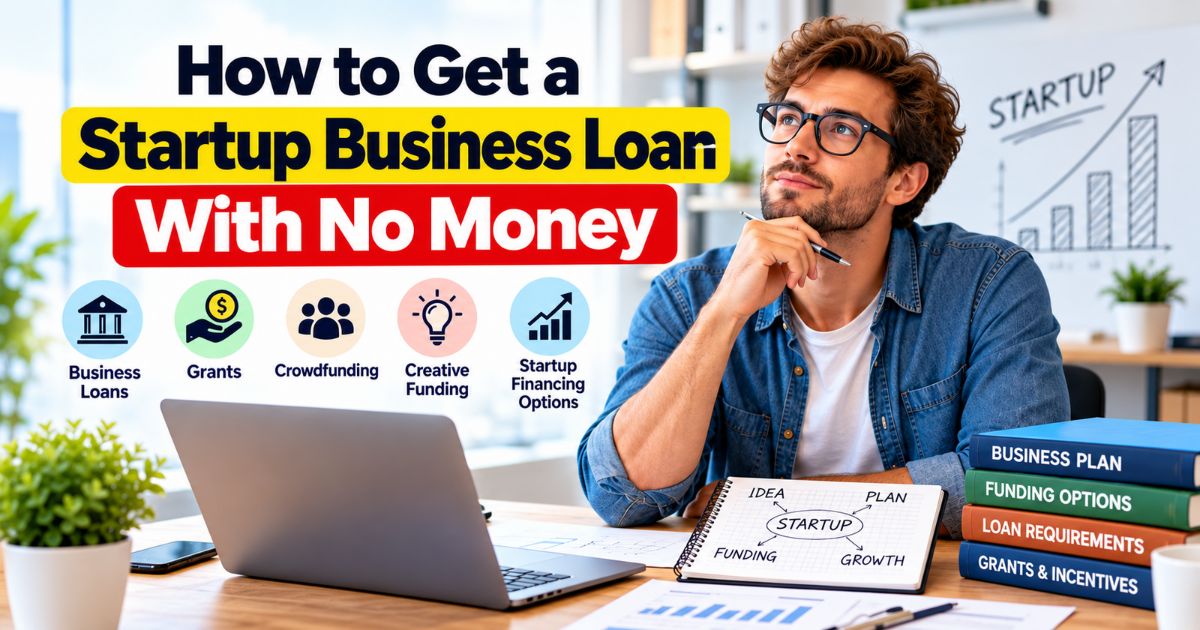
Learning how to get a startup business loan with no money starts with understanding what lenders actually need from a new business. Having little or no startup cash does not automatically prevent you from borrowing, but a lender will still want evidence that the financing can reasonably be repaid.
For a new company with limited operating history, lenders may consider the owner’s personal credit profile, available income, projected business cash flow, existing debts, collateral where applicable, and the specific purpose of the financing.
There is also an important difference between having no cash available for a down payment and having no financial resources at all. A startup with no revenue, no repayment source, weak credit, and no owner investment may have fewer options than a founder who lacks startup cash but has strong credit, outside income, customer contracts, or other financial support.
This guide explains how to get a startup business loan with no money, which startup financing options may be available, how to prepare an application, and when small business grants, crowdfunding, or bootstrapping may be safer alternatives to debt.
For a broader introduction to business borrowing, see our business loans guide.
Key Takeaways
- A startup loan with no money down is not the same as guaranteed financing with no repayment requirements.
- There is no universal minimum credit score or down-payment requirement that applies to every startup lender.
- New businesses may be evaluated using personal credit, income, projected cash flow, contracts, collateral, and other financial information.
- SBA 7(a) loans are provided through participating lenders rather than directly by SBA.
- SBA Microloans currently provide up to $50,000 through approved intermediary lenders.
- SBA does not generally provide grants simply to start or expand an ordinary small business.
- No-collateral business loans may still require a personal guarantee.
- Compare fees, repayment frequency, total repayment, collateral, and guarantees before borrowing.
- Bootstrap funding methods, presales, crowdfunding, or other funding sources may be safer when a startup cannot yet support regular debt payments.
1. What Does “Startup Business Loan With No Money” Mean?
When founders research how to get a startup business loan with no money, they may be describing several different situations.
- No cash available for a down payment
- No established business revenue
- Little personal savings
- No business assets available as collateral
- No previous business-credit history
Those situations are not identical.
A founder may have no cash invested in the company yet but still have strong personal credit, employment income, signed customer contracts, equipment, or a financially stable business partner.

No cash does not eliminate the need to repay
A lender still needs a reasonable basis to believe the financing can be repaid.
Depending on the lender and product, underwriting may consider:
- personal credit history;
- business credit where available;
- income;
- expected revenue;
- cash-flow projections;
- existing obligations;
- business experience;
- contracts or purchase orders;
- collateral; and
- personal guarantees.
Our business finance guide explains how borrowing, cash flow, and financial planning fit together.
A personal guarantee is possible, not universal
Some lenders require business owners to personally guarantee startup debt, while others may use different structures.
A personal guarantee can expose the owner to personal liability if the business cannot repay, so read the agreement carefully before signing.
If collateral is involved, review our secured loan guide for additional information about borrowing against assets.
2. Assess Your Borrowing Position Before Applying
The next step in understanding how to get a startup business loan with no money is identifying what strengths you can show even if you do not have much cash.

Check your personal credit reports
A new company may have little independent credit history, so some lenders may consider the owner’s personal credit profile.
Review your reports for inaccurate information and dispute legitimate errors before applying.
List available income and repayment support
Potential sources of financial support may include:
- employment income;
- consulting or freelance income;
- existing business revenue;
- customer contracts;
- customer deposits;
- co-owner contributions; or
- other documented sources of cash flow.
Calculate the minimum amount you actually need
Do not begin with the largest loan amount a lender may offer.
Calculate the amount needed to reach a specific business milestone, such as:
- purchasing essential equipment;
- building initial inventory;
- launching a minimum viable product;
- fulfilling a confirmed customer order; or
- covering a defined working-capital need.
Borrowing less can reduce both monthly payment pressure and total financing cost.
See our finance tips for entrepreneurs for additional startup-planning guidance.
3. Build a Loan-Ready Startup Plan
A strong business plan cannot guarantee approval, but it can help lenders understand how the company intends to generate revenue and repay financing.
Explain the use of funds
State exactly how the money will be used.
Instead of asking for $30,000 simply because that amount is available, a stronger request might show:
- $12,000 for equipment;
- $8,000 for inventory;
- $5,000 for licensing and setup; and
- $5,000 for working capital.
Create realistic cash-flow projections
Your forecast should account for:
- expected revenue;
- cost of goods or services;
- payroll;
- rent;
- insurance;
- tax obligations;
- marketing;
- loan payments; and
- other recurring expenses.
Include a downside scenario rather than relying entirely on optimistic sales projections.
Demonstrate customer demand
Useful evidence may include:
- signed contracts;
- letters of intent;
- preorders;
- customer deposits;
- market research; or
- existing sales.
Our business finance management guide covers forecasting, budgeting, cash flow, and debt management in greater detail.
4. Prepare Documents Before Approaching Lenders
Documentation requirements vary by lender and financing program. There is no universal rule that every startup must provide the same number of tax returns, bank statements, or operating records.
SBA guidance explains that 7(a) application requirements can vary based on the lender and the financing request.
Review current SBA 7(a) loan information.
Documents a lender may request
- government-issued identification;
- business formation documents;
- EIN information;
- ownership records;
- business licenses;
- tax returns where applicable;
- bank statements;
- financial projections;
- business plan;
- existing debt information;
- customer contracts;
- collateral documentation; and
- proof of income.
Ask each lender for its current checklist before submitting an application.
Our financial success strategies can help you organize your financial information before applying.
5. Compare SBA-Backed Startup Financing Options
SBA programs are among the startup financing options worth researching, but SBA backing does not mean guaranteed approval or automatic zero-down financing.
SBA 7(a) loans
The SBA 7(a) program is a major small-business lending program.
The SBA generally provides a guarantee to participating lenders rather than lending directly to the business.
Applicants still need to satisfy applicable eligibility and underwriting requirements, including demonstrating a reasonable ability to repay.
See official SBA 7(a) information.
SBA Microloans
SBA Microloans can be especially relevant for startups seeking relatively small amounts.
The current program provides loans of up to $50,000 through approved nonprofit intermediary lenders.
Funds may be used for purposes such as:
- working capital;
- inventory;
- supplies;
- furniture;
- fixtures;
- machinery; and
- equipment.
The intermediary lender makes the credit decision and establishes loan terms within program requirements.
Review the official SBA Microloan program.
SBA Lender Match
SBA Lender Match can help connect business owners with participating lenders that express interest in their financing needs.
Using the service does not guarantee a match or loan approval.
Before borrowing, compare financing costs using our business loan interest rates guide.
6. Consider No-Collateral Business Loans Carefully
No-collateral business loans may appeal to a startup that has no real estate, equipment, or other substantial assets to pledge.

However, “no collateral” does not necessarily mean the financing creates no personal liability.
Unsecured does not always mean no personal guarantee
A lender may not require a specific business asset while still requiring one or more owners to personally guarantee repayment.
Review the agreement to determine:
- whether a personal guarantee is required;
- which owners must sign;
- whether liens may be filed;
- what constitutes default;
- what happens after missed payments; and
- whether automatic bank withdrawals are required.
Do not assume unsecured financing is always faster or more expensive
Approval time and pricing depend on the individual lender and financing product.
Compare written offers rather than relying only on product labels.
| Financing Detail | Offer A | Offer B | Offer C |
|---|---|---|---|
| Amount Received | _____ | _____ | _____ |
| APR / Financing Cost | _____ | _____ | _____ |
| Fees | _____ | _____ | _____ |
| Payment Amount | _____ | _____ | _____ |
| Payment Frequency | _____ | _____ | _____ |
| Total Repayment | _____ | _____ | _____ |
| Collateral | _____ | _____ | _____ |
| Personal Guarantee | _____ | _____ | _____ |
For broader comparisons, see our business loan guide.
7. Are Small Business Grants a Realistic Alternative?
Small business grants can provide non-debt funding, but founders should be cautious about claims that government grants are widely available simply for starting an ordinary business.
The SBA states that it does not generally provide grants for starting or expanding an ordinary business.
SBA grant programs are generally targeted toward specific purposes such as research, innovation, manufacturing, export activities, or organizations that support entrepreneurship.
Review official SBA grant information.

Use Grants.gov carefully
Grants.gov lists federal funding opportunities, but every grant has its own eligibility rules.
Being a small business does not automatically make your company eligible for every federal funding opportunity.
Review federal grant eligibility information.
Watch for grant scams
Be cautious of anyone promising guaranteed government startup money in exchange for an upfront fee.
Verify every opportunity through the relevant government agency or official program website.
8. Use Crowdfunding and Creative Funding Solutions
Crowdfunding for startups can reduce reliance on traditional loans, but crowdfunding comes in several different forms.
Rewards-based crowdfunding
Backers may provide money in exchange for products, early access, or other rewards.
Potential campaign expenses include:
- platform fees;
- payment processing;
- marketing;
- manufacturing;
- shipping; and
- reward fulfillment.
Equity crowdfunding
Equity crowdfunding involves selling an ownership interest or another security.
Investor.gov explains that securities-based crowdfunding is subject to applicable federal securities rules, including Regulation Crowdfunding.
Review Investor.gov guidance on Regulation Crowdfunding.
Other creative funding solutions
Creative funding solutions may include:
- customer deposits;
- presales;
- supplier payment arrangements;
- strategic investors;
- owner contributions;
- friends-and-family financing; and
- reinvesting early sales.
Each option has different financial, ownership, and legal implications.
Friends-and-family funding should still be documented clearly so everyone understands whether the money represents debt, equity, or another arrangement.
Our entrepreneur finance guide provides additional planning strategies.
9. Use Bootstrap Funding Methods Before Expensive Debt
When a startup has very little cash, bootstrap funding methods may help the company reach a stage where better financing becomes available.
Start with the smallest workable version
Instead of financing a full operation immediately, consider whether you can validate demand through:
- a minimum viable product;
- a limited service offering;
- small initial inventory;
- preorders;
- freelance or contract labor;
- home-based operations where legally appropriate; or
- founder-provided labor.
Use early revenue to build a track record
Even modest sales can provide evidence that customers are willing to pay for your product or service.
A business with real revenue and documented cash flow generally has more information to present to lenders than a business relying entirely on projections.
Know when bootstrapping is not enough
Some companies require substantial equipment, licenses, inventory, or facilities before revenue can begin.
In those situations, alternative startup funding, equity capital, or structured financing may be more realistic.
Our business finance strategies can help you evaluate borrowing alongside cash-flow needs.
What About Low-Interest Business Loans?
Low-interest business loans can be attractive, but “low interest” should not be treated as a guaranteed financing category for a new startup.
Your actual cost may depend on:
- personal and business credit;
- operating history;
- repayment capacity;
- loan amount;
- loan term;
- collateral;
- lender policies;
- program requirements; and
- market conditions.
Compare the complete financing cost rather than the advertised rate alone.
Use our business loan interest rate guide to understand how rates, fees, and repayment terms work together.
Compare Startup Financing Options Side by Side
| Funding Option | Repayment? | Important Consideration |
|---|---|---|
| Bank or Credit-Union Loan | Yes | Startup requirements vary by lender |
| SBA 7(a) | Yes | Participating lender underwriting applies |
| SBA Microloan | Yes | Up to $50,000 through approved intermediaries |
| No-Collateral Business Loan | Yes | May still require a personal guarantee |
| Business Credit Card | Yes | Rates, fees, limits, and liability vary |
| Small Business Grant | Generally No | Eligibility can be narrow and competitive |
| Rewards Crowdfunding | No loan repayment | Campaign and fulfillment obligations |
| Equity Crowdfunding | No scheduled loan payment | Ownership and securities-law obligations |
| Bootstrapping | No external loan | Growth depends on available resources and revenue |
Be Careful With Revenue-Based Financing and Merchant Cash Advances
Some startups researching alternative startup funding encounter merchant cash advances or financing where payments are connected with business sales or frequent bank-account withdrawals.
These arrangements may use pricing structures that are difficult to compare directly with ordinary installment loans.
Review frequent withdrawals carefully
The Federal Trade Commission has taken enforcement action involving business-financing providers accused of misrepresenting fees, guarantees, collateral, and withdrawals.
Read FTC guidance for small businesses seeking financing.
Before accepting an alternative financing arrangement, determine:
- how much cash you actually receive;
- total repayment;
- payment frequency;
- fees;
- whether payments change with revenue;
- personal guarantee requirements;
- collateral or lien terms; and
- default provisions.
How to Apply Strategically
Once you understand how to get a startup business loan with no money, build a focused lender shortlist instead of submitting applications randomly.
Step 1: Identify lenders that work with startups
Confirm that a lender actually finances businesses at your stage.
Step 2: Confirm eligibility before applying
Ask about:
- time-in-business requirements;
- revenue requirements;
- credit criteria;
- minimum loan amounts;
- collateral;
- personal guarantees;
- application fees; and
- permitted uses of funds.
Step 3: Compare written offers
For each offer, record:
- amount requested;
- amount actually received;
- APR or other financing cost;
- fees;
- payment amount;
- payment frequency;
- repayment term;
- total repayment;
- collateral; and
- personal guarantees.
Step 4: Match financing with business cash flow
The cheapest-looking offer may still create problems if payments become due before your customers pay you.
Our financial planning strategies provide additional guidance on managing debt alongside cash flow.
When Should You Delay Borrowing?
Knowing how to get a startup business loan with no money also means recognizing when taking debt may be premature.
Consider delaying financing if:
- you cannot identify a realistic repayment source;
- the business model has not been tested;
- the loan would mainly cover ongoing operating losses;
- payments would consume most expected cash flow;
- a personal guarantee would create unacceptable household risk;
- the financing agreement is unclear; or
- a smaller bootstrap approach can test the idea first.
A slower launch can sometimes be financially safer than expensive debt taken before the business has demonstrated demand.
Startup Funding Checklist
Before accepting financing, confirm:
- What exact business need will the financing solve?
- How much capital is actually required?
- How much cash will you receive after fees?
- What is the APR or other financing cost?
- What is the total repayment amount?
- How frequently are payments due?
- Can the startup support payments if sales are lower than expected?
- Is collateral required?
- Is a personal guarantee required?
- What happens after a missed payment?
- Are automatic withdrawals required?
- Can the debt be repaid early?
- Does early repayment reduce financing cost?
- Are there restrictions on the use of funds?
- Have you verified the lender or provider?
- Have you compared debt with non-debt alternatives?
Also review our business loan comparison guide before signing.
Frequently Asked Questions
How to get a startup business loan with no money?
You may be able to qualify by showing other evidence of repayment ability, such as strong personal credit, outside income, contracts, projected cash flow, a viable business plan, co-owner resources, or eligible collateral. Requirements vary by lender, and financing is not guaranteed simply because a product is marketed to startups.
Can I get a startup loan with no down payment?
Possibly. Some financing programs may not require a traditional cash down payment, while others do. Verify each lender’s requirements rather than assuming every startup loan requires or waives a down payment.
What startup financing options should I compare?
Startup financing options can include bank or credit-union loans, SBA-backed loans, SBA Microloans, no-collateral business loans, business credit cards, crowdfunding, equity funding, presales, qualifying grants, and bootstrapping.
Are no-collateral business loans available to startups?
Some lenders offer no-collateral business loans, but the lender may still require a personal guarantee or other protections.
Can SBA help finance a startup?
Potentially. SBA 7(a) financing is provided through participating lenders, while SBA Microloans are issued through approved intermediaries. Applicants still need to meet applicable underwriting and eligibility requirements.
Does SBA provide grants to start a normal small business?
Generally, no. SBA states that it does not provide grants simply for starting or expanding an ordinary business. Its grant programs generally serve specific purposes.
Are small business grants free money?
Small business grants generally do not require loan repayment, but recipients must satisfy eligibility, use-of-funds, reporting, and other program requirements.
How does crowdfunding for startups work?
Crowdfunding for startups can involve rewards, equity, or other structures. Each model creates different obligations, and securities-based crowdfunding is subject to applicable securities regulations.
What are useful bootstrap funding methods?
Bootstrap funding methods may include reducing launch costs, starting with a minimum viable product, reinvesting early revenue, accepting customer deposits, using presales, and performing more work internally.
Can a new startup qualify for low-interest business loans?
Low-interest business loans may be available to some startups, but rates depend on the lender, borrower, credit profile, repayment ability, term, collateral, program, and market conditions.
What are creative funding solutions besides loans?
Creative funding solutions may include presales, customer deposits, strategic investors, rewards crowdfunding, equity crowdfunding, supplier terms, owner investment, and documented friends-and-family funding.
Should I borrow before my startup has revenue?
Only after carefully evaluating repayment risk. If there is no realistic source of cash for scheduled payments, delaying the loan or using another funding approach may be safer.
Conclusion
Understanding how to get a startup business loan with no money requires more than finding a lender that advertises easy startup funding.
Begin by identifying the exact amount you need, preparing a realistic business plan, reviewing your credit and financial records, and demonstrating how the debt could be repaid.
Then compare SBA-backed loans, Microloans, banks, credit unions, no-collateral business loans, and other legitimate financing alongside small business grants, crowdfunding for startups, presales, and bootstrap funding methods.
Do not assume that having no down payment means financing will have no conditions. Review total cost, repayment frequency, personal guarantees, collateral exposure, fees, and default provisions before signing.
The best funding structure is one that helps the startup reach a measurable business milestone without placing unreasonable pressure on either business cash flow or the owner’s personal finances.
Continue with our guides to business loans, business loan interest rates, finance tips for entrepreneurs, and business financial management.